| OCR Text |
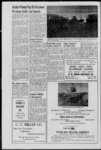
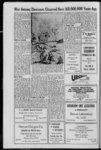
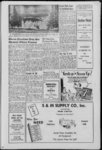
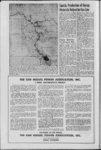
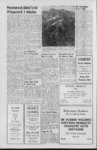
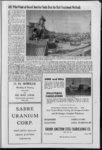
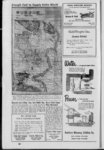
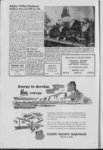
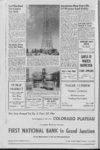
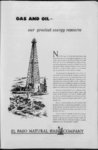
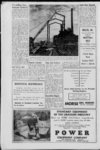
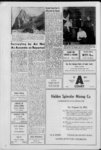
Show San Juan Basin Gas Production Curtailed by Market Availability An analysis of production statistics indicate what the development of a gas market has meant for the San Juan Basin of Northwest New Mexico. Although it was known n in the early twenties that the Basin contained large gas reserves it was not until 1929, when gas lines were completed to Durango and Albuquerque and vicinity, that development began on a very large scale. Even then the market demand was not great enough to encourage large-scal- e exploration and development, and although gas was discovered in Pool in 1926 the it was not until 1946 that any large development occured. Most of the early gas production Piccame from the Fulcher-Kurt- z tured Cliffs Pool, discovered in 1927, and the Barker Creek Dakota Pool, originally discovered in 1925 and developed beginning in 1941. In 1949 the Federal Power Commission approved the application of the El Paso Natural gas Company to take gas from the San Juan Basin for California markets, and development during the past four years has been at a very rapid pace. At the end of 1950 there were a total of 245 producing gas wells in the Basin. Cumulative production to the end of 1950 totaled 93,931,216 MCF of gas. This amount was marketed entirely by the Southern Union Gas Company through its lines to Durango and the Albuquerque area, plus the amount which was marketed in Aztec dating back to 1921. The El Paso Natural Gas Company completed its lme to California and started making deliverie in August, 1951. Production for 1951 jumped to 28,117,808 MCF. Total cumulative production to January 1, 1952 was 122,049,024 MCF. By the end of 1951 there were 315 producing gas wells in the Basin. Even greater development has taken place during the last three years. By the end of 1953 there were 1181 gas wells producing. Total cumulative .production to January 1, 1954 was MCF. When this is compared with the total cumulative production to the end of 1950 MCF) it can be seen that over twice as much gas has been marketed during the last three years as during the whole previous production history, dating back twenty four years. By the end of 1953 deliverability of wells in the field finally caught San-Jua- Blanco-Mesaver- arfi of gases from thouDRILLING In the San Juan Basin of northern New Mexico results In a blow-of- f sands of feet beneath the earth's surface. This photo, from the files of the Aztec, N. Mex. Indefield, resulting in many new operapendent Review, shows a producer in a previously tions in the immediate area and bringing in oil and gas for delivery to pipelines taking the g fuels to points of use. un-test- energy-producin- EVERYTHING TO BUILD ANYTHING Paint It - Fix It BIG JO LUMBER CO. P. O. BOX 5 AZTEC NEW MEXICO Complete Stocks MINING MACHINERY Joy Machines and Parts Machinery Center 2nd East - 3rd South Phone 2695 Moab Utah New Revenues Add New wealth brought into the Navajo Indian tribal funds from uranium, oil and gas leases is being reinvested to produce new income and new advantages for members of the tribe. For example, a motor hotel was built at Window Rock as an investment, trading posts are being constructed, and numbers of water wells are being drilled. Also they are improving their one large lumber mill. The Navajo budget for big business in 1954 was over $1,600,000, and they have voted to spend $350,-00- 0 to provide adequate clothing for their own school children. The Navajo tribal council, acting under impetus of the tribe members, voted not to distribute income received from land leases to the 75,000 to 80,000 members of the tribe. Members of the council say there has been but little mand for any per capita payment because the Navajo wants to support his family by earning money himself. However, last fall there was a considerable amount of unemployment on the reservation and the relief load, financed entirely from federal funds, was running at $11,000 per month, a pittance considering the size of the population. The Navajos are proud of the fact their general assistance program is low in comparison with communities off the reservation. The Navajo Is considered to be a methodical worker. Past employment has been good in agriculture and on railroads and now added to these are the hundreds of jobs open in uranium mining and milling, plus jobs around gas and oil lease operations. Last year the tribe's income was about $6 million from wages and unemployment benefits. The Navajo leads a very frugal life, spending as little as possible for luxury or recreation, and it is common knowlege that the family always is first in any program of spending the family income. Individuals are important, too, but must be secondary to the family unit. ROCKY MOUNTAIN li reporter Published Monthly BOX IS2S May Hold New Wealth To Indian Funds WINDOW ROCK, Ariz. $3.00 Per Tear DENVER Navajo Tribal Lands G. WINDOW ROCK, Ariz. Warren Spaulding, superintendent of the Navajo reservation Indian agercy, visualizes a .ime in the near future when natural re' sources on the tribal lands will bring great wealth. The surface hasnt ev .1 been scratched, he says of the vast potentialities here in uranium, gas and oiL People are co uing in with millions of dollars in backing, including big organizations which are pulling their operations out of Utah, says Spaulding. At the rate these majors are coming in, we really are going to have something. Uranium development on Navajo land has so far resulted in payment to the Navajos of more than $1,600,000. That particular phase of development of natural resources is in its infancy. Oil and gas leases have brought in a total of $18 million so far, some of the oil leases going for as much as $300,000. Spaulding reveals that a total of 720,000 of the reservations more than 15 million acres are now under oil and gas leases, while only 35,000 acres are under mining permits and leases because of the limitation of 960 acres for any single operation. up with maket demand, having the effect of curtailing per well production and causing a rapid slackening off in the rate at which new wells were being drilled. Even so, there was a total of 331 wells completed through November of 1954, of which 283 were producers. There are now slightly in excess of 1600 gas wells drilled which are capable of producing gas, but not all of these are presently producing. This has been caused by contractural obligations which some operators have made with new proposed pipeline outlets not yet completed. It has also been caused by some of the new wells being located a long distances from pipeline connection so that there has necessarily been some lag in new connections. When the deliverability of producing gas wells in the Basin fields began to surpass the present market demand, it was only natural that the need for proration would arise. This is necessary so that the available market is allocated to the total producing wells in such a way that each well will be able to produce its equitable share of the total gas produced. The New Mexico Oil is at Conservation Commission present making an exhaustive study of all the factors which will go into the proration formula. Evidence and arguments were taken from all interested operators at proration hearings during the summer of 1954. CAPITOL URANIUM COMPANY Mining Leases Exploration Claims Purchases Sales 803 W. Main P. O. Box 1874 Farmington, New Mexico WELDED TANKS of ALL TYPES Structural Steel, Reinforcing, Sheets and Plates FISHER VALVES and AVAILABLE From CONTROLS Our San Juan Basin Plant AMERICAN TANK & STEEL CORP. New Mexico Farmington MININ URANIUM AND OIL PROPERTIES EXPLORATION DEVELOPMENT PRODUCTION -- Interested in purchasing for develop n ment or proven uranium properties. semi-prove- JOHN R. HENSLEY CHIEF GEOLOGIST URANIUM CENTER GRAND JUNCTION, COLORADO V. C PERINI JR. GENERAL MANAGER 210 MIMS BUILDING ABILENE, TEXAS tfK |