| OCR Text |
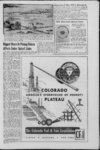
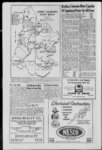
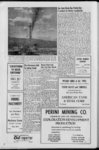
Show Geiger Counter Invented in 1920; Operation Simple Coal For 2,000 Years Needs Under Colorado In 1920 a couple of researchers developed an instrument for There is enough coal under the measuring radioactive radiation. Colorado Plateau to supply the enToday the instrument is embod- tire United States for the next ied in a compact unit and is 2,000 years, and to supply power for the Western Slope uranium inknown as the geiger counter for thousands of years, acfamiliar to every uranium hunt- dustry cording to Tom Allen, Colorado's on er the Colorado Plateau. coal mine inspector. Allen would like to see Heart of the instrument is the power plants serving all of tube, developed the vast Colorado Plateau region, by W. Geiger and M. Mueller. believes the key points for and he The tube utilizes two of the properties of beta and gamma radia- power plants would be at Durango, tion: the ability of gamma rays Paonia or nearby, and the Book and beta particles to ionize a Cliffs of the Grand Valley. A report on the synthetic liquid gas or to make a gas conductive fuel potential of Colorado released to electricity. of Mines, DepartInside the tube commonly by theofBureau the Interior, on Decemfound in most detectors is a thin ment there are 14, 1951, reveals wire sealed within the evacuated ber of tons of coal in deposits tube, running parallel to the sur- billions plateau area in face of the metal and electrically throughout andthebillions more on the insulated from it. The tube is Colorado, of the rest plateau. It would be connected in series with a bat- feasible to mine most of but tery and earphones, or a neon in- some of it is in strata that it, makes adthe is and dicator, voltage it very difficult and therefore not justed so that the tube will not to mine. conduct except when brought into practical In the Green River region, lying of d Geiger-Muell- er the field radiation. radioWhen the penetrating active particles or rays enter the tube they ionize the gas, and an electric current is set up which causes the earphones to click or the neon lamp to flicker. When the earphones click once or the neon tube flickers only once, a ray or particle has passed thru the tube. Of course, larger geiger counters are equipped with meters to measure the amount of radiation and other devices to provide Users with average counts. Alpha rays are absorbed by most materials, and the outer wall of the geiger counter absorbs them so that they are not southwestern Wyoming and northwestern Colorado, an area of about 3,100 square miles, coal deposits are quite general. The Green River region, by the Bureau of Mines, is separated from the North Park field to the east by extensive faulting and uplift and from the Uinta region on the south by the uplifts extending southeastwards from the Uinta Mountains of northeastern Utah. g formations of the region are confined to Moffat, Routt in Coal-bearin- Uranium From paints, made with micals derived from oil, have been made to change colors when they reach certain temperatures. They ean be sprayed or spread on inaccessible spots in aircraft engines or industrial heat exchangers where it is important to know the maximum temperatures but difficult to use measuring instruments. Chemicals made from petroleum are used not only in special purpose paints for industrial use, but tai paints for homes as well. che- Tell-tal- e Walt Rotlmann Agency new process for recovering from the slimy water of the manu which is a facture of phosphate fertilizer has been developed. The process, a creation of Columbia University chemist Dr. Victor K. LaMer, uses specially treated potato starch, lime water and other basic chemicals to curdle and settle uranium bearing solid materials out of the water which was once considered useless and a nuisance. The process has been made available to phosphates manufacturers free, though there has been no public announcement of its comA uranium mercial Complete Insurance Service Representing Travelers of Hartford Phone 3838 Grand Junction, Colo. 312 Main application. In explaining the technique to the American Chemical Society, Dr. LaMer compared the process to that of curdling creamy milk by treating it with acid. He explained that in the case of the phosphate slime, the solids are mostly clay and similar substance, but contain a commercially-usefu- l amount of uranium. He added that while uranium has already ben extracted from high grade slime, more of it has been thrown away than was recovered. With the new process, for the first time, U308 can be taken from the low grade waste. VOLTRON CORPORATION 104 West Rood GRAND JUNCTION, COLORADO Phone 3727 Robert L. Redmond Offices in Moab & Los Angeles John P. Kellogg PIONEER LODGE Mr. and Mrs. Ray Muths, Owners , Your Room Will Always Be In Perfect Order t College Fund Up Problem to Driller From Oil, Gas Oil well drillers have many problems confronting them on every job, and one of the most serious is deviation, or crooked hole. The weight of a string of drill pipe tends to keep the hole vertical but when the drill bit strikes a wall of rock lying at an angle to the surface it tends to sheer off or dig in, depending on the angle. Either way, the hole must be straightened. It sounds impossible, but it is an everyday chore in an oil field on the Colorado Plateau. After the driller finds the degree and direction of the deviation he has a number of tricks he can try. He can reduce or increase weight on the drill bit; he can use an extra heavy drill pipe, to add weight and rigidity, or as a last resort he can use a whipstock. This is a long, thin wedge into the drill hole. One side of steel big enough to fit snugly of the wedge is perpendicular to the base, like a right triangle, with the opposite side sloping at an angle. It is placed at the bottom of the hole so that the slope is counter to the unwanted angle, in the hole. Since the drill cannot force its way into the steel, it takes the only alternate course: straight down, which is where the driller wants it to go. enThe University of Texas dowment fund has been boosted $4,760,000 by a new sale of leases on its oil and gas lands. Bonuses at the latest sale covered 33,478 acres. The leases also call for $1 an acre annual rental, royalty, on productica and in several blocks a requirement for early drilling was added. Stanolind Oil & Gas Co. paid $1.7 million for drilling rights on 2,574 acres in Andrews County. A well must be started to 12,500 feet within 180 days. The tract is north of the Means East (Strawn) field, also in Andrews county. Texas Co. put up a $250,000 bonus for a 2,562-acr- e drilling block in Ward County. The location is two miles south of a gas discovery well owned by Magnolia Petroleum and about two miles north of a Lion Oil field. Texaco t test must start drilling a within six months. and northeastern Rio Blanco counties. The Uinta coal region lies in Utah and Colorado, extending eastward from the state line for about 120 miles. Total area underlain by formations approximates 6,000 square miles and occupies portions of Delta, Garfield, Gunnison, Moffat, Pitkin and Rio Blanco counties. However, only a relatively narrow fringe around the margins of the region has been explored or developed, said the Bureau of Mines report. A noteworthy member (of the geologically younger seriments) is the Green River formation . . . which contains the oil shale horizon that is being mined and converted to liquid fuel products near the town of Rifle in Garfield county, the report said. Louisiana produces enough oil Although not standardized, the every 10 days to pay for the Louireport relates, the principal fields siana Purchase. in the Uinta region are most frequently identified as the Lower White River, Danforth Hills, Grand Hogback, West Elk Mountains, Grand Mesa, and Book Cliff fields. Next listed by the Bureau of Mines is the San Juan River consisting essentially of relatively level tablelands and high A mesas in southwestern Colorado, drilling rig where the formations weighs about 200 tons, and costs at represent a northern continuation least $300,000. of the major San Juan Basin of northwestern New Mexico. The total area in Colorado of the San Juan region is approximately 4, 500 square miles, including parts of Archuleta, Dolores, La Plata, Montezuma, Montrose, and San Miguel counties. Adv. Co. In a generally northwest-southeas- t in coal fields the direction, San Juan include the FIRST NATIONAL field of southern Montrose "The Most and northern San Miguel counties, s BANK BUILDING the field of cenEffective Way tral Montezuma county, the Mesa Verde National Park field of southto Advertise." ern Montezuma county, and the Durango field of southern La Plata 217 and western Archuleta counties. Well Located ind The Durango field is to other districts, comprised of Bulletins and 1799 Hesperus, Red Mesa, Bayfield, and imPanels. Poster most as the Pagosa Springs portant. The Colorado state coal mine inspector, Tom Allen, reports that GRAND JUNCTION 437 Colorado Ave. only one mine in Archuleta county reported activity in 1954, and that COLORADO to October of 1954 only 295 tons Grand Junction had been produced that year, and that was primarily for local consumption. In Delta county, seven mines had produced 30,453 tons of coal through October of 1954. They were the Blue Ribbon, Green Valley No. Red Can2, King, BODY & PAINT SHOP on No. 1, Tomahawk, and Top. FRONT END ALIGNMENT Garfield county had a production of 23,151 tons of coal for the first ten months of 1954 from eight mines, the Atlas, Harvey Gap. IHI No. 2. IHI No. 3. Marion-KilroNew Castle, North Canyon, SERVICE and Sunlight. By far the largest coal production was in Las Animas county, Master Mechanics At Your Service where 689,788 tons were mined dur25 mines ing the ten months, from Complete Overhaul reporting to the state coal mine These mines employed inspector. 1,216 men during the reporting 530 Colorado Ave. hone 2352 period. Grand Junction, Colorado Gunnison county was next in production, reporting that 203,420 tons had been mined from 13 mines. men were employed in Gunnison county mines for a total of 214 days during the reporting period. One mine had closed and two others were idle during October. La Plata county mines produced 29,292 tons of coal from 12 mines, one of which closed and four others became idle. In Mesa county, 29,386 tons of coal were produced, providing employment for 44 men for a total 147 days during the first 10 months of 1954. Largest producer was the Cameo which, during August, reported 4,038 tons of coal brought to the surface, and a total production of 15,309 tons. . Moffat countys Red Wing mine reproduced 59,973 tons during the porting period and vas the only mine reporting. In Montrose county, the Independence mine reported production of 1,884 tons, and in Rio Blanco county, three mines showed a production of 10,501 tons of coal. Routt county mines produced 321,204 tons of coal in the period, providing employClaims Corporations Syndicates ment for 260 men for a total of 106 days. Eleven mines made the Oil and Gas Properties report. San Miguel countys only reportwas ing mine, the idle in October, and during 1954 Telephone 584 had produced but 51 tons of coal. P.O. Box 1948 528 Vi Main St. In all of Colorado during the ten months period ending Oct. 31, 1954, Grand Junction, Colorado 2,170,343 tons of coal had been produced. There were 150 mines listed of which 10 were idle, 7 were closed, and 13 made no report during October. east-centr- al west-centr- Utah-Colorad- o g east-centr- n, one-eigh- 5,300-foo- LA SALLE fully-equipp- g MINING Cochran Outdoor CO. Nucla-Nor-woo- d VVasle Mailer Tell Temperatures Plateau-Ali- en Deviation Serious 124 North Ave. Grand Junction, Colo. Phone 3760 Cortez-Manco- P. O. BOX PHONE Paonia-Farmer- s, y, DON KIMMELS AUTOMOTIVE LUCKY LAKE URANUIM COMPANY CRESTLINE URANUIM COMPANY h STANLEY J. LAKE URANIUM MINING ten-mon- Keck-Reiianc- e, |