| OCR Text |
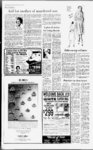
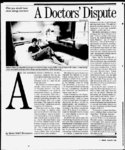
Show 0 What you should know about allergy treatment A Doctors Disrate SMeOv KmzBlmck Star emphasizes the use of antihistamines and other medications. This approach generally involves skin tests, a list of substances to avoid and sometimes referral to another specialist. The theories and tactics of clinical ecologists have these allergists up in arms. Clinical ecology is not recognized by the American Board of Internal Medicine, says Dr. Stephen Wasserman, chief of adult allergy at the University of California, San Diego, Medical Center. Moreover, some of p the proponents have formed associations, used testimonials of patients who have suffered and seen the light, and employed methods that are not scientifically validated. Others, like Dr. Dean Metcalfe of the National Institute of Allergy and Infectious Diseases, are concerned that using unorthodox methods to treat serious conditions attributed to allergies could cause complications if recognized treatment is delayed. Regarding such cases, Metcalfe warns: A diag: nosis potentially valuable to the patient could be missed. Also, he might be taken off recognized medical therapy while other things are tried. He adds that ecology units can be costly I self-hel- Patient relaxes in controlled environment at clinical ecology unit in Dallas one of seven in the country. Actual testing occurs in a small booth into which allergyausing substances will be introduced. RE YOU SUFFERING FROM A PHYSICAL OR PSY-chologi- condition that has not responded to traditional medical therapy? If so, you could become an unwitting victim in a bitter war between specialists. Practitioners of a maverick medical specialty called clinical ecology assert that many illnesses from arthritis to schizophrenia are caused by undiagnosed allergies to substances in man's environment. Their view is strongly resisted by traditional allergists and immunology specialists, who say that allergies affect only a small percentage of the population and that clinical ecologys methods are not only wrong but also dangerous. These physicians say that, to diagnose an allergy, an antibody called IgE must be present in the blood. But clinical ecologists take the broad position that anything in the environment that a patient reacts to can be an allergy, says Dr. Marshall Mandell, head of the Alan Mandell Center for Diseases in Norwalk, Conn., a pioneer in the field of clinical ecology. That includes natural gas used for heating, chemicals in food and water, synthetic fibers, favorite foods, even the fumes from mothballs. ic by Sheila Sobell Moramarco The debate has grown heated since PARADE first reported on the new clinical ecology units in 1979. After studying a number of the controversial procedures used in clinical ecology, the National Center for Health Care Technology, a division of the U.S. Department of Health and Human Services, concluded last year that all were ineffective and should be con- sidered experimental. Under investigation were diagnostic techniques like sublingual and subcutaneous testing where an extract of food is placed under the tongue or injected into the skin to see how the patient responds and neutralization , which supposedly creates a temporary subimmunity to the allergy-causin- g stance. If an allergy to an inhalant is suspected, the patient may be confined to a small chamber to test his reactions to gases in the air. To prevent new allergy-addictiofrom forming, the patient must relearn how to eat, often cutting down on foods eaten frequently. Some patients are given a regimen of vitamins and other supplements to build up the immune system. In rare cases, a change in daily surroundings could be recommended. In contrast, a traditional allergist and often will not be covered by third-part- y insurance carriers. In the last few years, however, research has shown that allergies to such foods as wheat, milk, eggs, chocolate and cola can trigger conditions like bedwetting and migraine headaches. Such findings have led Dr. James C. Breneman, the author of Basics of Food Allergies, and other less cond servative but physicians board-certifie- to conclude that hidden allergies are the least recognized and least treated diseases in the U.S. Some experts estimate that 60 percent of all human illness involves food intolerance, Breneman maintains. The results of the allergy debate are not yet in. While it is w ise to heed Dr. Metcalfes advice, it also makes sense to investigate other medical options when persistent but not ailments resist traditional therapy. Perhaps that hacking cough, gastrointes-tirta- l disturbance or learning disability is really the result of where you live and what you eat. p 12 PARADE AUGUST 1,1982 I |