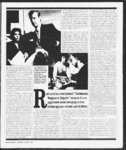
| Show - 10"t1twtm01fknp 06 - I The Salt Lake Tribune E3 - Sunday February 26 1989 What novelist Salman Rushdie wrote in The Satanic Verses By Michiko Kakutani New York Times Writer Born in Bombay to a Muslim family (which later moved to Karachi Pakistan) Sam Rushdie has spent the last two decades living in England and in all his fiction he has used his perspective — what he calls his ''stereoscopic vision" — to look at the subcontinent both from within and without Although the novelist has written of the responsibility of writers to deal with public as opposed to private issues his new book The Satanic Verses (Viking Penguin) which has prompted Iran's Ayatollah Ruhollah Khomeini to call on Muslims to kill him remains the most autobiographical of Rushdie's novels and the least overtly political Midnight's Children which won England's prestigious Booker Prize and brought Rushdie to the forefront of a new generation of British writers stands as a dark parable of Indian history since independence: the decline of the books hero — from a brilliant childhood into adult cynicism and despair became a metaphor for the country's own fate its high hopes of democracy crumbling in the the tumultuous period of emergency rule declared by Prime Minister Indira Gandhi in 1975 After the book's publication in 1981 Gandhi threatened to sue for libel over a passage that implied she bore responsibility for her husband's death Shame published in 1983 focused even more closely on political issues using Mohammad Zia brutal rise to power as the president of Pakistan as a springboard for creating a phantasmagorical portrait of a country that was "not quite Pakistan" fools Peopled with a cast of petty Shame offered a portrait of a country teetering precariously on the edge of absurdity like one of the fictional countries in Evelyn Waugh's black comedies Although the book received some positive reviews in Pakistan that country later banned it The Satanic Verses in contrast concerns itself less with political events than with the consequences of cul tural exile and the more personal matters of identity and metamorphosis Although there are chapters set in Bombay much of the novel takes place in London Rushdie's current home Like the author's earlier books it is written in roiling street-smar- t prose but much of the anger that animated those other volumes (particularly Shame) has dissipated here replaced by a lyricism that nearly passes for nostalgia In fact the central (and most persuasively written) sections of The Satanic Verses deal with what appears to be a thinly disguised autobiographical material — a man named Saladin Chamcha who has moved to England and become an Anglophile returns home to Bombay to visit his aging father and is forced to come to terms with his own past his anomalous condition as a spiritual and cultural exile Counterpointing Saladin's story is the story of Gibreel Farishta one of India's biggest movie stars who like Saladin has miraculously survived a 29002-foo- t fall from an airplane Whereas Saladin's quest for identity takes him to India and back and is told in fairly straightforward terms the journey of Gibreel who has begun to suffer from the delusion that he is really the Archangel Gabriel is a more inward one taking him into the dreamworld of madness and paranoia The sections chronicling his adventures are quite appropriately described in the fantastical surreal terms of magic realism It is passages from Gibreel's dream sequences that have so outraged Muslim fundamentalists Their objections revolve around these points: — The name Mahound One of the characters in Gibreel's dreams is a businessman turned prophet named Mahound — a figure whom Muslim critics regard as a thinly and perversely disguised representation of the Prophet Mohammed The name Mahound is the name multi-cultur- 's used in certain medieval Christian plays to indicate a satanic figure — The Satanic Verses The title of Rushdie's book refers to an incident in Mohammed's life recorded by early Arab historians and discredited by later experts on the Koran In the incident Mohammed accepts three pagan goddesses as a means of furthering his own cause and subsequently repudiates this act as having been inspired by the Devil These actions are by the fictional Mahound in what critics charge is an attempt to revive a blasphemous story — The word of God To believing Muslims the Koran is accepted as the word of God dictated by the Archangel Gabriel through the Prophet Mohammed and set down immaculately by the Prophet's scribes In contrast the fictional Mahound is victimized in one dream by an untrustworthy scribe named Salman (Rushdie's own name) who changes words and meanings as a kind of test of the prophet's omniscience — The wives of the Prophet Muslims regard the wives of the Prophet Mohammed as the "mothers of all believers" and have violently objected to what they see as Rushdie's characterization of Mahound's wives as prostitutes What in fact happens in Gibreel's dream is that the whores of a local brothel "had each assumed the identity of one of Mahound's wives" as a sort of business gim- sions both "is and not" Mohammed just as the characin and is not" Mohammad Zia Shame just as the character Saladin Chamcha is and is not" Rushdie That is one of the liberties of fiction Saladin for instance obviously shares certain characteristics with his creator: both were born in Bombay both are humiliated as scheolboys in England both try British women (Rushdie's first wife was British: rus' second wife is the American novelist Marianne Wiggins) both struggle to come to terms with their two homelands On the other hand Rushdie is not a radio celebrity like Saladin does not survive a 29002-foo- t fall from a plane and contrary to what his critics believe he has not sprouted horns and a tail (as Saladin does in the book) Saladin's temporary transformation into a devil is meant by Rushdie to indicate not only the constant possibility of metamorphosis — by changing names address- es hairdos — but also the consequences of such transfer- mations Indeed Saladin's physical change signifies in some sense the horror with which he is now regarded by oth- ers: his family and former neighbors in Bombay look upon him as a traitor someone who has abandoned his home for the phony enticements of England his English acquaintances see him as some sort of pushy arriviste a " foreigner who will never fit in It's a predicament now shared by Rushdie who finds himself caught between two cultures two ways of look- ing at the world Though he has lived for years in the West with its tradition of freedom of expression his family roots are in the Islamic faith — a fact that fundamentalists who revile apostasy hold against him "What is being expressed is a discomfort with a plural identity" Rushdie said last autumn And what I am saying to you — and saying in the novel — is that we have got to come to terms with this We are increasingly becoming a world of migrants made"- up of bits and fragments from here there We are here And we have never really left anywhere we have been"' ter Raza is is Ilyder q - mick Irreverent as these episodes may be there seems to be little actual malice on the part of Rushdie (who is no longer a practicing Muslim) toward Islam or religion in general In the first place the portrait that emerges of Mahound is that of a very human figure afflicted by the usual human problems — a portrait not unlike that of Jesus in Martin Scorsese's recent film version of "The Last Temptation of Christ" In the second place that portrait comes to the reader through the intermediary figure of Gibreel a character suffering a crisis of faith and later diagnosed as being mentally Mahound to use one of Rushdie's favorite expres 1 — Littmama's insightful Planets Beyond Planets Beyond: Discovering the Outer Solar System by Mark Littmann John Wiley & Sons 286 pp 82295 If you have space on your shelves for just one book concerned with astronomy the discovery of the most distant planets the efforts of early thinkers to measure easily visible "close in" planets or to explain the recurrence of comets this excellent work Planets Beyond: Discovering the Outer Solar System by Dr Mark Littmann should be a top choice Remember Mark? He was in effect the youthful founding father of our own Hansen Planetarium a chap able to explain and explicate the goings-on in the skies above us Utilizing our town's rather modest planetarium dome and instrument Dr Littmann proved able to give nonscientific dunderheads such as myself and more importantly whole hordes of Utah school children a baof what's been sic understanding happening in space for many eons — and what's happening out there tonight illustraSpiced with tions though it is Planets Beyond requires rather more concentration and cogitation than was demanded of us in those comfy planetarium seats But the author no prexy of an educational publications firm has his old ability to filter considerable essential knowledge concerning stars planets and outer space into this very useful book In addition to retelling the life stories of (among others) William Herschel John Couch Adams Percival Lowell Littmann and Clyde Tombaugh writes well enough to give readers a notion of life beneath the great domes of our major observatories Alas nowadays it would appear as well-chose- n tronomers rarely strain their eyes Instead they peer at computer screens and printouts as often as they look aloft through anything resembling the popular notion of an eyepiece You are liable to agree with me that stargazing was much more exciting if not exacting when Herschel or Johannes Kepler fashioned their own 'scopes and looked up volume As This is no Thomas McDonough a fellow science writer quoted by Dr Littmann put it the history of scientific stargazing is filled with "fascinating stories about the eccentric brilliant and characters of the science" That's putting it mildly The history of astronomy astrophysics and all of science is of course the reportage of the lifework of men (and an increasing number of women) oddly willing to turn their backs on family financial affairs wars raging hither and yon and more commonplace perceptions of the world Including of course a welter of religious views Sometimes practitioners of astronomy were vain sometimes courageous sometimes blessed with indry-as-du- sight sometimes afflicted with acarrogant blindness toward the cepted views of their time Despite the almost astronomical number of learned men who have contemplated the skies they have not yet as Dr Littmann makes clear given the world 100 percent fool-proprovanswers to able chapter-and-vers- e those perhaps unanswerable pair of queries — where did we come from where are we going? How and why? on Planets Beyond is as recent discoveries methodology and skyscape matters yet to come as any single volume can be in this nation's underfunded "space age" ' - 5- )4f 1::rf 1i41& V - 4 fi F LOVA :TO - 1SSCit 300- 'Ar:V ' )4( (gi 5 4 )4f i- 1 'Y'' o ff ) After reporting on the recent knowledge space probes have given us of distant Uranus Neptune and Pluto some scientists quoted specu- late that that trio of distant skywanders may merely be overgrown comets — or may be much more than our commonplace planets Littmann gives us in very nearly understandable language the reasons why we puny mortals are able to fling our space probes such enormous distances (by utilizing the gravity of neighboring planets almost as sling shots) He comes as close as any mortal can to making me understand how a "blink microscope" functions and why such a gadget is utilized The book includes understandable diagrams and pictures d sky-o- b and black-andwhi- color-enhance- d Free reading Thursday Waking Owl Books 208 S 13th East will present a fiction and poetry reading featuring authors Shelby Raebeck and Jennifer Ashton Thursday at 7 pm The free reading is in association with the University of Utah Creative Writing Program 1 M II s Seaver covers familiar territory with his latest novel Beanball second murder one where cocaine was mentioned in passing The problem with Beanball is that Danzig and Burr have been through a lot of this before The first time was in Murder at the Super Bowl when top billing for the authorship went to football player Fran Tarkiiigton Still Seaver and Resnicow's writing and plot are acceptable and there's enough baseball lore between the murder and the unmasking of the killer to satiate even the most hard-cor- e fan — Sharon Miller United Press International Beanball by Tom Seaver with Herb Resnicow Morrow 224 pp $1695 As if the pressure of being a newspaper columnist and covering the World Series as a reporter isn't enough authors Tom Seaver and Herb Resnicow impose on their hero the burden of solving a murder in order to keep out of jail Marc Burr might not face murder charges even if he doesn't find the real killer but the police are hinting heavily about taking some action The problem is that Lt Harvey Danzig has found Burr at the scene of a )4r Iii) - e'llam''''s t )41 e 44 " Illb - 1- ip' g - )4 SPn (All Baskets )47 Containers e e 3 r ir Si 't - ' - I :- 'r leach ' - : L:-- ' t t 07 - - tr tr9 4151 ' )4 ti 7 I ' lit UTAH CRAFT & FLORAL SUPPLY ROY 5420 S 1900 ur 773-444- 4 If A A A jos OREM SALT LART W 3220 S STATE ST 1016 E 7200 S 5724 S REDWOOD RD 486-101- 566-128- Aki v so tag ( 7 214 E 1300 S 226-137- 7 969-266- 0 90 lic 8 r r t t t k P r) - ' 0f otj 1 P Call 533-640- March 3 & 4 March 17 & 18 March 24 &25 Tenor Gar) Bachlund in BRITTEN Les Illuminations WAGNER Siegfried's Rhine MAHLER Symphony No 2 "Resurrection" With the Utah Ma vlast tescerpti Joseph StIsersteln Journey Joseph Silserstem Sy mphom Chorus soloists JoAnn Ottles & Laura Guff Joseph Siilserstein conducting conducting conducting CjIKSL akg44iat40iksAakiyksfoyawisii-i- e - t - t : a PRI 'E ts tt: - : 1 - 1:14) fo - e ' !AAT ' k ' !hi ' L I - 00°" k ' v- - - !:' h r - 1 — — I 44k C LEARANCE t - 25051d0:11G703A0Ciony517: 41 1 6900 So Highland Drive 0- - (20th East) :::::: Phone 1 4stz:z 4 t -- I 1 4544-ips- - D I z: 1 - I 1011-1- 3 L - t 7 Alexander Peskanox plays PROKOFIEV Piano Concerto No 2 SMETANA UTAH SYMPHONY I - : ' etT!0: it - ' I1 : " A! A ' ( it 1'- Live classical music at Symphony Hall Counting down the greatest hits of the past three centuries students Symphony Hall 8 p ni Tickets $9 to $27 i 0 0411ss e 4' t consider music that has survived a few hundred - Nkr- A About the time Brahms put the finishing touches on his beloved Violin Concerto a man named Darwin startled the world with his theory that only the fit survive Today in an age when most music is lucky to survive a few years m-1- ---- tzi 11'4wesi"-- Experience hits that have truly earned the tide "golden oldies:' ) AI : -:"''' 1- ' I - 0 off )4t : le 414 to Reg 1049 s Ea (c'' I k 3 And Ceramic 4 ''1 a I 1 nguBsouquet 279 k(' ale 24i elk" t - - - 01-s &:- - le Trill - 4-- It 0 a ol- h : '''' - ploW de stSStt : '1410se z - ' it ' ty ) ei - -- of- :- ° - NI 4Abilmr - ZP e"A- t With 14 heads Reg 899 '4 i Planets Author -- --tp- A Tulip Bush ' Dr Mark Littmann low "bookies" In this month's lecture Dr Peterson will discuss the Brooks bi - Several popular styles & color s to choose from : : i Sale Ends Sat Mar 3 - '' I Brooks: Mormon Woman Historian won the David W and Beatrice C Evans Biography Award will be guest speaker Sunday at 3 pm in the sixth in a series of 90- minute "books and authors" sessions at the University of Utah J Willard Marriott Library auditorium Admission to these "Afternoons at the Marriott" is free and the public is invited to attend the monthly lectures sponsored by Friends of the University of Utah Libraries who encourage the public to come out meet the speaker ask questions and mingle with fel- SELECTED SILK FLOWER : i : Nool - tr a : end-not- Juanita whose recent book I uji)HFAT SALE sl'alm oliv44öprilts 40AW PT4 t4rif: el' iv : P' ography how he came to write it and how he set about the task He also is the author of a collection of short stories The Canyons of Grace published by the University of Illinois Press and a novel The Backslider published by Signature Books as well as being editor of Greening Wheat: Fifteen Mormon Short Stories also published by Signature The "Year of the Library" lecture series funded in part by the Utah Endowment for the Humanities is intended to reacquaint members of the community with the Marriott Library during its 20th anniversary while providing an opportunity for readers to meet Utah authors said Robert L Stayner Friends of the Libraries chairman Dr Levi S Peterson professor of English at Weber State College Pak"Ok - 9 z sot 4 d ( : Ar jects in fascinating detail It includes "scorecards" of the flights of Voyager I and Voyager II — with stress on the fact that Voyager II will fly to around and past Neptune in August of this year By that time I hope readers will have crammed their heads full of data concerning spacecraft instrumentation close encounters charged particles magnetic fields and asymptotic velocity Some of us may even speak learnedly of the "encounter star" Camellopardalis the Giraffe Wading backwards through pages of solar system statistics orbital data chronologies and footnotes we may be able to learn why what we simple folk think of as a camel bred with a leopard should produce a giraffe One small cavil concerning Dr Littmann's book — the page makeup is at times confusing Just as I was airily congratulating myself on my ability to understand that Neptune was indeed a planet found on a sheet of paper my train of thought (hauled by a very tired locomotive) was derailed by the sudden intrusion of a page concerning George Biddell Astronomer Royal Airy a long-deaWell no one said this would be an of the easy read for Salt Lake Astronomical Society — Jack Goodman IT-7T- h - - Levi Peterson speaks on book at U Marriott Library today 4k 44 4 942-590- 4”4-44- )4 0 V- - -- - 44s 4144441( v11 |