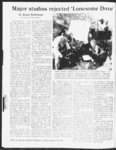
| Show Y V- - The Salt Lake Tribune Sunday February 26 1989 A17 GOP Mafia Both Became Losers When Louisiana Elected Duke By Jason Berry Special to the Los Angeles Times David Dukes election to the Louisiana Legislature casts a shadow over the whole political landscape The Republican Party has been humiliated former Ku by the victory of a Klux Klan grand wizard who defeated GOP loyalist John Treen by 224 votes The triumph of Duke who had registered Republican just before the race is an embarrassment at a time when GOP Chairman Lee Atwater and others are trying to attract black voters Times-Picayun- om:312Lunses '' '''l furl 'pill 4' 'I'lltimi '!:iialli 4 I N I't N IA g1 ' W t I i DM DkVID IA ki ' L 0 it '' - ' It r ''--- t : 404 a Sk‘1 es 4 Otit: if I 11a i I i ' IliN116 s itti '' nit ' 4 tt Lt 0: eii 1' :12 " g4'1"Nitotte- - 04 - I l 111 ib : ' '' 4 1 ' 0 - ritit 41 witte5 ' '1° ' 1 ‘‘ ‘ 4' 4( -- ! N ' ' ' 1:':f 44 Ok i 11' 'I! I : d' il ' ' ' 'I' :' - A gor ' - Y ! wow— --- I - t'i II q0! Cf: 7to '1 i 1 11 ii 4 Ili 11' 1 t' '' ti !! 1: I p ! ' fy it :k A 4 1 i 7' 1471 ‘u-rst- '1- 01 0- t - ‘i ! t 0 fft 1 : N e i' f 60'''-- ''NN' 4 1 ' 11 t- ' 41di z' i N ‘‘kI' -- ''d:''1iii''‘ : - ''-'- 6 144 " ' pkv 0 q i" A - '1 A vtittiLmeit I ' s e (0400 i ! le ' ill ' 11 il "r- i i! - trit i lot d- Fall-broo- of 'rorrance Calif The party is scheduled to with have a convention in Chicago March Duke as a speaker The new Populists like the new Duke take labels loosely The populism originals of the 18908 were farmers who rebelled against escalating rural credit and railway freight rates movement of cooperative it was a grass-root- s marketing and purchasing outlets The farm ers forged ties with urban trade unions creating the People's Party otherwise known as Populists By the early 1900s the movement had expired A strain of did mark early populism but it was not a dominant characteristic Cart° glorified that strain In 1957 he founded the Liberty Lobby in Washington DC which League of BNai Brith considers "the most active a multimillion-dolla- r organization in the country operation" Another Cart° spinoff the Institute for Historical Review has argued that the Nazi Holocaust is a hoax Several 4-- 5 anti-Semit- years ago the institute offered $50000 if anyone could "prove" the existence of Nazi death camps A Jewish survivor collected $90000 in an settlement In 1985 Duke reportedly twice met with Carlo in California As early as 1970 he seemed to share some of Carto's sympathy for the Third Reich As an undergraduate at Louisiana State University Duke put on a uniform with swastika to protest a speech by attorney William Kuntsler and carried a sign saying "Gas The Chicago 7" — Kuntsler's clients Last month Duke called that incident "a lark something I now regret" In 1980 be wrote a "Dear Patriot" letter to fellow Klansmen calling the Holocaust a hoax "perpetrated on Christians by Jews" Soon thereafter he left the Klan and formed the National Association for the Advancement of White People Today Duke calls the NAAWP "a civil rights organization" stressing that it it IRS status has Lance Hill a Tulane University doctoral rt non-prof- candidate in history has followed The NAAWP News during the decade Hill says: "The contrast between Duke's campaign per sona and his activist ideology can largely be attributed to his belief in the strategic necessity of political deception In 1984 the NMWP News observed that since the public still regarded White supremacy as immoral racist activists should conceal their opinions and 'never refer to racial superiority or inferiority only talk about racial differences carefully avoiding value judgments'" The same year The News reprinted an article from Instauration — an avowedly publication — advocating segregation of ethnic Americans in geographic zones All Jews would live in Manhattan and Long Island renamed West Israel blacks would live in the Gulf South renamed New Africa and Latinos in a strip of the Southwest renamed Alta California In late January this year when James Gill anti-Semit- Funeral Is Tmniiag Point for Japan By David Williams Special to the Los Angeles Times Emperor Hirohito's death on Jan 7 and his burial on Friday represent key chapters in an unfolding national drama and the stakes include survival of Japan as a political democracy Tension began two years ago when the emperor had major surgery From that point on an unprecedented war of nerves gradually mounted When the late emperor suffered a relapse last September alarm bells began to ring in earnest We Americans have had a poorly perceived but genuine role in this drama based on US insistence that Japan (what Washington cheerfully refers to as "burden sharing") The "slippery slope" argument is as old as the postwar "MacArthur" constitutiom Rearming will lead to resurgent nationalism and fierce nationalism will lead to the death of democracy Many American critics g have dismissed the argument as an idle obsession but the op position in Japan already feels that it is dying the death of a thousand cuts -- - - 4 1471iii3V-14:11-- - o "I I English-languag- I as well I t ! On two consecutive days the Mainiehi Daliy ran a front-pag- e apology: the earlier piece )abeled an "extremely grave error" was canceled" and "retracted" Notice of the firing and demotion were given prominent play n the unambiguous hope that such sacrifices would ward off social censure And iolence 1 right-win- g Such fears are not the product of overworked journalistic imagination The Asahi shImbun Japan's second largest daily has repeatedly had its offices around the country )(111bed In 1987 there was a rifle assault on ? ipe- 'N di 1 ' ' t - lki ' ‘ -- — - (--- - 0 ) e :w- : i iritif -- '::--- 4 - 10 "!':: kfiwp"10 1 t : -- - ' jr : -- 4 !'17- II 1' fV Zdtf-:4154-- t46-77-- : I - - - ::Itz - Emperor Akihi to g e -- z 40 n 1 Th i 1'1 MNO David Williams is an editorial writer for the Japan Times nerve-rackin- :tf ' ' ' left-win- ' ltiti g re-ar- The most sensitive battle of all has been over what place the emperor — once the supreme focus of nationalism — is to occupy in the of the Japanese people How the late emperor died how his passing was received by the nation and how the new emperor articulates his constitutional function has been testing Japan's posture as no other event could has been The Japanese the object of this struggle rarely an actor in it The real battle has been between elites over what message what image what interpretation was to be transmitted to the public via print and electronic media Often covert and subtle this contest for the hearts and minds of a nation has been the five central story of the last months leaving Japanese reporters blurry-eye- d with exhaustion Part of the exhaustion was caused by fear Reporting on the imperial institution is a nightmare of linguistic snares social taboos When a Japaand interpretational bear-trap- s nese editor at the Mainiehi Daily News accidentally ran his newspaper's carefully prepared obituary before the emperor died the man lost his job and his boss was demoted The mistake was partly a consequence of automated printing but this was no excuse 'Co speak of the emperor's passing before the fact was inauspicious in the extreme Especially on the right wing of Japanese political 'Pinion many thought that the president of Vainichi Shimbun the huge parent of the Afainichi Daily News should have resigned 11 la -- gan of the Japan Communist Party the most fearless critics of Japan's emperor system Since when the nation be gan what was in effect a deathwatch speaker cars have been conspicuous by their absence The streets of Tokyo took on an eerie quiet as right-wingroups agreed that nothing should disturb the high solemnity of the Japanese nation in official mourning Now that the emperor has been buried a major demonstration of muscle by the country's 120000 rightists (many of them gangsters) is confidently predicted At the same time the wide and diverse world of the Japanese right — the young the intellectual in his tough in his speaker-ca- r think tank or the ruling party ideologue on the hustings — has been struck a blow from an unexpected source: the new emperor himself The essence of action within the closed court of the imperial Japanese house is the symbolic gesture Just as a classical drama can turn on the absence of a chair or the slightest abandonment of formal speech the new occupant of the Chrysanthemum Throne made a revolutionary gesture in his first formal address by merely adding the honorific san in speaking of and to the Japanese people something his father would have never dreamed of doing Another move also stunned Japanese con servatives: The new monarch used the occasion of his first address to come down firmly in favor of Japan's postwar constitution Many conservatives object to the constitution's peace clause its symbolic definition of the emperor and its foreign authorship The speech immediately raised two sensitive questions Since the Imperial Household Agency no longer appears to attract the ablest civil servants and since the new emperor has yet to assemble his own group of top advisers did he write the speech himself? Many Japanese commentators suspect that he did Second and still more interesting why did Prime Minister Noboru Takeshita approve the content of an address so obviously contrary to his party's traditional notions of impede! dignity and its opposition to the 1946 constitution? One veteran Japanese journalist who has covered the imperial household insists that former Prime Minister Yasuhiro Nakasone would never have accepted the address as written: only Takeshita's awe of the imperial institution and his own lack of clear ideological principles allowed the speech to be presented Other sources say that the emperor would have had his way in any case The net result of last week's burial is mixed The Japanese tight can claim a major victory for intensive education in nationalist sentiment during the last month Yet the new emperor's stance seems to confirm the view of those who argue that the modern Japanese imperial court has always looked in the right direction even if it sometimes found itself in the wrong end of the room Whispered speculation that the emperor's liberal stance makes him vulnerable to right-winor worse remains just that: protests speculation But there is no question that Japan has just experienced an extraordinary turning point The test of a democratic society has so far been met but it has been a close run More important the drama is not yet finished the newspaper's branch in Hyogo Prefecture that left one reporter dead another in grave condition These anonymous attacks on the most conspicuous defender of Japans postwar settlement and constitution are almost certainly the work of one or more right-winradical groups The country has as many as 800 of them Where violence and physical Intimidation are judged inappropriate the radical right has other more sophisticated tactics When the Japanese version of Penthouse (published by Kodansha) ran a story claiming a sexual scandal in the imperial household rightists brought pressure on advertisers Eventually the magazine had to halt publication but the final issue included a formal apology to the imperial family Then there is that most formidable weapon: Armed with as the oversized speaker-ca- r many as 20 separate speakers these cars can make normal conversation impossible for 1000 yards in any direction Last year the right mobilized more than 100 such vehicles to lay siege on the annual meeting of the Jawhich is pan's Teachers Union (Nikkyo-so- ) uncompromisingly opposed to any form of tar Japanese rearmament Other speaker-ca- r gets have included Akahata the official or g d g g mail-orde- ' 414 to - ' 4 fito P4clik ‘ '"' 7:Ir‘ t i 114rN - e well-bein- '''73' ' gi4:WI'' 1 i t ''' -- i " ly "or kiv wk fp It ?' 1''' mu OL'A ‘i f ti ) '1 ' h 'pit IV it " 41iiAi I r' VI '' ': Id I Ils'it! - '1 fire t 4to d V k 4014: x 41' l0 §'' 4' - t y t ' ''' ‘ '1( ' It ' 1' i ill fft mist ' '41( 10 L '1k aolooft neo-Na- 1 t t tili 't I " I I "1"440t9 II : ' i 4 ''' 'k (n14- : k in ' ' 14 - ' 'Ii'''''''°7"'' ' - '‘‘$ morllibmi40hvo ' !4 WiVvItt:ICIT1 I ' Ow '' -- PLEAg MEET iO4' '' ''‘N i 11f ' liC Jason Berry is an investigative Journalist whose books include "Amazing Grace" a memoir of civil rights politics in Mississip tki4 ‘ '' MIISNCIOTFIZZ ' ' tsk American journalism also lost Duke humbled the media by putting distance between himself and ideas he had advocated for 20 years using local TV news to orchestrate the image of a sleek conservative Reporters focused largely on the connection with the Klan which Duke claims he left in 1980 They let him skirt a larger issue: Duke's belief in the theory of a master race and his current links The result was inadequate public information The election was also a loss for the city A 96 percent white suburb voted its fury against next-doo- r New Orleans with its black voting majority and a recent wave of street battles that broke out after the Martin Luther King Day march Duke also enjoyed a strange climate of historical amnesia suffered by his potential enemies during the campaign: Black leaders showed profound apathy and Jewish leaders said little apparently afraid to raise emotional temperatures in middle-clas- s Metairie An ideological virus pulsing with has worked its way into the body politic finally gaining an elected seat after nearly a decade of campaigning In 1983 Duke's one k time ally in the KKK Tom Metzger of Calif left the Klan after having won the 1980 Democratic primary in a San Diego Congressional District with 33000 votes Metzger who led patrols to keep Mexican immigrants out and advocated marksmanship classes in schools was eventually trounced by former Rep Clair Burgener in the general election but his primary victory proved that a political opening existed That same year a former Nazi Party leader rein North Carolina Harold Covington ceived 43 percent of the vote in a losing race for attorney general — running as a Republican Late last November Duke embarked on twin campaigns One was the Statehouse election designed to soften his racist image — the -new" Duke in quest of political acceptability The other was an ideological extension of his 1988 presidential try on the Populist Party ticket Launched in 1982 the POpulist Party is the brainchild of Robert Weems a Jackson Miss leader of Klan resurgence and Willis A Carto of the Neu Orleans wrote a scathing column about that plan Duke said that The News published controversial arti cies that he did not always agree with The current issue of Instauration features an interview with Duke conducted in December "I came to understand" he says that the of most universal element in the any society is the biological quality of the people I learned that once the gene pool was damaged all hope and promise for the future would be lost irretrievably" r News advertises booksDukes own bookletof raw "Who Runs the Media?" purportedly documents "Zionist control of America's mass media" The News also sells tapes of the late George Lincoln Rockwell founder of the American Nazi Party The day after his election Duke announced: "I have a hand of friendship out to the Jewish community" But when reporters from the national and local media began pressing him on the theory that the Holocaust was a hoax Duke refused to discuss "what I did 10 years ago" and abruptly halted the news conference Last spring running for president first as a Democrat Duke bought TV spots in Louisiana and won 23000 votes on Super Tuesday — more than Bruce E Babbitt and Paul Simon In Arkansas Missouri Oklahoma and Texas he won 18000 more Then he jumped to the Populist Party announcing: "The one primary issue before us is whether our heritage and our way of life our very bloodline is preserved in this nation" Duke received 42778 votes in 11 states last November His Populist campaign director was Ralph Forbes of Arkansas a former captain in Rockwell's American Nazi Party Duke's links to Carto the Liberty Lobby or racism never became an issue in the February election Reports tagged him "a former Klansman" — ignoring the rest That Duke's name and address appear on the list of "support organizations" published in the newsletter of The New Order — a Milwaukee-baseNazi movement — never surfaced as a campaign issue At Duke's campaign reception I circulated among his supporters before the vote count Besides locals people had come from Arkansas Mississippi Florida and other parts of Louisiana I have never seen such raw anger "Phil Johnson is a communist!" one man yelled "Jews control the media!" shrilled others For 30 minutes three men regaled me insisting that the Holocaust was a myth Then Duke came to the podium beaming "I don't think there's ever been a candidate more lied about and hurt than I was" he said Then he promised that more candidates like him will be coming forward "across this state across the Southland and the country" Duke with blond hair dark mustache and articulate delivery was as cool as the other side of the pillow — a perfect media candidate d Reunion Renews Horror Of Cuban Missile Crisis By Theodore C Sorensen Special to the Los Angeles Times The most extraordinary aspect of last month's Moscow conference on the Cuban missile crisis was the fact that it took place at all No one could have imagined in October 1962 when Robert McNamara McGeorge Bundy and I were conferring in the Cabinet room with President Kennedy and a dozen others on the world's first potentially nuclear confrontation that one day we would gather in Moscow with Soviet and Cuban counterparts for a frank and friendly exchange of facts and views about the crisis IMM MPW1 Theodore C Sorensen who served as special counsel to President John Kennedy now practices law in New York On Oct 18 1962 as he met tensely in the Oval Office with Soviet Foreign Minister Andrei Gromyko and Ambassador Anatoly Dobrynin the president could not have imagined that one day these men and their colleagues would be sitting around a Moscow table amiably answering our questions on the crisis exchanging acknowledgements of error with us and openly disagreeing among themselves Among American scholars and experts the 1962 confrontation over missiles in Cuba is almost everyone's favorite crisis Hawks like to talk about Kennedy's naval blockade facing down Nikita Khrushchev and forcing his missiles out of our hemisphere Doves like to talk about Kennedy's cool diplomacy peacefully resolving the crisis without the United States firing a single shot Revisionist historians like to complain that Kennedy needlessly brought the world to the brink of nuclear destruction over a Soviet action that however hostile and surreptitious did not fundamentally threaten our security Right-winscholars like to complain that Kennedy's refusal that October to launch an invasion of the communist satellite 90 miles from our shore cost the United States its last best opportunity and excuse to go in there and take Cuba away from Castro theorists are divided into those admiring the carefully executed management of the crisis by Kennedy and his advisers and those castigating the mistaken assumptions and miscalculations on both sides that nearly led the world to a nuclear nightmare As the discussion in Moscow conbut only firmed there is some truth in each of these perspectives Ulsome timate release of the transcript of our proceedings will no doubt provide new ammunition for each of these analysts justifying new editions of their books new essays and new lectures on their favorite crisis War-game- s But the 1962 showdown over Cuba was my least favorite crisis I hope never to see its like again Our discussions in Moscow refocused my mind not on the suc- cessful statesman-lik- e resolution of that conflict which filled me with overwhelming pride and relief at the time but on the terrible vulnerability and fallibility of man in the nuclear age We talked earnestly in Moscow about the invaluable role of continuing communication between the combatants during a nuclear crisis I agree that this was one of the most important lessons of 1962 But it is now clear that some of those communications included deception exaggeration and bluff which could have led to unthinkably disastrous consequences We talked proudly in Moscow about exour respective commanders-in-chie- f ercising careful control of the situation to avoid plunging headlong into the irrevocable and unknown Kennedy and Khrushchev do indeed deserve praise for their ultimate caution and their rejection of less temperate advice But it is now clear that no military machine can be wholly free from dangerous human and mechanical errors beyond the control of the most prudent commander-in-chie- f We talked matter-of-factlin Moscow about the calculations and the numbers that weighed heavily in the balance of choices during those 13 unprecedented days and nights in 1962 — the number of missiles on each side the number of nuclear warheads in race the number of air sorties required for a -- surgical strike" at the missile sites the number of troops on both sides the number of casualties expected even the numerical odds of war But it is now clear that no one in the room in January 1989 or in October 1962 could quantify an acceptable level of nuclear destruction or an acceptable risk of nuclear war It is thus not surprising that the meeting in Moscow has refueled old controversies — within more than between the two superpower delegations — over how great the riAs really were as the crisis neared its climax on the night of Oct 27 1962 In truth we will never know with any certainty — no matter how many conferences we hold or how many pieces of evidence we selectively recall — whether Kennedy would have in fact launched an invasion of Cuba had the Soviet rockets not been removed promptly or whether Khrushchev in response would have launched an attack on Berlin or Turkey We will never know whether the Amen-caforces storming Cuba would have used the tactical nuclear weapons recommended by the Pentagon We will never know whether the Soviets either before or after such an attack would have fired missiles at American their Cuban-basecities rather than have them captured or destroyed by American forces On these questions we simply do not know what might have been Thank God y n d i A "A"ALANALALAKIOLOOk 4 llg MI AIL Aft At ol elit ol AM imon ofoniA0FLAS to est Alt oft Ara p4 4 44 Ang 4"01 74 44 44 go " 4 |