| OCR Text |
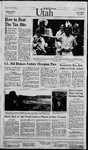
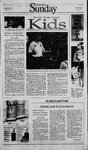
Show SUNDAY, MAY 28, 1995 The Salt LakeTribune PERSONALS SECTIONJ = ATTITUDE Page J-6,7 Page J-8 sy Ki KIps TEACHING Amber Purcell, center, teaches in Mountain View's extended-day mentoring program. Museum’s Mentors Help Peers Learn About Science By Brandon Griggs ‘THE SALT LAKE TRIBUNE Getting rowdy fifth- and sixth-graders to pay attention to their teacher at 4 p.m. on a sunny spring dayis never easy. It’s even harder whenthat teacheris 13 years old. Ask Sandra Sorensen andtwoother seventh-graders at Glendale Intermediate School in west Salt Lake City, who spent an exasperating Thursday afternoon recently trying to teach a groupof elementary schoolers aboutscience. Despite Sandra's best efforts, the students wriggled in their seats, joked among themselves andtalked back to her. “T figured this would be easier thanit was. It was a lot moredifficult than the younger kids,” said Sandra,” who had moresuccess earlier in the week commanding a class of first- and second-graders. Winning the respect of a 12-year-old can be difficult when you're just a yearolder. “They know we're only over at the junior high,” Sandrasaid. Whyis this group of adolescents teaching elementary school?It’s all part of a new project, called Youth Teaching Youth,that allows junior high schoolers to serve as mentors to younger students while teaching them basic biology, geology and anthropology. Funded by grants from Salt Lake County and the federal government and developed by the Utah Museum of Natural History on the University of Utah campus, the projectis the only oneofits kind in the state. Since mid-April, Glendale Intermediate School students have ventured across the street twice a week to teach students in Mountain View Elementary School's extended-day program. The two schools were selected because mostof their students come from lower-incomefamilies andlive in neighborhoods ravaged by gangs and drugs. Without this project, most of these students would havelittle exposureto science — or to the educational programs offered by the Utah Museumof Natural History. Eighteen Glendale seventh- and eighth-graders (some 45 applied) are serving as instructors in the project. Many were recommended by their teachers because of their science interest. Since January, they have been trained at the Utah Museumof Natural History in topies such as archaeology,fossils, rocks, dinosaurs andinsects Learning about science is one thing. Teaching elementary-schoolstudents about it has proven moredifficult. In the Youth Teaching Youth classrooms,it is sometimeshardtotell the teachers from the students. As Mountain Viewfifth- and sixth-graders dragged themselves into a classroom after a playground soccer gamerecently, their minds were not on schoolwork. “They're a little wound up today. We had a crazy soccer gameout there, and someof themstill have a chip on their shoulder,” said Mountain View teacher Lisa Stephens, who occasionally stepped in to restore order. Someof her rowdier studentsliketo test their teachers to see how muchtheycan get away with, she said “They're kind of looking at [the Glendale students] like, ‘Whyshould I respect you?’ As long as the Glen- Rick Egan/The alt Lake Tribune Utah Museum of Natural History arms Sandra Sorensen, others with science-teaching skills. dale kids hold their ground, they'll be fine,” Stephens said. While the young teachers had sometrouble with the older students, they ran the first- and second-grade classes smoothly. Many of the younger Mountain View students responded well to the hands-on teaching approach, which allowed them to dig in a dirt-filled aquarium forartifacts, draw their own pictographs and make(ossil imprints from shells and clay. “This has really caughttheir attention,” said Mountain View teacher Brenda Tanneras herclass learned about dinosaurs from the Glendale students. Tanner nodded toward a second-gradeboyin a sweatshirt who listened raptly as a Glendale student explained the difference between dinosaurs and modern-day animals. “It’s usually hard to get him engaged,” shesaid. To bring the materialto life, the Glendale studentteachers use skulls, fossils and dinosaur bones supplied by the museum asteachingtools. ‘Weuse real museum artifacts wheneverpossible,” said project coordinator Lanai Greenhalgh.“They can learn by looking at the real objects. It’s much more powerful than pictures and drawings and textbooks.” The effectiveness of children teaching other chil- drenis still being debated. Some teachersbelieve students areless intimidated by their peers and therefore will relate better to them in the classroom. Others fear that teens barely older than the students they are teaching cannot commandthe authority to keep a rowdy class undercontrol. “On one hand, they're teachers, but on the other hand, they’re still peers,” Greenhalgh said. “They're havingto play two roles.” Onething the project has doneis give the Glendale students a new appreciation for their own teachers. These seventh- and eighth-graderssay they never realized how difficult their teachers’ jobs were. It’s also made them better students, they say. Project coordinators hope to receive another grant that will allow them to expand the program into additional elementary schools next year “For an after-school program that’s entirely voluntary, I think it's been a success,” Greenhalgh said. The project's goals — to teach the Glendale students how to work with other kids, to boost their self-esteem and to provide positive role models for younger students — have been met, she said. “My goal wasnever to turn theminto teachers.” For Father's Day June 18, wewill print the best photos showing a Utah father ~child relationship. Send photos with your name, address and phone number, telling who is in the picture and whyit is a special moment, to “Faces of Fatherhood,” Features, The Salt Lake Tribune, Box 867, Salt Lake City, UT 84110. Deadlineis June 9. Photoswill not be returned IN ANOTHER TIME CRIME AND PUNISHMENT Settlers Relied on Smoot, all under the leadership of John Ostracism, Whipping To Curb Lawlessness prophet Joseph Smith. C.C. Rich and John Young, Brigham's eldest brother, were counselors to Smith. The council did what it could to hold things together. Becauseall but a very few ofthesettlers were Mormons, minor violations of common law were punished by disfellowshipment from the church, a sentence tantamountto ostracismin the pioneer society Being cut from the church community ByHarold Schindler ‘THESALT LAKE TRIBUNE ‘82: 4% Executive vice president ‘8 92: 9% . 3% TTT Where the opportunity Is Industries with largest Share of women managers Finance,Insurance, real 1 estate STORRS41°. Services doy “ SOLS ‘ . Why ‘glass ceiling’ happens J ® Fewer women are in jobsthatallow them to move up corporate ladder @ Stereotypes — womenfelt to be less able to do the job 1B White male In the earliest days of frontier settlement — before proper courts could be established — maintaining law and order was a mite touchy Border townsandrailheads of the 1860s and °70s answered with town-tamers and lynch laws, but for MormonsofGreat Salt LakeCity in the late 1840s, options were pretty much limited to public whipping and ostracism from the church community —orboth After theinitial explosion of immigrants in Great Salt Lake Valley in 1847, Brigham Young returned to Winter Quarters in Nebraska for the thousands of church members preparingto trek to their new mountain home, While he was gone, a High Couneil was named to govern in his absence Its members: Henry Sherwood; Thomas Groves; Levi Jackman; John Murdock; Daniel ‘Spencer; Lewis Abbott; Ira Eldredge; Edson Whipple; Shadrach Roundy; John Vance; Willard Snow; A.O. Knight-Ridder Smith, uncle of the martyred Mormon wasa serious matter since survival during those early times depended on harmony and mutual cooperation Five so-called Bishop's Courts handled most disputes, since they were primarily courts of arbitration, designed to settle differences without complicated recourse to civil courts that would organizelater. The High Council also took responsibil- ity for regulation of trade with Indians, location ofa city cemetery, granting of the first divorce and authorizing the purchase of mountaineer Miles Goodyear's trading post on the Ogden River. Among thefirst cases to confront the High Council was that of five young Mormon Battalion men who were charged with “unbecoming and demoralizing conduct.” John D, Lee noted “four of the soldier boys cut a Spanish Rusty” at a party in Cottonwood Canyon — riding there and back each with a youngladysitting in the saddlein front, and the rider with his arms around the woman. (Shockingly outrageous behaviorin those times.) The fifth man wasriding along “sawing on a violin.” They stayed all night and came home the same way, according to Lee Thecouncil fined each of the four $25. Theincident was the subject of sermons in church the following Sunday by Amasa Lyman and Erastus Snow, who decried such carryings-on and the unwantedintroduction by battalion veterans of other “savage Spanish customs.” The miscreants were disfellowshiped by unanimous vote of the congregation. After a suitable period (and payment of the fines), the contrite hellions usually werereinstated. However, as Great Salt Lake City burgeoned and law-breaking increased, it became obvious thatstricter measures were needed. Though the settlement was a church community for at least a decade after its founding, it was not entirely free of rascality and legal clashes. MoseaStout, for instance, who became a prominent lawyer in Utah Territory, had more than enough work, if his journal is anyindication. Still, before the town had a jail and be@ See HISTORY, J-3 |