| OCR Text |
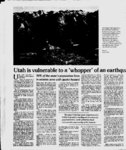
Show The Wasatch Fault escarpment, below the towering Wasatch mountains at the mouth of Little Cottonwood and Bell's canyons is vividly shown in this 1970 photo. Major segments of the Wasatch fault and several other faults in the region are moderate-angl- e faults, dipping to the west. An earthquake would be under the valley floor and not under the fault scarp. Photo by Lloyd S. Cluf Utah is vulnerable to a whopper of an earthqu could Utah experience a of an earthquake 90 of the state's population lives in seismic zone with quake hazard any time. the assessment of Genevieve Atwood, director of the Utah Geological and Mineral Survey, in writing From the Directors Desk in the winter 1985 issue of the UGMSs quarterly publication, Survey Notes. She was commenting on the lead article in the publication, Earthquake Hazards in Utah, written by Don R. Mabey, deputy director and coordinator of UGMS earthquake studies. Even if the whopper doesnt occur for another century, several historic earthquakes provide ample ev- Mabey wrote, the earth scientists must convince the community of the hazard and work with decisionmakers to recommend appropriate actions to provide the desired degree of protection for life and property. The first reported earthquake in Utah was felt in Nephi and Provo on Dec. 1, 1853, six years after the first Mormon settlements in Utah were established. Since then, 15 earthquakes of magnitude 5.5 or greater have occurred in the state or along its borders with adjacent states. Damage caused by these earthquakes varied widely depending on the location of the earthquake and the degree of development at the time. The two largest historic earthquakes in Utah occurred before the extensive seismic network that exists today was developed, and there is some uncertainly as to their exact magnitude, according to Mabey. These earthquakes were the Richfield earthquake on Nov. 13, 1901, and the Hansel Valley earthquake north of Great Salt Lake on Oct 5, 1934, which produced more deformation than any other earthquake in Utahs historic record. These earthquakes have been assigned magnitudes of more than 6.5, but probably no greater than 7, Mabey reported. idence that less major events quakes will cause extensive damage that will make the flooding and landslide events of 1983 and 1984 look minor in comparison, the director wrote. Mabey, in his article, said that 90 percent of the states population Uvea in an active seismic zone with an earthquake hazard that deserves the attention of officials and the general public. If the whopper earthquake were to hit Utah, damage would be extreme. The U.S. Geological Survey has calculated that in a major earthquake in the Salt Lake City area, 2,300 people could die and 9,000 suffer injuries requiring hospitalization, reported Mabey. U possible dam failures are included, be explained, as many as 14,000 people might die. If the earthquake occurred at night when most people are at home, casualties would be much lower. Property damage could be in the billions of dollars, he emphasized. Because Utah has never experienced a highly destructive earthquake in a heavily populated area, Although a destructive earthquake could occur anywhere in Utah, Mabey reported, "both the geologic evidence and the historic seismicity indicate that such events are much more likely to occur in the seismic belt that trends Inter-mounta- in - generally north across western Utah. . Included in this belt is the corridor of cities along the Wasatch Front, extending from Santaquin to Brigham City. Mabey explained that the Intermountain seismic belt is along the eastern edge of the Basin and Range Physiographic Province that is generally defined as the region of alternating elongated mountains and valleys extending from west Texas through southern New Mexico, southern Arizona, eastern California, Nevada, western Utah, and into southern Oregon and Idaho. In evaluating the earthquake hazard along the Wasatch Front with the data presently available, the assumption should be made that an earthquake can occur anywhere at cavations. Estimates vary substantially but suggest a major faulting event occurs somewhere along the Wasatch fault on the average of about 450 years. Recurrence intervals on faults west of the Wasatch he added. fault are less The magnitude of an earthquake along the Wasatch Front that would cause surface rupture is subject to conjecture, but Mabey estimated that the maximum could range from 7.0 to 7.5, with the minimum likely to be about 6.6. For planning purposes, he said, a conservative assumption is that a magnitude 7.0 to 7.5 earthquake will effect some area of the Wasatch Front on the average every 300 years. In addition to direct damage caused by an earthquake, Mabey said, secondary effects can produce extreme destruction. Secondary effects include ground shaking, sur- well-know- Because Utah has never experienced a highly destructive earthquake in a heavily populated area, earth scientists must convince the community of the hazard. any time along the Front or along several ranges to the west, Mabey declared. And probably without warning, wrote Director Atwood. Mabey said that estimates of recurrence intervals of earthquakes are based on determinations of the number of faulting events that have occurred during the past several thousand years. This can be done, he said, by dating fault scarps or displacement in recent sediments revealed in ex face rupture and deformation. Some secondary effects of major concerns along the Wasatch Front include (1) flooding caused by the failure of dams or other water containment structures, (2) landslides and mudflows, (3) hydrologic effects such as soil liquefaction (where soil behaves as a liquid), and increased spring discharge, (4) seiches (waves on an enclosed body of water such as a lake or tank), and (5) inundation caused by surface deformation. Mabey explained that the under standing required to adequately evaluate the earthquake hazard along the Wasatch Front necessitates information on the subsurface geology at least to the depths at which earthquakes occur. He said most earthquakes in this area are within 10 miles of the surface. He said some information is available from deep holes mostly drilled in the exploration for petroleum resources, but the most important source of information is from geophysical surveys, particularly seismic reflection profiling. This involves the generation of a sheet wave at or near the surface (often with an explosive charge) and then recording waves reflected back to the surface from layers in the earth. This method can can be used to map layering in the earth to depths of tens of miles. From information already known, the conclusion has been made that major segments of the Wasatch fault and several other faults in the region are moderate-angl- e faults, dipping to the west Because of the westward dip of the fault, the focus of the earthquake is several miles west of the fault trace on the surface and the epicenter the point on the earths surface directly above the focus does not coincide with the surface trace of the fault, reported Mabey. This diagonal dipping does not necessarily cause more or less damage, but it is important to understand that the earthquake is under the valley floor, and not under the fault scarp. He said that a major earthquake along the Wasatch fault, and the subsidence and tilting accompanying it could significantly alter the valley floor. Mabey wrote in his article that earthquake research during the last |