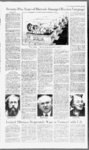
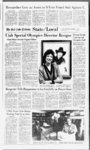
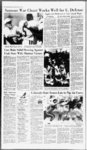
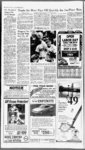
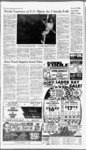
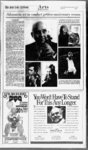
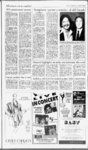
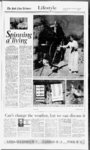
| Show The Salt Lake Tribune Years of Rhetoric Damaged Russian Languag6s Seventy-Plu- s By David Remnick The Washington Post MOSCOW — What a strange vision on Soviet television last Monday night: Alexander Yakovlev Mikhail Gorbachev's most trusted colleague on the Soviet presidential council reading a long statement of repentance in memory of the names "of the lost" Explaining Gorbachev's recent decision to "rehabilitate" the murdered and the exiled everyone from the peasants of the Ukraine to Alexander Solzhenitsyn Yakovlev spoke of restoring "the moral law within us" "We are not somehow forgiving them for the sins of the past that would reek of hypocrisy" he said "We are instead forgiving ourselves for it is we who are to blame that they were forced to live with lies and were trampled underfoot They wanted to make a world more kind a free place to live And the state answered with the evil of prisons and -- --- I"I- -- - 1 WAR IS PEACE FREEDOM IS SLAVERY IGNORANCE IS STRENGTH Through it all I kept thinking how Stalin's homicidal KGB chief Lavrenti Beria called his interrogation cells "sincerity rooms" The ferocity of the Stalinist abuse of language has at least one equal in the 20th century Nearly 15 years after World War II George Steiner published an essay called "The Hollow Miracle" contending that the language of Hitler and Himmler had nearly killed German a language "used to run hell getting the habits of hell into its syntax" "Languages have great reserves of life They can also absorb masses of hysteria illiteracy and cheapness" Steiner wrote "But there comes a breaking point Use a language to conceive organize and justify Belsen use it to make out specifications for gas ovens use it to dehumanize man during 12 years of calculated torture Something will happen to it "Something of the lies and sadism will settle on the marrow of the language Imperceptibly at first like the poisons of radiation sifting silently into the bone But the cancer will bedestruction The lan gin and the deep-se- t Atii60111p1p7AMMMIMVIT rflfornmeltd102&0171 ' r 1 - f:ttit- tx i l'' 9''' t t ''' 1SP S tt 1 I t o 11 ': I 4' il : :Of' li 4 :' : At t 01 ''' - li r i' - 'L ' ''' 4t 1' ' - ' ' ' '' - - 43 ik 0" '' t ' i: c ' - " r--------------1- ) i I Alexander Sohhenitsyn Citizenship Restored -- — -- --- - :' - : -1- 7-- 16 - tk 0 7 ''''-- '' - ''' -- 10' I 1 1 ' 1 - i '3 - V f'i 0 C- -- 'I qz :5i U - vs itAt I -- (it! 41 - 4 -- '‘' --- " ‘1 k' Vr a - -- - Ilv-Int- 7-- fti1 ( 1 -- 1 - Mini A' —t1 'at' 1( : 77 44 :: i: r 41 ?' : - - T1:- - 3i - - & --- - 4 - v Z' - - :11 v 1II t17 v -- - - k c --- -- " I? Z 4"-- - v- 7: ( z---- :° 441 1 morl frer-7Y7- " - '' ( utr tw --- 1: -- - 6 7 ik ' - -- 01: - fri 0 32 -- ( -- 0 - ' 7 -I lam lif'- :' - - - s ' i 7 p' ' 17 1 Q z 1 - - ' Q - Rik '"e it t s 01 7001p1P E) - 'Alt d114 I - r f- -) 'T 1 - 1 Lr11 :::: - ' Z 10 '1'- '7r l' I -ItP :a V Yr 1 I I ' 's - -- 1 - "Novoyaz" We memorized long lists of stock phrases from the lexicon of the Communist Party For example this sentence from the 1981 Soviet textbook "Reading Newspapers": "Socialism has added nearly 40 years of life on the average to every man and woman in the Soviet Union" Or from a slightly earlier era this in the government newspaper lzvestia: "Academician Sakharov's libels against the Soviet state are an attempt to betray a peace-lovin- g that people" It was the Winston Smith read on sign: emblazoned above the gates of the Ministry of Truth: – i to end censorship and return honor to the writers who kept the language alive will prove in its way as important to the Soviet Union and its future as the establishment of an elected legislature and economic restructuring -- -1 t David Remnick is a Moscow correspondent for The Washington Post In 1990 Russians call it - T I - By returning citizenship to Solzhenitsyn Vladimir Voinovich Lev Kopelev Vassily Aksyonov Ir Ma Ratushinskaya and many others Gorbachev also means to atone by decree for one of the most brutal assaults of the Bolshevik period: the assault on the Russian language and independent thought The legacies of the Soviet attack on agriculture pluralist politics civil liberties and the natural sciences are all well known — especially now as the Soviet Union struggles to enter the modern world of democratic institutions and a market economy The more the Soviet Union tries to create a civil society and meets yet another barrier the more it is forced to understand a history of labor camps collectivization and slaughter But bow to understand the life of a Iangruage? What is the legacy left behind by a war on the word? The questions are anything but academic The Bolshevik war on one of history's great literary languages was a sustained attempt to leech Russian — and the Russian people themselves — of liberty to make sheep of 280 million men and women A few years ago as preparation for my assignment to The Post's Moscow bureau I took a course at George Washington University in what is known as "political" or "newspaper" Russian Really it was a course in the cliches the block phrases of totalitarian habit and mind In "1984" George Orwell called it — - T –— fr---- camps" Newspeak Ali Sunday September 2 1990 s' 1 t' 1 --- -- - - r'1 z- - - -- -— —-- V: - - tr -- : "Pssst Lenin gruage will no longer grow and freshen It will no longer perform quite as well as it used to its two principal functions: the conveyance of humane order which we call law and the com- munication of the quick of the human spirit which we call grace In an anguished note in his diary for 1940 Klaus Mann observed that he could no longer read new German books: Can it be that Hitler has polluted the language of Nietzsche and Holderlin?' It can" The Bolshevik pollution of Russian began long before — say with Lenin's order to execute the poet Nikolai Gumilyev in 1921 — and lasted until just a few years ago The current liberalization perestroika is not the first time the Soviet leadership has allowed the physicians of a language its writers to try to heal Russian and individual thought The "thaw" in the early years of the Khrushchev regime which saw the publication of Solzhenitsyn's "One Day in the Life of Ivan Denisovich" Maximov's "A Man Survives" and other essential works gave first voice to the silenced of the Gulag But once more the wall came down and most writers — genuine writers — were arrested sent into exile were silenced once more The Stalinist assault on language led by commissars of culture ideology chiefs and newspaper editors was as unforgiving as his war on private farmers or "rootless cosmopolitans" To run Bolshevik hell Stalin developed a grandiloquent public language that seemed at times like an abomination of the stock phrases and holy formulae of the Russian Orthodox Church A former seminarian whose first language was Georgian Stalin initiated a kind of holy Bolshevik liturgy that allowed no deviations and was meant to narrow the range of permissible thought Editors of Pravda who had direct access to all Politburo meetings were the monkish scriveners of Stalinist Newspeak Each day they set down the party line in the approved vocabulary Even today on the desk of Pravda editor (and Politburo member) Ivan Fro lov there is a cream-colore- d telephone a direct line with no dial that says on it "Gorbachev" To succeed — to survive — in public life party members substituted genuine knowledge and argument for the provided script this abstracted artificial language Dimitri Simes who emigrated in the 1970s and is now a scholar at Washington's Carnegie Endowment remembers going to Young Communist League meetings as a young man long after Stalin's death and feeling the power of the Bolshevik liturgy "You not only had to agree with the ideas and policies being expressed in that morning's Pravda you also had to use the exact same phrases to express your unfailing agreement" Simes said "Because after all if you used your own language and logic then maybe your agreement with the party line was merely a matter of coincidence And this could not be tolerated "Just as dangerous you always had to pay attention to any changes in party line and language If on a Thursday you were still mouthing the language of Tuesday's Pravda without bothering to check if the script had changed you were running a tremendous r--- - - - --- 4 - - did you too get an eviction notice?!" members knowing children in the '30s named Traktor to honor the glories of collectivization and Elektrifikatsia to commemorate the Leninist slogan "Socialism equals Soviet power plus electrification of the whole country" Here in Moscow the writer Len Karpinski's first name comes from Lenin not Leonard the journalist Vil Dorofeyev's first name is the acronym of Vladimir Ilyich Lenin The Communist Party not only developed an of its own it also shot imprisoned exiled and censored the lifeblood of liberal Russian its writers The Alexander Herzen once said that Russian literature was an uninterrupted indictment of Russian reality The Bolsheviks would not permit indictment Their means of censorship were far more brutal than anything ever imagined by even the most reactionary czars How to calculate the loss of Osip Mandelstam? Of Isaac Babel? The analogy is meager but at least try as a beginning to imagine y American culture if the government had executed Frost Fitzgerald Hemingway and Faulkner exiled Bellow Lowell Bishop and Ellison censored Eliot Stevens Updike and Roth Imagine the bookstores and libraries stocked with pulp political tracts and engineering textbooks Imagine a political rhetoric so hollow that Leonid Brezhnev could (as he once did at a congress in Baku) read the same page of a speech twice with almost no one noticing There were moments in the Soviet assault on the word that became literature a tragic comedy Listen to just one moment in the trial for "parasitism" in 1964 of the poet Joseph Brodsky before he was sentenced to five years of internal exile Frida Vigdorova's transcription of the trial became one of the first examples of samizdat or underground literature of the Khrushchev era and reads like an addendum to Gogol's "The Inspector General": Judge: And what is your occupation? Brodsky: Poet Judge: And who recognized you to be a poet Who put you in the ranks of the poets? Brodsky: No one And who put me in the ranks of humanity? Judge: Did you study it? Brodsky: What? Judge: How to be a poet? Did you attempt to finish an institute of higher learning where they would prepare you? Brodsky: I don't think it is given to one by education n 19th-centu- ry 20tb-centur- poet-translat- 2 459: A By what then? from God Brodsky: I think it is Just before Brodsky emigrated to the West a party official in Leningrad went after another literary dissident: this time a young man named Revolt Pimenov "If you think we will ever allow people to say and wnte everything they want I tell you it will never happen" the official told Pimenov "Of course it is not in our powers to make everybody think the same But we do Judge: have enough power to prevent people from making things that are damaging to us" Today the official who helped send Pimenov to jail Vadim Medvedev is a member of Gorbachev's presidential council This spring Pimenov was elected a deputy to the parliament of the Russian Republic Russian and Russian literature survived despite the best efforts of the state Spoken Russian proved resilient to the demands of ideology In a society where private life grew alienated from the public the language of the kitchen table grew as distant from the syntax of Pravda as Spanish is from German People even resisted the most basic terms of Sovietized Russian so much so that they have always had trouble addressing strangers — unable to stomach the ideologized "comrade" but hesitating as well before the "mister" or "sir" Russian literary art survived first of all abroad Brodsky a winner of the Nobel Prize and probably the greatest living poet in the language now lives in Greenwich Village an exile In fact with Solzhenitsyn Aksyonov Kopelev Sasha Sokolov Voinovich Yuz Aleshkovsky Sergei Dovlatov Vladimir Maximov Andrei Sinyavsky also living in exile there is little doubt that contemporary Russian literature is strongest outside Soviet borders Especially following the rise of the dissident movement in the 1960s much of the exile literature made its way back to the Soviet Union through underground samizdat manuscripts passed hand to hand European emigre publishing houses often funded by Western intelligence agencies also helped support modern Russian literature Ardis an independent publishing house run out of a basement in Ann Arbor Mich published more exceptional Russian literature in the Brezhnev era than the entire Soviet publishing industry Although in the Soviet Union sycophantic hacks tended to dominate the journals and writers unions not all the writers who remained in the Soviet Union were suffocated and by the system Some found a "third way- - literary styles and gestures that managed at once to avoid compromise and the censors Fazil Iskander a hilarious and daring writer from the Caucasian region of Abkhazia used allegory the grotesque and regional myths in "Sandro of Chegem" to write about Stalinism Andrei Bitov in "Seven Journeys" criticized Russian culture by writing about smaller peoples within the Soviet Union But even Iskander and Bitov could not publish most of their work until the glasnost era Bitov's novel "Pushkin House" a novel that also pays homage to all forebears of Rusthe 18th- - and sian literature was for years available only in smuggled foreign editions The average reader one without the connectms necessary to get hold of a samizdat or emigre book simply had to do without "We have our exiles and heroes and that helped sustain us but for the most part we have had no literature only the myth of a literature" said Natalya I vanova one of Moscow 's leading critics "A language cannot survive on the 'art' supplied by sycophants and s for very long it becomes a diseased language a diseased culture" Which is why Gorbachev s order over time free press since The road to a Western-styl- e March 1985 has been full of fits and start petty reversions to the old ways Gorbachev has growled at various editors The style or argument even in the most progressive newspapers is still full of intolerance illogic jargon and Aesopian language But the progress has been stunning — far quicker than anything seen in the economic realm certainly — and Gorbachev surprised even his own team the "perestroika army" with the latitude he was willing to show When Vita ly Korotich was brought to Moscow from Kiev four years ago to take over the editor post of the weekly magazine Ogonvok he discovered the only instructions that his predecessor had left to him were a complete list of the birthdays of the members of the Politburo In the past editors of Ogonyok (a particularly wooden journal) knew they had to honor somehow these men on their birthdays the only question was how With a color portrait! With a congratulatory announcement framed in red? The imagination reeled For Korotich the birthday of an especially odious Politburo member Dinmukhamed Kunayev was fast approaching Korotich decided to discover the limits of glasnost He called Alexander Yakovlev for advice None was forthcoming There was the signal Kor0 tich let Kunaev s birthday pass without congratulation There as no reaction "For me that was the signal to begin" Korotich said Ogonyok quickly became a centerpiece of glasnost In 1988 and 1989 especially the "return of necessary things" as Ivanova has titled a collection of her essays made for a period of cultural jubilation When such works as "Dr Zhivago" and "1984'' were finally serialized in the journal Novy Mir subway cars were packed with commut ers reading intently from the pale blue monthly But those who expected that glasnost would also reveal quickly an enormously talented cast of suppressed writers in the Soviet Union were badly disappointed Vladimir Dudunti sev's "White Robes" and Anatoli Rybakov's "Children of the Arbat" caused a sensation for their journalistic explorations of the Sta lin era but as novels as works of language they were dull — James Michener in Russian: Younger prose writers such as Viktor Yerot feyev and Tatyana Tolstaya and a playwright named Ludmilla Petrushevskaya are great discoveries but they do not yet make for anything approaching a re naissance The appearance of genuine individual genius in literature happens when it happens For nc w the real renaissance is in the press Even official newspapers such as lzvestia Komsomolskaya Pravda and Sovietskaya law Rossiya disregard or mock the Stalinist -guage Old stock phrases such as our bright' shining future" are only used as irony a split with Newspeak The same is true in political discourse Many in the Congress of People's Deputies speak with a penetration that mocks the blandness and posturing of American legislators Language is also at the center of nationalist politics in most of the Soviet republics The attempt to make Soviet Russian the primary national language was an insult to both Lithuanian and Lithuanians Georgian and Gem Oen& In nearly every republic the issue that first galvanized nationalist support and eventually led to declarations of sovereignty was the issue of language Language is communi the carrier of a civilizationg ty once that had been regained the future cracked open After seven decades the damage to the Russian language and culture is incalculable You can hear it even in the speeches of Gorbachev the Soviet leader who has moved to restore normal conditions to language and literature As he shifts back and forth between party cliches and a more honest Russian speech he seems at times like a patient waking from the effects of general anesthesia struggling for a real clean sentence But be has done a great thing Gorbachev has recognized that language is older than the state and without a language of truth the state cannot long-neglect- self-rega- rd live 1 '444111414k 011 : Ao- "- tome' A 'i ""I' - "1' —00 04- 4 1 multi-generation- al risk" 1144 'et '" In04 1 : - 1110 '' s i 0 ! ' ' '' Ai "'?!e- ' f 19th-centur- y Sovietized Russian tried to render meaningless such words as "liberty" "democracy" "freedom" Read the Soviet constitution of the Stalin era and you would think you were reading the words of John Stuart Mill and not the hangman Sovietized Russian tried as well to erase history the connection with the past It reversed reality and glorified the new ideology Suddenly streets named for Lithuanian knights and Russian gardens became Lenin Avenue Dzerzhinsky Street Prospect Marx Children were named for Politburo members Andrei Sinyavsky a novelist living now in Paris re t Mikhail Gorbachev Language Is Truth non-talent- ' 1 ' 1 ''' ''''' s :41k e' '''' - I ' 01111 li ' )f Joseph Brodsky God Makes Poets 1 Isolated Siberians Desperately Want to 'Connect' with US By John Curtis Perry Special to the Los Angeles Times America's nearest overseas neighbor is the Soviet Union Yet our view of that country is Eurocentric we tend to look at it the long way eastward across the Atlantic instead of westward across the Pacific Many people in Vladivostok the leading city of Pacific Siberia are urging us to look across the Pacific Don't ignore the regions closest to you they say John Curtis Perry is director of the North Pacific Program at the Fletcher School of Law and Diplomacy in Medford Mass At a time of global trend from nationalism and centralization to regionalism and local authority the geography of proximity takes on new importance Yet Vladivostok headquarters of the Soviet Pacific fleet has remained remote to Americans and even Soviet citizens because of poorly developed transportation networks and government security policy fortress city capiA visit to this tal of the Primorie (Maritime Province) reveals a smoldering rage against the Moscow bureaucracy and a warm desire for economic independence for the region Some are even talking of political autonomy In the Primorie's case yearnings for greater independence do not sten' ft um etilitit differences with Moscow (Slays heavily predominate in the Soviet Far East) but erupt instead from a sense of administrative abuse "They treat us like a colony!" is the cry Local people find the central authorities condescending in their attitudes and incompetent at dealing with local problems Why for instance Vladivostok asks is Leningrad dictating the study of Pacific oceanography? What does it know about the Pacific? No matter who is to blame the local econo long-seale- d my is certainly in a bad way suffering from its narrow base of timber fish and extractive industries The region must import 50 percent of its food Existence is characterized by scarcity dilapidation and alarming environmental degradation "You cannot believe how bad our life is one woman scientist remarks "We talk of nothing but the struggle to find essential material things food clothing a flat" No won der turnover is high: many workers and intellectuals who come to the Par East soon leave in disgust Yet the foreign visitor is impressed by the courage and intellect of the people their savage humor and ruthless candor "We are survivcrs they say proudly Civilians do not conceal their resentment toward the military They have made of our Primorie a wasteland surrounded by a hedge one scholar remarks Some of missiles: people talk of the desirability of getting the Navy out and wistfully refer to Singapore as a g possible paradigm a great naval base turned into a center for the manufacture of high-tecconsumer goods But the iron grip of the mihtary keeps the "open" status of Vladivostok ambiguous even four years after Mikhail Gorbachev's speech there promising it In the city's intellectual community there is thirst for change a longing for international interactions in commerce and culture The phrase "joint venture" hangs on everyone's lips The citizens of Vladivostok respect the Japanese Old Toyotas and Mazdas find appreciative new owners here South Korea is But everyone attracting new admiration wants to practice English and visit the United States World peace depends on a stable Soviet Union It is to no one's interest to have that huge nation fall into economic collapse and political chaos What can and should the United States do? Massive investment in the Soviet h Union or even just in the Primorie is unfeasible Even if we were to find and commit the money the scale and complexity of the problems are too great and not to be solved by anyone except the Soviet people themselves What many people of the Primorie would like ib the chance to study in the United States in order to develop a stronger sense of the necentrepreneurial culture they perceive essary to the success of a market economy We should offer them this opportunity American troops occupied Vladivostok for a year and a half at the beginning of the Bolshevik Revolution their presence interpreted by the Soviets as imperialist aggression We now have the opportunity to erase that image A program bringing 100 scholars a year from the PrIMOnt for the next five years would cost relatively little Yet in a population of only 2 million it would create a critical mass for change and yield great return both to lorelations cal benefit and that of US-Sovi- I |