| OCR Text |
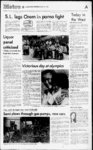
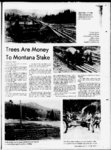
Show John Hellyer of the Big Fork ranch operates a tractor to pile trees in a central loading area. ; , ( - Thomas Woytus and John Hellyer of Big Fork Branch loosen 4 cables on trees which have been hauled into loading area. ( i 4 4 4 T rees Are Money To Montana Stake 4 4 ) KALISPELL, MONT. There are those who say money loesnt grow on trees. But for tne members of the Kalispell Montana Stake thats exactly where tiiey get their money for their welfare assessment trees. The stake, located in the northwest comer of the state, takes in an area of approximately 12,000 square miles. Because there is very little farming or dairying in the area, the question arose as to how the stakes welfare assessment could be met. There are millions of trees in the area, and the U. S. Forest Service opens acreage of forest periodically for timber harvest. The acreage goes to the highest bidder and the trees are cut in compliance with the Forest Service thinning A member of the stake submits a bid based on the number of trees available for harvest in the designated area. About 1,000 trees per acre are harvested by stake member crews and all cutting is done by priesthood members like work is done on any welfare farm. The areas bid on are usually within 30 miles of Kalispell, according to Jack R. Herron, high council chcirman of the stake post committee. Three other high councilors serve on the committee with Brother Herron. They include Calvin R. Galloway, Marvin II. Jones and LeRoy Turner. The committee assigns the acreage to be harvested on the basis of the membership of each ward and branch. The work involved in making a fence post consists of cutting and trimming the trees on the mountainside, translanding porting them to a central regulations. The trees harvested are good for fence posts, with several posts coming out of one tree. Stacks of logs, cut into , in a fence-po- lengths, are stacked st central area ready for peeling, pointing . - - - - area, loading them on trucks 250 to trees per truckload transporting them to the post yard located three miles south of Kalispell where they are cut into proper lengths, peeled, or de barked, and pointed. Trees are primarily lodgepole pine. Crews of five men each, a crew chief and four helpers, are assigned to the cutting areas, and the post yard. Crews will cut, trim and haul around 100 trees period. during a Work shifts are from 8 a.m. to noon, and 1 p.m. to 5 p.m. Three to six posts are cut from each 350 four-ho- tree and trees are three to six inches in diameter. The stake owns a post peeler and pointer, and a tractor for use in the post yard. Posts are sold on the open market as untreated or unereosoted posts and usually bring 50 cents per post at the yard. TTiey are sold primarily in eastern Montana and southern Alberta, Canada. The project, which has been in operation about five years, provides over 50 percent of the stake welfare assessment. Plans are underway to increase production and sales. 1 I 1 Chips fly as stake members operate a machine which pine logs cut to right length. puts a point on de-bark- ed WEEK ENDING MAY 15.' 1976 CHURCH 1 3 . j r |