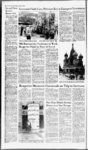
| Show SUNDAY SELECTION t aV410laginVi'4:' 666MNV k4o&666obo— Ati The Salt Lake Tribune Sunday September 30 1990 Curtain Falls as East German Turmoil Seethes Continued From A-- 1 it that West German prosperity will pay for decades of Communist idi- In Luckenwalde more than 1000 people in a population of 26500 already are out of work Food prices are artificially high because of a lack of competition Investors are deterred by tangled property ownership and too outmoded factories that would be more expensive to absorb than ignore The water supply is contaminated with cadmium The town's cobblestone roads are hazardous to man and machine and need to be replaced State subsidies which account for 90 percent of the town's budget will end Dec 31 At City Hall staff members are hurrying to learn the West German codes that will take effect Wednesday No one has offered to help and the town cannot afford a consultant A request for millions in capital ocy "The unfriendly feelings toward the people of East Germany are proving a difficult factor for Germany politically" said Kurt Karsch a director of Deutsche Bank Berlin "It's a real shame that Germans with the best Opportunity in this century are worried only about what it will cost" Several hundred East German dentists gathered outside East Berlin's red brick City Hall last week to complain that West Germany is cititreating them like second-clas- s zens a grievance common throughout the country "We were euphoric when this started" Rudiger Rothe said of last year's street revolution "We were told that our achievements would be rewarded accordingly And now I'm standing here and I earn less than a cleaning lady in the West" A complex 1000-pag- e treaty sets out the terms of German unification including guidelines for an entire network of salaries benefits prices and rents The enormity of the proissues ject is reflected in micro-size- d such as doctors' pay The treaty permits professionals in the East to charge 45 percent of the standard fees collected in the West There is no ceiling on the price - k Jr c i'''''" ts - - ' : ' ' ' ' '' ''' ''' ' ' ' ' ' ' : ' ' ' :: II ( s s 1 wrrn t a - ' '" fI ' l'L - f 4 ni1::" ' :' ' '''' ' ' '''' ' 'N'A-- '''' '4§) Ye' ' N " ' -: - 4 i 4- t' ' Alfri f ' 1 :: IF : ' '4: - : ' 0 '' s -w I ' t i' 0 " 4::'': if —A 4' 7 ' ps4 47 ' 4 4t ' ! 4 1P1 - e r '- ' ' ing at stroke of midnight Tuesday to celebrate union of East and West Germany I Decades of Doctrines Dissolve As Two Germanys Become One By Charles Goldsmith member of NATO but the German forces will operate under tough restrictions insisted upon by allies who remember all too well who started two world wars But the military agreements that accompany unification have allowed the world to embrace a new era of security "We have drawn a line under World War II and we have started counting the new age" Soviet Foreign Minister Eduard Shevardnadze said after the four wartime allies signed a treaty relinquishing their rights over German territory "We may see teething problems during the transition period especially problems relating to resentment of the population" says Simon Lunn deputy secretary general of the North Atlantic Assembly a group of NATO parliamentarians US officials have already heard the rumblings and Defense Secretary Dick Cheney announced Sept 18 that operations would cease at 94 military facilities in West Germany while 14 other West German sites would be scaled down Soviet troops are already finding life increasingly difficult in East United Press International BRUSSELS — The unification of Germany not only alters the playing field for Europe's armies it caps a dizzying year in which the game itself has been forever changed In both East and West old assumptions about European military strategy have become dusty historical trivia while post-Col- d War crises like the current stand-of- f in the Persian Gulf pose new challenges for generals whose primary enemy had been the one across barbed wire separating the two German states NATO doctrines like "forward de- fense" and "flexible response" Western security pillars for four decades became obsolete soon after the Berlin Wall began tumbling Nov 9 y The Warsaw Pact collapsed with frightening speed as country after country ordered Rus: sian troops to return home ingloriously to a Soviet Union lacking either jobs or housing for them As for Germany persistent and painstaking diplomacy backed by a wad of cash from Bonn to Moscow will allow a unified Germany to be a once-might- r' everyone' I r: 4 - --' a t 1 '"'"'": ' - : ' tt 4ot 1 i '' It ro ' ( -- drive-throug- - gt c - :VP- It 4" 1 - -- -"t ed ' ' 1 ' ''''' eqAt t''' '''" 4 - ''- c-- A "‘"t z '' w ' - '' ' 1 t - '- - - ''' 1 - r 44:ei - d 14 ' ' ' ild - If i''' i ' t - ' 0' qoof ' k I - 1 —14 '‘'1- t -I F - v slogans such as "Russians Out" have been sprayed on monuments and military barracks- Soviet soldiers complain that store clerks will no longer serve them and East Germans openly insult them in the streets The unofficial Soviet servicemen's union Shield claims authorities made few provisions for returning troops "It seems that the country is not awaiting the soldiers and especially the officers and their families back" said retired Maj Veniamin Turchin a Shield coordinator "There are no schools for their children no apartments for their families There are problems with medical care" West German Chancellor Helmut Kohl has made it clear he will be delighted to see the last Red Army soldier out of Germany During the transition period Soviet troops in Germany will have "no punitive or security functions" says Shevardnadze but will instead "be engaged in routinc filings like training of personnel" The idea of one Germany prompted the superpowers especially from the Soviet Union (which lost up to 26 million mca in World War II) to demand restrictions intended to keep the German military on a very tight leash The rules of the transitional period and beyond are spelled out clearly in the treaty signed Sept 12 by the two German states and wartime allies Britain France the United States and the Soviet Union: — A united Germany's armed forces ("ground air and naval') must be reduced to 370000 men within three to four years — Germany cannot acquire nuclear chemical or biological weapons and "only peace will emanate from German soil" — Germany's "definitive" borders will include only the current territory of East and West Germany a promise to Poland that the OderNeisse Line will remEin Germany's eastern border To the east of the line is former German territory ceded to Poland after World War — All Soviet troops will be withdrawn from East German territory by the end of 1994 The Bonn government agreed separately to pay about $8 billion to help Soviet troops adjust to life back home — After 1994 German troops belonging to NATO's integrated command can be deployed on East German territory but without nuclear weapons carriers — n NATO troops cannot be "stationed or deployed" on East German territory a restriction that prohibits even temporary maneuvers there "By the time the transitional period is over NATO will have completely rethought its doctrines in light of the CFE Conventional Forces in Europe) agreement" says Lunn a former NATO planner - Non-Germa- 4 - Anti-Sovi- ' i' e t 43 ' 4 - 4)!": vi1 v i' a o A i 4p ' e t - ' 3 ' t 400 14' ' ''is7N-- f' 4 0 ) 4 IO ' is a -' ' 0 i I ' E '1 7 1 — ' ' 11 I ''' ' 1 41 i 1- 11 ' b- t -9 ''41'LZIjs 4- t'r tI 4 t —Associated Press Loserahoto E German troops march in last changing of guard in front of memorial to victims of fascism Germanys join Wednesday I f fr t 4 t til 4 k iit z I - Pt 1! '" I Sittl i :!?: 1:' ail e 4 1 - LAtarawaLT:1-:!:L'::-r'- - s 1 ' 114 '''' Pat'k''l rto-- —11: eik ' IL t too 4 t ''tI ' tt 'n tr fr t " i4 1 04 ' I I! ' t 04 : 1 4 ft - - : ': o1 J '' 0 1 - t' ' i-- ' ed ''' 1 I 7 'a z YvAlzi ' t v At k0 '' vl o i y ' A ' i ' t i ' ' t ' O -1 -' '" t 1 1 - ' ' o 1 '' ' 4 It'r fe' t '1 i - ' Jz ' 4' '- 17:") p i el i 10' "'"b- - II 1 1 4 l 1 2 c) — -- - z oo 741 Ness Laserphotti Bonn government pumped about 65 billion marks — $42 billion — into private hands in the East Easterners went to the West to shop and sturdy cars Were the mot popular purchase for people used to long waits to buy East German car The resulting increase in sales was a potent boost to the West German economy The German Institute for Economic Research a respected independent agency predicts 4 percent economic growth for 1990 inflation under 3 percent anld employment growth to more than 2 percent But the growing consumer demand has been the only strongly positive effect so far in the East German economy The East is still waiting for largi private businesses to announce plans a tillTvEtti Welding a Single t7177M-7-7—1"---"--4A----- t German Economy Unified Germany 1990 East Germany will contribute a significant percentage of land and population to the merger but Its overall economic contribution is small hMqPWM WEST GERMANY Land: 137743 sq miles Population: 776 million (1989) EASIGEt3MANY4 TF96RA force: 383 million (1988) 4 Cross national product: $16 trillion (1989) 88Crie f oils: $3547 Imports $2838 billion (excludes billion (excludes n 'etre-Getm- trade) trade) Int'St 38-- I i 1 962VoLt i 5004- -1 : "two-plus-fou- t 1't t Germany 4 By Larry Thorson Associated Press Writer WEST BERLIN — The two German economies the juggernaut and the wheelchair have little to do with each other three months after they merged It's a big disappointment for those who believed capitalism would bring benefits and progress to the East soon after economic union occurred on July 1 Instead there has been little investment in East Germany Many businesses have failed and there has been a tidal wave of unemployment East German industrial production in July was a whopping 42 percent below July 1989 But German economic officials and analysts think things are fine that the problems were inevitable —Assoc toted Press Loserphoto Huge German flag is tested to make sure it's perfect for hoisting on Reichstag build- - 1 i Fine Say Analysts i '''' ' ' 2 German Economies : : 7 New 100 mark bills featuring likeness of Clara Schumann renowned 19th century pianist go into circulation Monday 1 A to i' af': ' - dot ''- 7 - : "i" 'ye 'r ' I 1 A" LZI- - ''' 'ts I'tp l i t 0 - ' 0 ' ' 7 V ti 11 1 ' c 1 0 I t ' i : or' kirgtts' I ' t ' ' -- (a - - t 4 t N'' A - i : 4 litwo s- - 4 - ' '' 'w o 'i l"'°31 1 ''''' ' ' - 4 -- ::'IJ1:4c' - ' 14 P'k - ' ' It ''' s - - 4- ' f A) c ry b t li e Nor ' ' tfr t4''!) l 4 r 'v ' v ollt-he -- k-- e t - - - ' ' 1 1110 H' o 4 ' - ' ' r Air ' - sti' A i° —4 i u 1 4 t kt‘-- 1 - ' 1 '''""B1 i ' - ''' 1 ') V o' 4 i ' 1' '1 r-v- ! it: :4e7 -N A' P i f lit ! '14 - '''Ao : :' '' ' -- 2 4 t 1 tinued "Thank God capitalism is taking over because it's the only way to save the country" Border controls fell three months ago when the two German currencies became one Formerly busy highway h customs posts are like lanes in a ghost town broad plazas of abandoned buildings whose purpose died with the ideology that built them Road signs are being changed Karl mostly by being painted-ove- r Marx Stadt reclaimed its old name Chemnitz The mandatory driving corridors for foreign travelers in East Germany no longer exist Berlin no is longer referred to as East Germany's capital — "Hauptstatit der GDR" — on the autobahn signs The two Berlins are being stitched back together after nearly 29 years as the aching symbol of Europe's division Road crews pour and flatten steaming asphalt to connect severed streets in the inner city Much of the Berlin Wall has been torn down Industries are laying off workers by the tens of thousand Government offices are preparing to surrender their functions and to shut their doors Everywhere East Germans are looking for work and wondering what will happen to them next ' 4 i into debt" he said Emotionally the transition to the market economy is particularly painful after decades of fixed wages and guaranteed employment "All of my patients are thinking 'Finally I'm going to get good care from my own doctor" said Gabriele Hoffmann a dentist from Saxony "How am I going to pay for the instruments? Where am I going to get the loans? I'm 44 years old I should have achieved a certain status but I'm starting over from scratch "They stripped us of our courage We have no stamina We are so un- ruined environment" Stuermer con- ' ' A A ' 1 7 Germany's socialized system of medicine and enter private practice he estimates that he must borrow $133000 to $200000 "I'd rather be unemployed than go "These people are coming out of a jail house What's to be preserved?" asked West German historian Michael Stuermer "This is a rundown ruined country with a rundown ruined people and a rundown ' N - ti - rivzw---- ' - - ': mans on both sides of the old divide have accepted the challenge of unification and grimly determined will not allow the project to fail—by dint of will if nothing else "In spite of all the question marks and missed opportunities I think there is a great political determination" Stock said "They have to finish this no matter what Nobody over there can afford to let the East German part go down the drain "That is the biggest asset we have They cannot afford to let us go" t ' if 1 I ' t 1 ' 4 i f' I' r1 14': il I lo 4 — 'OrAe t l - a doctors must pay the same prices as their Western counterparts Rothe's medical instruments are out of date and his clinic's Siemens y machine was built before World War H For him to leave East In the quiet East German town of Luckenwalde south of Berlin dozens of people stood in line the other o resign from their churches aim was to avoid mandatory W German taxes that are chan- 'nel back to the church treasuries The attitude of the people in line ranged from disappointment and dismay to bitterness at the way things are turning out They worried about their jobs and they complained about a new sense of powerlessness this time against West German domination: "They're playing with our lives We'll have to eat window putty the way they're gambling with us" said Annemarie Wietnann "If you asked me I wouldn't unite I'm just cursing the whole thing" Rita Koenig said "We have much lower incomes and now I'm a short-tim- e worker We don't know what tomorrow will bring at all" The rapid pace of unification as well as its scale has contributed to the problems A year ago the notion of a reunited Germany was hardly considered and rarely discussed Surprisingly little forethought went into the nuts and bolts of the merger which was prompted by East Germany's sudden economic and political collapse "Crisis management" is what Hindrichs who worked closely on the treaty calls the unification process While East Germans complain that the ideals of their society were sacrificed to West German expediency critics in the West contend that there was little to save and the sooner the old order was buried the better for In the dreds of billions of dollars Although special funds have been created and the Bonn government has made a "no new taxes" pledge in advance of elections on Dec 2 few expect taxes to remain steady The short-terconsequences of unification are as difficult to calcucosts Gruschka late as the long-terand Walter Stock an East Berlin academic see a satisfactory ending with a measure of drama and upset along the way "Unemployment and low wages A" wk" ' ' of equipment however which means that East German dentists and certain" i 4 '0 lop way" 7N - f4-- no differences between East and West they have to pay" said Mayor Peter Gruschka "There is no other ' 7 'my ' i 4 'N gt:" Germany and probably also the rest of Germany but I don't foresee any real social unrest" said Stock "I think the government will be able to control this process and put out the fires one by one" s Yys'" I will strain the social fabric of East t 7 r— end grants is pending "If the West Germans want an integrated Germany where there are 4 'Based estimate at $14 trillion for West Germany Unofficial estimates for East Germany vary due to changes in two exchange rates and other recent economic nuctuadons i On Official : VM111111111W11111111111MEMOP Source: PlanEcon AP research APT Dean "The conditions for further growth in Germany are extraordinarily good" said Peter Pietsch an economist with Commerzbank one of West Germany's leading banks Pietsch thinks the only problem for the German economy these days is the Persian Gulf crisis meaning possibly higher oil prices The Bundesbank the West German central bank said in its monthly report released Sept 18 that there had been continued economic growth in West Germany since July 1 Depressing effects of the gulf cri- sis and slackening demand in export markets were "more than compensated for by the swift expansion of domestic demand" and by increases in imports to satisfy pent-uneeds of p East German consumers the report said The 166 million East Germans have been the key to economic growth in West Germany as the two Germanys approach full unification next Wednesday The single Germany will be a country of almost 80 million people with an economy almost double the size of France the in Europe On July 1 the currency union between the two Germanys let people in the East convert their salaries and much of their savings from East German marks into the powerful West German mark The next-bigge- st CO for substantial investments that will spin off industrial jobs The disincentives to invest in the East are many: low labor productivity rising pay demands poor telephone and utility services old environmental hazards such as poison wastes conflicting claims to property ownership But some smaller operators are venturing into the East Martin E Borner a Canadian real estate entrepreneur who was born in Dresden in what is now East Germany is spending the week proposing projects including urban renewal and an advanced heating system in his native city and others Borner president of Montvest Realty Ltd of Oakville Ontario recalls being rescued by his father from the Allied firebombing of Dresden in February 1945 when he was 15 "Now I'd like to do something to help Dresden" he said Heiner Flassbeck a chief analyst at the German Institute for Economic Research said such entrepreneurs will be pathfinders to economic growth but their impact will not be felt for three to five years Big investors now are put off by lack of advantage in labor costs and by a "very bad infrastructure" Flassbeck said "To fix that takes time and it's a question of the length of the transitional period" - |