| OCR Text |
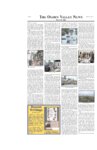
Show THE OGDEN VALLEY NEWS Page 8 Volume IX Issue XI March 15, 2004 HAITI cont. from page 1 of the island years ago and had imported slaves from Africa to work their sugar and coffee plantations. Creole is the language that was picked up from the slave era and has only recently become an official written language that is now being taught in the schools. After a 5-week course in the church missionary training center in Provo, we landed in Haiti on May 10, 2002 with our limited Creole in our heads, but with lots of excitement and anticipation for what lay ahead. Indeed, our hearts were almost bursting with excitement as we disembarked from the plane and received our first glimpse of Portau-Prince. What a beautiful city with palm trees, bougainvillea, flamboya, hibiscus, and many other tropical plants. Haiti is a very mountainous country, and we were surprised that even Port-au-Prince is nestled into the mountains. Then there was the sunshine— the ever-present sunshine—with temperatures that hovered around 100 in the summer but came down into the lovely low 80’s in the winter. Even though very warm in Portau-Prince and the lower elevation cities, clouds and mist frequently hang over the that come into the harbor. There is every kind of item you could possibly need. You just have to know where that vendor has set up business or catch them walking up and down the streets with the goods on their heads! Pots and pans, shampoo and toothpaste, spaghetti and corn flakes, baseball caps, fans, dishes, and clothes . . . and clothes, clothes everywhere! They are spread out on the sidewalk for display or hanging on a cement wall. Clothing that does not sell at the second-hand stores in the USA is bundled up in bales and ends up in countries like Haiti. It is sold on the street and the people can buy it at affordable prices. The average Haitian does not go into an expensive shop or a grocery store to buy products. The few stores in Haiti cater to the well to do, and to the many people who are in the country with humanitarian and religious groups. When you drive down a street in hilly Port-au-Prince, the colors that greet your eyes is almost mind-boggling—school children walking hand in hand in their bright color-coordinated uniforms; peasant women with colorful scarves on their heads selling produce grown high up in the mountains; men and women walking with straight backs and high necks carrying anything you can imagine on their heads, from eggplants and tomatoes to ninety pound bags of cement. They found out many years ago that their heads could serve a very useful purpose! Many Haitians are so accustomed to carrying things on their heads that even when the load is not heavy, they automatically put it up on their heads. For example, Elder Allan Wiscombe with Haitian family making peanut butter. tops of the mountains, and the temperature is much lower at higher elevations. It rains in Haiti about eight months of the year; when it rains it comes in torrents. It rains mostly in the late afternoon and evening and then it clears up. Most mornings are bright and beautiful. During the four or five rainy months, it rains nearly every night. Having lived quite a sheltered life, we weren’t quite prepared for the culture and the poor economic conditions of Haiti. Only about 25 percent of the people in the cities are gainfully employed, meaning that they have a regular job. About half of the population lives in rural areas and about half live in the cities. Port-au-Prince has tripled its population in the last ten years as people have flocked to the city to try to upgrade their economic conditions. But this trend has created many slum areas in Port-auPrince where the living conditions are very poor. We felt that the people in the mountains had much more pleasant living conditions, even though they were considered to be very poor. What an education we had over the next 22 months! I had often thought to myself it would be so great to have the opportunity to travel back in time, and indeed, we were back in time now! Haiti is truly a land of contrasts. The old is side by side with the new. On the streets of Port-au-Prince are thousands of street vendors—people who make their living selling their wares that they have purchased from a middle man who buys them at the wharfs right off the boats Open air markets. I have seen a woman walking with just her purse on her head! Every day in Haiti one can find the marchées (the markets) but Saturdays are the big days. At the marchées one will find as many as a dozen women lined up, each selling mangoes. One will see lots of chickens and goats tied up by their legs that people will buy for their dinner. The common man in Haiti has no refrigeration so something like meat has to be purchased live. Then there will be large burlap bags filled with all kinds of things—rice, several colors of beans, corn, or coffee. You can imagine the dazzling array that greets the eye. Then there are the people who sell charcoal. The beautiful country of Haiti has been deforested in many places because the people need the trees to make charcoal so they will have fuel to cook their food. After the charcoal is made (on the spot in wooded areas), it is placed into burlap bags and hauled on trucks into the towns and cities where it is then repackaged into smaller affordable bags that people can buy for their day to day use. It is not uncommon to see charcoal stoves right on the sidewalks grilling chicken or goat meat, or cooking up some delicious joumou (pumpkin) soup. Of course the most common meal being cooked on the street is the daily favorite—rice and beans. There is an Deseret Writings By Sherm Hislop Sherm is a Valley native whose writings are based on being raised in Ogden Valley. His writings are based on the stories, tales, experiences, teachings, and examples of neighbors, friends, teachers, and citizens of the Valley. His writings include: Tales of the Wasatch, Musings of a Mountain Man, Eight Brothers Serve for Peace, Testimonies, and others. www.deseretwritings.com Call 888-379-0412 area of bogs in the St. Marc area of Haiti that can produce rice but, unfortunately, not enough to supply the eight million people populating this country, so we saw a lot of bags of rice that had “USA” marked on Sister Betsy Wiscombe with Haitian child. them. Ninety percent of basic food commodities is imported. Needless to say, there are hundreds of people lining the streets—buying, selling, sitting, or walking. Many are stand on the edge of the sidewalks waiting to flag down a tap-tap. I need to tell you about the tap-taps because they are so representative of Haiti. Someone will save up enough money to buy an old pickup truck and then they will outfit the back with benches, a roof, and steps to climb into the vehicle. They then paint the outside of the truck with all sorts of colorful curlicues and designs and sometimes hire a young lad to ride on the back as the official “promoter” of the truck. This youngster will urge the people to ride in this particular taptap. When it is full enough, away they go down the street. Along the way, if someone needs to disembark, the passengers in the back will tap the truck loudly so that the driver stops. There is no signal or anything, the driver just pulls over slightly and stops. So we had to be constantly alert in Haiti; there just were not the rules and regulations we are accustomed to here in the United States. People stop their cars in the middle of streets to engage in a conversation with friends; there are virtually no street lights or stop signs, and there are no emissions rules. Transportation in Haiti. So Port-au-Prince, in spite of its beauty, does not have very clean air because of the constant spewing forth of diesel exhaust from the cars and trucks and the ever-present taptaps. Driving in Haiti was truly an adventure. To make a 60-mile trip would often take three hours because of the traffic, the people on the sides of the roads, and the poor condition of the highways. Haiti has two national highways, one for the south arm and one for the north arm. Both of them only go so far before the pavement turns into dirt. On the north we could drive as far as St. Marc on a paved road. On the south, we were able to go all the way to Les Cayes before the road turned to dirt. But, oh my, the potholes on the south arm highway! I never was good with curvy roads, even as a little girl, so whenever we traveled out to the southern towns, I had to take my Dramamine tablets because the car was constantly swerving to dodge the potholes. Which leads us to the infrastructure of Haiti: the poor Haitian government has so little funds to work with, and often it is not distributed with the best intentions, so this country suffers from a great lack of the basics such as paved roads, as I’ve mentioned, electricity, sewer systems, and running water. I personally feel that clean running water is the number one need of the people. There is water that has been channeled out of the mountains, but there is a great lack of reservoirs and pipe systems to get the water to the individual homes. People, especially children, walk great distances carrying plastic bottles of all sizes and shapes to bring home the daily water for the family. Sometimes they pay a little for it and sometimes a humanitarian group has made a well with a pump available. In some wellto-do areas, the people will have water cisterns to gather rain from roofs of their houses and big trucks will also come and fill the cisterns. That’s how we got our water, but of course we used bleach in it for washing our food and our dishes. We always drank bottled water at home and when eating out. We stayed quite healthy in Haiti, and if you do become sick, there are doctors and hospitals. They may not have the equipment and the knowledge of our country, but they do their best. Because of the cost associate with going to the doctor or hospital, many Haitians just do not get the medical care they need and so the life expectancy in this country is lower than in America. In fact, the average life expectancy in Haiti has dropped five years to age 49 during the past ten years. However, credit needs to be given to the many aid organizations that give of their time and resources to countries such as Haiti. They have set up clinics, and if people are lucky enough to make it into one of these facilities, they can receive care and treatment from volunteer doctors and nurses who spend their vacation time in undeveloped countries providing services. We certainly were in the minority with our skin color in Haiti; sometimes young men or children would holler, “Blanc, blanc” to us. We would smile and wave back and say in Creole, “Yes, yes, we are very white, aren’t we!” Then they would burst into a big LDS primary class smile and laugh and be quite intrigued that we knew a few words of Creole. The people in this country have a natural beauty and their warm brown color ranges the whole gamut from very light to dark. The women are pretty and the men are handsome. The children are so beautiful, too. Most people have a ready smile and they are very open to on the spot conversation. They like to look nice in public and their clothing is always clean and pressed, even though they may have had to press their clothes with a nonelectric charcoal iron and wash their clothing by hand in a little tub. We became acquainted with one of our office security guards. What a handsome, friendly young Haitian man with a heart of gold! Over the course of two years we became good friends with him and his family. He works long, long hours and is the sole provider for his wife, two children, and seven other family members. He lives in a typical Haitian home with two cement rooms, no indoor plumbing, and no kitchen. The cooking is done in a corner of a room on Haitian landscape. the little charcoal stove. Their home is clean and tidy and what a joy to visit them. Just the hugs and kisses of the children were always worth the visit! We, of course, have been in touch with these people since our return, along with many other friends. Needless to say, a piece of our hearts is still in Haiti. The spirits of the Haitian people are something to be admired. They haven’t had many of the advantages and opportunities that we are accustomed to, but they have great faith and they believe that God will eventually make it right with them. It may not be in this earth life, but most of them have great hopes for the hereafter. I think my husband has a good summary of the Haitian psyche: for most, they are “resigned” and “resilient.” However, there are some who are not “resigned” and they currently are trying to turn things around in this country. Our prayer is that it will work this time—we have many friends back in Haiti and we so want for them to be able to progress and have the opportunity to work and have the things they need for their families. Note: Betsy and her husband are from Eden. |