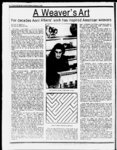
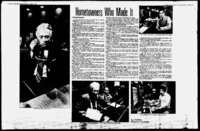
| Show Herald JournalCache Sunday January 5 12-- Thc A 1986 Weaver’s Art For decades Anni Albers’ work has inspired American weavers ings” as Nicholas Fox Weber a confidant writes in the exhibit’s companion book published by Smithsonian Institution Press “Albers who regarded the natural world as a source of beauty but also of uncertainty and even violence and death embraced abstraction as an e anchor” Weber notes “She found geometric forms reassuring with the potential to provide balance and calm She liked limitations few By David MMaxfield Smithsonian News Service Her name material of — has never been the chic yet her sublime gridlike fabrics and wall hangings have graced untold numbers of American homes and public sites for half a century To view a retrospective of her life’s work at the Smithsonian’s Renwick Gallery in Washington DC before it was taken down last week in preparation for a national tour later this month — was to understand the lasting appeal of Albers’ timeless textile creations Whether useful or purely aesthetic they have inspired generations of American weavers and designers many of whom regard Albers now 86 as "the artist of the — Anni Albers designer-lab-el pre-emine- man-mad- elements and simple colors and she took them as far as possible Order and equilibrium with no reference to time and place of her surroundings reverberate in the early wall hangings” In some ways this modem weaver this Bauhaus student who received her diploma for designing a material for an auditorium was still tied to the Old World Weber tells of the time when her new husband Josef Albers a modemish painter acclaimed in the art world of today for his “Homage to the Square” studies invited architect Mies van der Rohe and a female companion to dinner The bride determined to do her best made decorative butter balls for the meal “Butter balls!” van der Rohe's companion exclaimed “Here at the Bauhaus? At the Bauhaus I should think you would have a good solid block of sound-absorbi- nt loom” d A weaving one that in a color photograph appears to be a subtle composition of tan and gray variations dances to life under a beam of light its previously undetected metallic thread weaving a shimmering surface at once gleaming and elusive Another work this created in 1958 at first appeals to the eye as a richly colored abstraction in cotton and wool on second look a desert landscape of red and orange with yellow and blue highlights seems to form in the fabric Albers’ designs one admirer recently wrote “are deceptive appearing disapwith the pearing reappearong in a Mexican-influence- The Bauhaus whose modem ideas were anathema to the Third Reich closed its doors under pressure from the Nazis in 1933 but like its concepts its members found receptive homes in the United States Assisted by the architect Philip Johnson the painter and the weaver took refuge in a new experimental school in North Carolina — Black eye" Anni Albers now 86 at her loom in 1955 self-assur- ed up-sca- le well-design- ed j admitted S2SSS i & f Ajr- ng butter” hide-and-se- ek Albers’ abstract textiles — sometimes complex always intriguing — can easily be read as a metaphor for this octogenarian’s varied but by no means grandly chartered career as weaver writer teacher and in recent years printmaker About the pattern of her life’s work — 60 years of creativity beginning at the Bauhaus Germany’s innovative school of design — Albers has this to say: "I do not start out trying to do a garden or a pasture or something like that I start out getting my palette ready by seeing what will this do if I twist these threads if I use this if I do that I think (art histirians) always think you start with a developed concept Gandhi who can I believe be considered a visionary said "I never see beyond the next step”’ "There is nothing ‘arty’ about her” Renwick Gallery Director Lloyd Herman says of Albers who initially had “no interest” in an exhibition that honored her early work “Her manner but modest is reserved” he says “like most of her art The simplicity of her home and studio is an extension of her personality direct and honest eschewing fussiness or exaggeration” In fact this weaver whose designs have been produced by such modern-desig- n firms as Knoll International and Sunar Textiles lives modestly in a tract house in Orange Conn and enjoys nothing more she says than shopping for practical goods at Sears Such contrasts are not new to her Her earliest years in Berlin — she was born Anneliese Fleischmann — were years of privilege Her mother’s family the Ullsteins were powerful publishers her father’s side aristocratic But at 22 she was determined to take the unusual step of attending the recently formed Bauhaus in part to escape the tradition-boun- d Hamburg School of Applied Art where for two months she had labored unhappily at flowered wallpaper designs A brochure for the Weimar Bauhaus citing its emphasis on pioneering methods industrial design and the inseparability of art and craft made the school’s aproach seem worthwhile Still Anni's father a furniture manufacturer questioned the idea: “A new style? We’ve had the Renaissance We’ve had the Baroque There are no new styles” Thinking otherwise she insisted and soon was light-reflecti- Mountain College The couple brought along the Bauhaus view that functonal handmade objects and designs for industrial production are aesthetically equal to unique objects made as purely personal expressions At Black Mountain the Albers duo taught Anni requiring her students to investigate new materials and repsond to their properties Practicing that in her own work she experimented with all sorts of unorthodox fibers — cellophane plastics metallic threads waxed haraessmaker’s thread And at this time projects commissioned by clients were woven with functional requirements in mind For a New York shop Anni designed a screening material that allowed one to look out but prevented passersby from looking in For a Manhattan guest house built for Mrs John D Rockefeller III she wove chenille white plastic and copper Lurex warp into an overall pattern of subtle stripes that sparkled at night but had a subdued appearance by day In the 1940s Albers began to make small-scal- e weavings framing them like paintings The shimmering cruciform work in the Renwick show for example dates from this period Though dedicated to the artful design of textiles that filled practical needs Albers realized that they prevented the acknowledgment of fiber works as art “To let the threads be articulate again not to be sat on walked on only to be looked at is the raison d’etre of my pictorial weavings" she announced in 1959 During the 1960s her eloquent work “Six Prayers” commissioned by the Jewish Museum of New York City memorialized victims of the Holocaust “Although she had never been in a synagogue and had no sense of being Jewish apart from feeling that where there was she would qualify as a victim (because of her heritage) many American Jews clearly viewed her as a Jewish refugee from Nazism” Weber says In 1970 Albers was to surprise again When the couple moved to a house in Orange Conn Anni gave away her looms “happy to concentrate solely on graphics” Weber reports The thread is still present in her work however for many of her prints resemble textiles anti-Semitis- m That was only half the battle Anni found that the weaving workshop was the only one open to her Initially she was afraid that it would be “too sissy” and would require her to do things like needlepoint In practice she found the materials and techniques — the “limitations of the craft” — challenging and began to weave abstract images that “had the power and strength usually associated with paint ‘f a£s I to BBBaSC&SSSFSV 'in' 7 s |