| OCR Text |
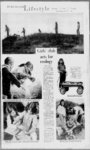
Show gab from the garden advice from the garden doctor time for dahlias do you really cl it? in our area by Dr. Arvil L. Stark Tribune Garden Consultant by Genevieve is PROCRASTINATION a perplexing human pro- pensity. Witness the long lines waiting until the final day for decals for their car plates, or postponers dashing to the post office before midnight on the deadline date for income, tax payment. Many gardeners belong to the same lot, they delay Boil preparation until the day of planting unaware of the advantages of doing it earlier for better tilth, easier working, and more leisurely gardening. Even the heaviest, cloddy, most onerous soil becomes a joy to work in spring if it is spaded or plowed in fall. But fall is past and spring fe here so whats for now? SOIL at the content facimoisture right litates the operation. Take a handful from the four to six inche depth and press it fato a ball. If the ball crumbles easily under slight pressure from your finger the moisture content is suitable for spading or tillage. Soil that is too dry will not form a ball and when it is too wet the ball does not fall apart easily. The fact that you may not be an organic garden WORKING er does not exempt you from using organic matter in your soil. Lawn clippings are a handy, cheap and nutritious, weed free source of organic matter. Last years leaves that you piled in the corner and forgot to put out for garbage collection are also valuab'e In fact, any plant debris thats handy will serve the p.irpose, but no matter what it is, dont fail to use something when spading or powing the soil. While youre at it spread a complete fertilizer over the organic material at the same rate as suggested for use on lawns, before turning the soil over. This is very important, especially if you are using straw, sawdust, or shavings for organic material. Decomposing organic matter uses the same nutrients as the plants so you must add enough for both while preparing the soil. Its still March. Experienced gardeners transplant their annuals in late April cr early May to avoid frost. Preparing your soil now will give it plenty of time to settle before seeding or transplanting. Get the job done right away so that you will have time to get your income tax in the mail the night of April 17 at 11:59 p.m. ITS SPRING! SUNDAYS DAHLIAS, actually natives of our southern neighbor, Mexico, are popular with local gardeners and do very well in our intermountain area. So popular is the plant here that there is a Dahlia Society whose members study the plants and encourage their culture. Clarence Brasher is president, and invites anyone interested to join the group. The society annually conducts a bulb sale and this years event is set for April 15 from 9 a.m. to 1 p.m. in the social hall of Sacred Heart Church, 2nd East and 9th South. The groups spring dinner will be April 19, with reservations under the direction of Armond Powell, 216 S. 400 West, Sandy. Richard Esta, dahlia expert, shows how to a clump preparatory to planting. divide usu announces tour Dahlias come in a variety of sizes, shapes and colors to please any taste, from the tiny pompons to sizes, the huge dinner-plat- e The singles are daisy-lik- e and lovely for arranging. a ferryboat ride to Vancouver to see the Queen Elizabeth Park, redwoods and some lovely flower gardens. Stops will be made in Baker, and Pendleton in Oregon, Tumwater and Seattle, Wash., and Boise, Utah State Universitys third annual Green Thumb Tour, April 17 to 25, will be to the Northwest. ' Del Faddis, Conference and Institute Division, Utah State University and Fullmer Allred, USU Extension Services will direct the tour. Arboretums, gardens and other interesting places will be visited, including the famous Butch-ar- t Gardens in Victoria, B.C. The tour also includes Orchid-flowerin- Idaho. Reservations should be made with the Conference and Institute Division, University Center, Box 1206, Utah State University, Logan, Utah 84321. Tour cost will be $180 a person. 7 o.m. to 7 p.m. Mon. thru Sat. ELBERTA FRUIT TREES m Delicious Jonathan Apple bear thii year 1972 3, ALL ESTABLISHED NURSERY STOCK -CONTAINER GROWN RAKES TILLERS 149 each or 12 13 Residential and Commercial 12t.r$99S EQUIP, with your Seod or Fortilixer purchost Seeder, Spreoder. Roller, and s, Flagstone Steps for Your Hillside 0 Sprinkling System Rock Walls iKY two-wee- hahe EOLIPSEl ivioioa 8391 South . . 21" mowers! d mu, in. 1 a snap Grassbag included e Patented alumi. PowR-Vahousing cutl clean, without spreads clippings evenly, bags clogging Complies with air existing Industry safety standards mower num-allo- y i! now only $139.95 e The Tough Ones. Built tough to make your life easy MILLCREEK GARDENS 7th East 255-333- . on Folding handle makes storage Imost anywhere V Lawns, Etc. M singles but the petals turn inward. Anemones have a ring of petals around the disk while collerettes, have collars around the center. Double flowering include decocactus, rative, informal decorative, ball and pompon. Incidentally, the flower was named after Andre Dahl, a Swedish botanist, who did much to popularize them. Dahlias can be propagated by seeds, by cuttings or by divisions. To make cuttings, place a root with an eye in a flat or clay pot,' cover it with vermicuUte, sand or soil, allowing the crown to remain above the soil. Put the container with the root in a bright, warm place and keep the rooting media moist. When the sprout produces the second set of leaves, cut it off with a sharp knife and pot it up. It will develop into a plant designing The LVUK like which can be placed in the garden in May. DIVIDING dahlia clumps should be done when the eyes begin to show. Study the clump and get as many divisions a containing tuber or root with a piece of the crown with an eye as possible. Plant the tuber on its side with the eye upright where you want the plant to be. The planting hole should be six inches deep and you should cover the tuber with three inches of soil, filling up the hole as the plant develops. Exhibition types should be planted in rows like vegetables, and should be staked, the stake going close to the plant. Miniature types do not require staking, but for all dahlias the tuber should be planted with the eye upright where you want the plant to develop. ALSO IN I INE for planting now are gladioli. Glad corms can be planted now intervals k and at until the end of June, to give you continuous bloom. When selecting glad bulbs, or corms, make sure they are firm and unblemished and never allow them to dry out before planting. Plant your corms in rows and space the rows feat apart. about two Corms should be planted about five inches deep and from five to eight inches apart. When the plants are about six inches tall, start a program of spraying. Dwarf cannas are interesting plants and are wonderful for borders. You can start the rhizomes in pots or flats this month. Cover them with about an inch of soil and water and set the plants outdoors when the danger of frost is over. ANOTHER interesting plant is the daylily. They will thrive almost anywhere and furnish an abundance of bloom. Extra Special Prices 95 5' to 6' $14.95 RENTAL OF LAWN each BIRCH, CLUMP DWARF PRIVET HEDGE Salt Dwarf or full fix 12" to 15" PYRACANTHA 8" to 12" POWER !LrL,u.$ll95 98rc" 498 ARBORVITAE WE RENT April Lake Dwarf. 15" to 18". $3 98 Res- - Golden Tipped MAPLE TREES Reg. 95 each Apple, Will SPRUCE are g semi-cactu- OPEN PLANT NOW! & Folsom Tribune Garden Editor ' Delicious Apple, Golden 11. 3500 So. 9th East 484-857- 9 |