| OCR Text |
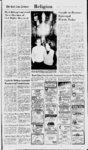
Show The Salt Lake Tribune. Columnist Joe Krail Did It His Way the Right Way Universal Pi ess S rditau, MILWAUKEE Buik here in my Midwest lor the wedding ol the son ol old friends. I wu.; enjoying the gleaming white snow and the special quiet of a Wisconsin winter Suluid'iy morning, when opened the paper: 1 Joe Kralt. the great newspaper columnist. had died I drew in my breath I had seen him at a Christmas party in early December at Georgetown University, and he had given and the ultimate entrepreneurs. They contract with a syndicate Joe's was the Los whuh sells, proAngeles Times Syndicate motes and distributes, while the columnist thinks, reports and writes. Newspapers pay for the column according to their circulation. so small papers might be paying the exorbitant sum of $5 or $8 or $12 a week. This means that most columnists cannot live solely off what they make from their columns. they work all the time, giving speeches, writing books and appearing on TV and radio, Every time 1 see a TV anehorperson interviewing someone like Moammar Kha-dafor Hosm Mubarak, I have to shak$ my head The TV "journalists" often pay PH people to set up those interviews. A columnist like Joe Kraft has spent a lifetime doing it the real way, patiently setting up sources and interviews. In addition, syndicated columnists almost always pay for all of the travel themselves, a cost that clearly is staggering Further, in this age in which Information is changing by the moment, he was up against the new "celebrity columnists. people whose names are known from politics or theater or almost anything at all. And, in some papers, he was up against the new idea that local informed people should write the columns, and the professionals should fade away. Neither one of these ideas, I am happy to report, in general has worked. The celebrity columnists generally are one note people, and their tiresome columns show that. Local people, no matter how brilliant or simply do not give what a Joe Kraft gave: the practical renaissance mind against which the curious reader can posit his or her thinking day after day A psychiatrist friend once said to me of the columnists. "People know you guys better than they know their own wives or husbands." I suppose that's why I felt I knew Joe Kraft better than I actually did. Another friend once said, "Writing a column is like being married to a nymphomaniac. it's nice, but . . . " Maybe that's why Joe died so prematurely: The column is always there, the search is always there, the responsibility is always there. IK. I'M A15 ' c'n ' ,r-A- - Saturday. January f? v ... - IS ALJ10 Wtf&.n fans y Georgie Anne Geyer me a big hug He had looked fine, his usual bright-eyeedgy self, filled as always with endless things to figure out in a turbulent world Then I remembered several years ago when we had met on a flight between Washington and my hometown, Chicago. I found myself rummaging for some answers from this master concerning our infinitely odd craft of column writing. "I do three things," Joe told me. "I stay close to the front-pagnews. 1 balance the column between dorriestie and foreign news, and . . : I guess, then, that I only write when e I have something personal and especially mine to say " I found these to be expert answers, and I jolted them down at the time. In fact, I found Jue always export He was a columnist whose style I studied, whose breadth I appreciated. and whose imperative for work in this crazy business I all too well understood His columns were filled with facts but. far more important, they were filled with the relationships between those facts. He would take a subject such as the Middle East, and in our column length of 750 wrds or so, give the reader a remarkable grasp of cause and effect in a crossword-puzzle world. He was never an ideologue, and he always maintained a humane skepticism. I liked that. To die at 61 it was too soon. Iife's-bloo- d Joe's death brought out some special feelings I have for loreign correspondents and syndicated columnists, both of which he exemplified They are the consummate individualists Drawn and Quartered whatpva W 5EM vmmmt mCCASTAUP haot mm tm W we OR BACK TO TUB "MEANWHILE AT THE RANCH, THE PRESIDENTS 006, One day, when a lady reminded me that FRO as a columnist. I was "free," I crabbily refree to work 16 hours a sponded. Yes. free day seven days a week." "Ah.'' said the wise lady then, "but you are morally free." Joe Kraft knew that, tou LUCKT, DENIES HE WAS PRESSURED THE WHITE HOUSE W DOMALD REGAN KUJty" The Public Forum Tribune Readers Opinions No Santa Claus? Tom Hoover (Forum, Jan. 1) worries that it children are taught to believe in Santa Claus they eventually may conclude that all father gods, angels, and invisible beings Jesus are. as he put it, baloney. Actually, losing one's faith in Santa Claus, the Easter Bunny, the Tooth Fairy and the Stork is a valuable part of growing up. When children grow a little bit they usually lose some of their childhood beliefs. If they continue to grow, they will lose other childhood beliefs such as the one about gods and goddesses and, even, werewolves. Giving up a belief in invisible beings gives a child a firmer grip on reality and teaches the child to distinguish between the real world and the world of myth (as in the creation, the myth of myth of the seven-dathe virgin birth, and the myth of the lost tribes of Israel). Can Mr. Hoover really distinguish between his gods and his Santa Claus? HAROLD M. ELLIOTT y Ogden Forum llulc Public Forum letters must be submitted exclusively to The Tribune and bear writers full name, signature and address. Names must be printed on political letters but may be withheld for good reason on others. Writers are limited to one letter every 10 days. Preference will be given to short, typewritten (double spaced) letters permitting use of the writers true name. All letters are subject to condensation. Mail to the Public Forum, The Salt Lake Tribune, P.O. Box 867, Salt Lake City, Utah 84110. most compelling response evolves through striving to live productive, Christian lives. men can obBy such means, serve and judge. fair-minde- d ADRIAN W. CANNON Proud Daughter Mrs. Kirk (Forum, Dee. 26) submitted a fine letter in support of Sheriff Hayward and should be applauded. However, she failed to say she knew Ron Cranfill had retired from the sheriff's department, that she was a friend of Hayward, that she was a clerical worker for the detective division and that after years of working there she still can not distinguish the difference between the and a retired (career) officer who always holds the honor of being an officer. Lt. RE. Cranfills career covered 21 years and at his retirement he was one of the field commanders, making him much more than just another outsider sitting back and criticizing procedures he had never dealt with. Lt Cranfill never failed to respect Sheriff Hayward as an outstanding investigator and one known around the country, as are his homicide investigators. Mrs. Kirk made it sound like Lt. Cranfill was either dismissed or quit the office unable to handle the duties. He was number 41 in office seniority. He grew tired of standing up to the system by not compromising his principles, and he would not tolerate being intimidated into submission, so at the age of 50 he decided it was time for him to leave. I am proud my father was a compassionate and respected deputy sheriff. I am proud he refuses to compromise his principles, as are my sisters and brothers. We are proud Ron Cranfill, "Lieutenant Retired." is our father' c.cuttia SS0URIDM) SfCJRSTE I security L MS. T. L. JACKSON Jusus Wouldn't Refuse Does the Mormon Church really pretend to be "Christian" by excommumcat'ng and turning its back on a truly courageous young man afflicted with a terrifying disease that has left him without hope or peace of mind Do they actually believe this disease to be a "scourge" given out at random by a vengeful God1 Would Jesus Christ refuse this young roan I Hunk not K llua. No Rebuttal Needed . Recently, a spate of letters to the editor condemned Mormomsm Writers claimed the LDS Church was "dealing from the bottom of the deck." inducing police to selectively arrest gentile jaywalkers; unable to perform public miracles; sequestering the McLcllin papers; maintaining a One writer abominated the church for allowing public viewing of. President Kimball's body, staling it was a family mutter. Actually, there was reciprocal love between President Kimball and church members. We also were his "family " Some letter!) were intelligent and sincere. But some must have come from the Flat Earth Society, e "Mormonlsm wa,s invented in Utah," etc Letters ol attack outnunibered letters three to one, ilowever, lack of Mormon rebuttal does not signify insensitivity or apathy. Generally. Mormons feel the pope-apostl- 1 Kearns Wildlife Concerns The loss of wildlife habitat has been a continuing process in my lifetime. Sharply in focus recently were stories featuring the legal killing of more than 200 deer grazing 80 acres of young wheat. By my calculations of values, such action is economic insanity Something is wrong with the thinking of the people of this state when the wanton destruction of a wildlile resource is tolerated and there are no protests. Why are the rod and gun clubs mule' Where are the defend- ers of wildlife? The Fish and Game people did some carping, but on procedure problems it is not their job to influence public opinion. Laws and regulations regarding the taking of game are determined by elected officials. It is the duty of the constituency to change governmental policy. Let's use our political muscle to save land suitable for wildlife particularly tracts used In winter. Wheat production is subsidized by taxpayers. So arc the graziers of public lands. Stoncfruit orchards normally produce a surplus. Where conflicts occur and damages are paid to landowners, or access to fishing nied. the property should be bought wit h the sportsman's dollar Wake up Utah, before it is too late Lobby and elect those who support our plan for the future JIM FELTON St. George . Blowing Away the Years With Gillespie King Features Syndicate Dizzy Gillespie, s big, pleasant black man with a vast talent, was in town and we were talking about jazz "Oh, it's not just people our age," lie said, the kids are jazz fans, too go around to a lot of schools and colleges and they all want to talk jazz, to hear jazz " No one talks it better, few have ever played it as well. For a whole generation now we have been listening to and dancing to and talking about rock. And now Dizzy Gillespie was playing at a joint downtown as if Elvis and the Beatles and the Stones never happened and we weren't in New York at all but in a smoky bar on Bourbon Street or some dive in Chicago. It was nice, the music and the talk. And the memories. There was a place in San Francisco one ago and behind the night a quarter-centurbar, up on a narrow platform, Karl "Fatha" Hines was playing. Dizzy worked with Hines, maybe he was sitting in that night. I don't know, don't remember the name of the place, but I remember the sound There was a time In London when we hadn't lound an apartment, yet. and were staying In a small hotel in Mayfair, and 1 ou-I- s Armstrong was staying there, too Satchmo. There he was. the man himself. 1 shared the elevator with him once, too shv 1 y I 4 t even to talk to him. Who needed to talk, I'd heard him play. There was New Orleans. Another guy and I were there, staying in a boarding house in the Old Quarter, the Vieux Cane. We didn't have very much money so we went to bed early anil set the alarm for 10 o'clock. II James Hrady A .I o'clock at night and then we'd go over to bourbon Street where the clubs and the bars were just warming up. It was summer and all along Bourbon Street the windows and the doors were open with the music and the laughter and the smoke coming out Into the soft Louisiana night. Inside the bartenders poured the cold beer and the girls were beautiful, but always, up there behind the bar, the Jazz bands worked. That was why these places existed, that was why we were there. Some of the juzzmen were black, older men, with solemn faces. There was nothing solemn about the music. Others were white, younger men in striped blazers and straw boaters. White or black, it didn't matter. In one of the joints when they started to play "The Saints Come Marchin' In" the band got up and left the platform and strutted along the bar itself, kicking over glasses and stepping on soggy dollar bills and careless fingers And no one cared. I talked to Dizzy about all that and about places he hud played He knew the places, knew the names. He talked about France, where he went with Bill Cosby, and where the French had to be told who Cosby was. They knew Dizzy, they knew "le jazz hot." And we talked about Woody Allen, who plays clarinet in a New York bar called Michael's Pub every Monday night. "Yeah," said Dizzy, grinning, "and this time I was in Europe and they had this big ad for me and this teeny little ad for Woody Allen." When we were finished talking he got into his overcoat and picked up an old, worn leather case that had his horn inside and he went downtown to play again. Maybe it was the ten thousandth night, maybe the fifteen thousandth night like this, sometimes here and sometimes there. Only the faces In the crowd would be different. The smoke and the music and Dizzy would bo the same, unchanging and sweel and wonderful full-pag- e ) |