| OCR Text |
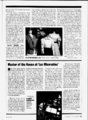
Show I III (s o far "VF Ej and Eap second film, "Powaqqatsi," nnijtth director Godfrey Reggio shows that BRIAN HAMILL Miming her directions because 'I'm an actress': Garry created two girls to double-dat- e Richie and Fonzie on "Happy Days." The duo Laverne and Shirley (Cindy Williams) was spun off the next fall and became an instant hit. As "Laverne and Shirley" zoomed to the top, it passed "All in the Family," costar-rin- g Marshall's second husband, Rob Reiner. She'd met Reiner the son of producer-director Carl Reiner while they were performing in an improv troupe. But the marriage unraveled under prime-tim- e stress. By the time "Laverne and Shirley" ended its run in 1983, Marshall was divorced and very, very tired. For the next three years, she had little to do with show business. Marshall jumped back into the business by deciding to direct, but the choice was hard. "I need an enormous amount of en- .... ....... ... v m . mmmm lower-middle-cla- ss . PARAMOUNT Number 1: Cast of 'Laverne and Shirley' 46 NEWSWEEK ON CAMPUS Working with Hanks on the set couragement to do anything even go out to dinner," she says. She took on "Peggy Sue Got Married" in 1984, but was fired after three weeks. "It was like being kicked in the stomach," says Marshall. A year later she got another chance. Whoopi Goldberg's director on "Jumpin' Jack Flash" was leaving after eight days of shooting. Could she be there on Monday? She could, and now she remembers with a laugh, "It was like cramming four years of college in one semester." The finished movie didn't win enormous praise, but it showed that Marshall could deliver even in difficult circumstances. Comic timing: She was more than ready when "Big" came along. Dressed in permanently creased pants and neobright Converses that matched her ponytail ribbons, she would mime her acting instructions to d flesh out her commands of "happy," "sad," "scared." "I can't help it," says Marshall. "I'm an actress." And, she adds, while chewing gum and smoking at the same time, "I was directing a after all." Unorthodox as this directorial approach may have been, it drew praise from Elizabeth Perkins, who plays Hanks's workaholic adult girlfriend in the film: "Penny has an incredible sense of comic timing. It's rote with her line, two beats, vaboom. She never misses." Directing has gobbled up so much time that Marshall has had to forgo acting to her regret. "It doesn't take a year and a half to do a role," says the exhausted director who might take her next job in front of the camera. Her only recreation now is the Sunday New York Times crossword. "I don't have time to be depressed," she smiles. After "Big" comes out she may not have any reason. Janet Huck in Los Angeles UU he has the courage of his convictions. His first motion picture, "Koyaanis-qatsi- " (1983), was a stunning, iconoclastic of work. A documentary without piece narration about America, "Koyaanis-qatsi- " combined time-laps- e photography and a beautiful, relentless musical score by Philip Glass into a dazzling feast for the eyes and ears. Now comes "Powaqqatsi," the second of his projected "qatsi" trilogy named after the Hopi Indian term for "life." Reggio has broadened his scope from the United States to the world, but he's maintained the blend of riveting cinematography (high-spee- d photography, which translates normal action into slow motion) and propulsive music (again by Glass). "Powaqqatsi" spans the globe, but it focuses on such Third World countries as Nepal and Peru. It's hard to decipher a specific message out of "Powaqqatsi," but Reggio splices a pointed contrast between native, undeveloped cultures and emergsocieties. Simple ing, folk societies seem especially pristine next to the squalor of newly overcrowded Third World cities. The word "powaqqatsi" roughly translates into "an entity that consumes the life forms of others to further its own life." Through Reggio's eyes, it seems unfortunately clear that man is both the exploiter and the exploited. Ron Givens non-narrati- ve semi-technologiz- one-wor- J fNf Technologized squalor: Child in Nairobi MAY 1988 |