| OCR Text |
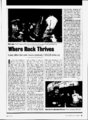
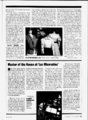
Show PHOTOS BY CAROL BERNSON Hard corps: A club where all kinds of rock get equal respect BLACK STAR and amplification was like that. Hanging out and exchanging ideas and getting loaded at the bar. Music was the center of everybody's attention. There's no other reason to hang out at a place UkeCB.G.B.'s." Seismic levels: For first-tim- e visitors, the place seems a little underwhelming. The only light upon the small tables (which are removed for hardcore shows) comes from neon beer signs overhead and patio candles. Tattered remains of ancient handbills dot the walls, and near the ceiling off stage left, someone has spray-painte-d "Giant Metal INSECTS." Maximum seating is 350, and the stage can hold only four energetic musicians comfortably. But the sound system produces extremely clean music, even at seismic levels, and musicians love to play there. "It's the most place in the city," says Binky Philips, who's performed there with a variety of bands over the past 10 years, and who recorded a live EP there last year. On a recent Thursday night, Philips's trio churned through a dynamic set of pure power pop to an audience of about 60. Among the crowd were Takayuki Chuma and Akitsugu Morita, two law students from Japan College in Tokyo on a three-wee- k American visit. Asked what they thought of the place, the two replied, "Good livehouse. " And indeed it is. music-o- riented Long after the new wave crashed, C.B.G.B. lives on sounds like a thermonuclear train wreck. It looks, as near as you can tell in the dim light, like a riot. Onstage, a hardcore group named Murphy's Law is surging through an awesome series of power chords, when its lead singer dashes across the small stage and does a half gainer off the edge while singing at the top of his strong lungs. He's in no danger, however, because the crowd a mix of skinheads, longhairs and everything in between is packed so tightly he cannot land on the floor. The three very large bouncers on the apron of the stage pull the singer back while simultaneously fending off the half-nud- e bodies that seem to be swimming toward the band as g audience the This is aloft. them passes the regular Sunday hardcore slam-dancin- matinee at C.B.G.B., what Rick the doorman describes as "totally, seriously mental." Now in the 15th year of its current incarnation, C.B.G.B. celebrates the spirit, energy MAY 1988 and creativity of rock mu- sic. (The full name of the club located in New York City's East Village, where Bleecker Street dead-end- s at the Bowery, is C.B.G.B. and O.M.F.U.G. The initials stand for Country, Bluegrass, Blues and Other Music For Uplifting Gourmandizers.) All kinds of rock get performed, from speed metal to power and the pop to is that restriction only bands play original material. d musical naThe ture of the club reflects the approach of its owner, manager and booker, Hilly Kristal, 56. "I don't make things happen," he says. "I struggle to let them happen." Of course, it was the explosion of the New York City musical scene known as new wave that put C.B.G.B. into the history books. Starting in 1974, and lasting through the end of the decade, the club became the center of the rock revolution as several local bands got national record contracts and became famous. art-roc- k, Television, Patti Smith, Talking Heads, The Ramones, Blondie and others came out of C.B.G.B. Chris Frantz of Talking Heads remembers it as a special time: "I grew up in Pittsburgh, Pa., duringjunior high and high school. I would read about all this stuff that was happening in England and in Liverpool at the Cavern Club, and then we moved to New York and C.B.G.B.'s R. G. open-ende- no Where Bleecker dead-end- s erw n at Bowery: Owner-manag- Kristal er NEWSWEEK ON CAMPUS 15 |