| OCR Text |
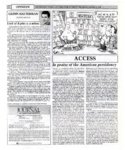
Show GLENN HALTERMAN COMMENTARY Lack of A-plus is a minus Considering the fac t that SUU is part of che public sector a realm whi ch ostensibly stresses compromise, democratic parti.cipacion, and equality, it is indeed perplexing that something so s rmple as the grading scale at this institution could be so biased. The grading system, as it now stands, discriminates against an entire class of students who may be considered to be some of the best and brightest on campus. In fact, the current grading policy, employing pluses and minuses on all passing grades-except Aplus-only hurts "A" students. Many universities across the country are currently converting their grading systems from a straight A-B-C-D-F scale to one using pluses and minuses, like the scale employed here at SUU much to the chagrin of students. Why are they upset! Let me explain. The main purpose of using a plus/minus scale is that it gives professors the ability to more accurately describe performance in a course. At an institution that omits pluses and minuses, a student who earns an 81 percent in a class and student who earns an 88 percent would both generally receive a B, even though there is a large difference in the percentage of their the actual scores. .conversely, a student at SUU, and at schools using pluses and mm uses would be more likely to receive a B-minus for an effort of 81 percent and a B-plus for earning an 88 percent. Fair enough. But why are "A" grades treated differently? Why don't students who perform exceptionally well in a course (about 98 to 100 percent).have their effort differentiated from others who barely get a" A" with 93 or 94 percent? The fact is that they should. While average students have the opportunity to offset a minus by earning a plus," A" s tudents have no such recourse. I as k you, " Why should the university want to re ward mediocrity, when it s hould be rewarding excellence?" Dr. Adrianna Kirkman, a professor at North Carolina State Un iversity, seems to understand perfectly the problems posed by plus/minus gradjng as well as the appropriate solution to the situation it poses. "The simple solution," she said, and one on which I and others concur, " is to give comparable credit to an A-plus that the 'plus' gives to a B or C, up to an overall grade point average of 4.0." Students in opposition to this position are invited to e-mail me at halter mg@student.suu.edu. In subject line please type "Plus/ Minus Grading" and in the body of the message include the phrase "No, I wouJd not like an opportunity to raise my G.P.A. I am happy with the status quo and SUU's unfair grading scale just the way it is." Regardless of the number of e-mail responses I receive, the fact remains that the addition of the A-plus grade, worth 4.3 points, is the only way to bring a sense of fairness to grading at SUU. For, in our current system, the negatives literally outweigh the positives. Glenn Halterman is a political science major from Parowan. UNIVERSIT Y JQ~~&1 PROFESSIONAL STAFF AND DESK PHONE NUM BCRS: Editor lnrry Boker 5116-775 1 Jun Rubinson 586- 1\1'17 Compu< Edi1o r Con,u lting Spon• fdhom Neil Gmlnc_r SS6·77S3 R~u Jewkes 58(,.77,l STIJDE:,/T STAff AND DESK PHONt NVl\fBiltS: Associate Ed.ho~ O.W. Andorsun 116~·82.Ui, 586-7750 Ben Win~low 865-Hl\ 58(>.7750 AP Wire Edi10r 1'.un1 E,..n Slit, 7759 Sporu Edilor Chad 1..Amb R65·844J Cop1· Editor T.ana Tew 586-'>4~~ Aru Editor Anna Turr,n 586-54~8 Ph~to Edlt~r John Guc_nlcr Sb6-7759 Adnnhin,c M2uger Maggie Nmcn ~- n,;s Opmlon 01rn1or Br•ndnn Rho<ks 566-1991 Advcni,ing Drsignu Gernmi~ Colo 586-7758 REPORTERS' DESK 586-7757 lhc lJnn·~hllt /ournal u rohh~hcJ evc.ry MonJay, Wcdnc~d.ly and Fncby ol thc :i.u.demic yea, as a rubhunon of \outhon u,~h Unavcrsuy ,u dcp.1nmt.1u of com.muruauon and the SUU Scudro1 As.."'4'.....uuon Tht •1cws ~d OJ'1D1®J a-pres..~ an die Jourllill arc thost- ol Lnd1~·u lu..al wrum and do not nncs.).lrily rdlcu the opmmn or the- /ouz.nul or an)" murr of ,he u.ruvcn:ity. Lcum 10 t ~ editor must be cypcd anJ 1ncludt the name ind phone number. Only t.hc namt wtll be printed Na.mo wall not be wHhhcld under , ny circ.ums-1.1.nc<", and the cd1uu ,escrvts ttht1ng rravalc~c.s. l.encn. mu.st be ,ubmittc.J by noon Fridays for Monday cd111on;, f uc.-.sdays for WcJ.ntsd.1y cJJtion, a.nd Thursd.ay.s for Fnday cd1uons. Cric:vancu: Any mdtvidu.aJ wnh a a;o~nnct: aptn$t the /ouma./ .t.bould durtt s.uch prob1cm first to the. <dttor ll unr,.olvnl, th.u ~cv,nct should then ho dnrtt<d ro th< /ourmu St«nng Commm«. wluch Is t hurod by Or Fm n C Peuson, 586-7971. Unl vu11ty /011m.J: OlftCCll 1n SUU Ttthnol"1C)' Bulld111& 00.l. Marl •t SUU Bo• 9.!S4, Cedar C11y. Utah 114710 FAX l4JS1586--5487. E•nml ,ddrcst: 1011m•l@suu..edu O PRINTt.D ON Rf.CYCUO PAPER. PLEASt RtCYCU. THIS COPY ACCESS In praise of the American presidency "A ccess" is a recurring column through which individuals may comment on issues of concern to our readership. Today's column is by Michael Stathis, associate professor of political science and international relations. It's a bit ironic that recent criticism of President Bill Clinton regarding certain moral transgressions should peak just a month before the celebration of Presidents' Day. But before we bury Caesar, it might be interesting to consider Clinton according to a historical perspective. The current president is not the first to be accused of moral lapses, or much more to the point, of Constitutional violations. To be honest, even the Prophet Lot would be hard pressed to find more than a handful of presidents who haven't tripped up morally, or haven't violated the Federal Constitution. But time and space offer constraints here, and only modem presidents can be considered. Morality and ethics, or the absence of these general values, seems to be in vogue regarding the modem American presidency, and well they should be. They certainly bring up more interesting issues than violations of the Constitution. Dwight 0 . Eisenhower had an affair before be ran for pres ident. So did John F. Kennedy, and he probably had several while in office. Jimmy Carter's record on this score is clean, but he did admit to having " lust' in his heart in an infamous Playboy interview. George Bush was accused of a pre-presidential affair, and given recent wisdom, we all know what being accu sed means. And Ronald Reagan was the only president to be divorced and to conceive a child out of wedlock, both before his election as president, and in all probability when he was still a Democrat. Candor in office is usually the first casualty of the presidency and generally has been compromised during election campaigns, if not t hen, certajnly at t he very i nsta nt these words are spoken, "I do solemnly swear that I will faithfully execute the Office of President of the United States, and will to the best of my ability, preserve, protect and defend the Constitution of the United States." Lyndon B. Johnson was less than candid about Vietnam . Nixon set the standard for dishonesty. Reagan's candor on Iran-Contra is still open to question. He's less than forthcoming about a secret and illegal war in Nicaragua. Bush's role in the Savings and Loan scandal is s till debated and only he knows what he knew, and when he knew it, about Iran-Contra. We do know he claimed he never tried to kill Saddam Hussein. Much as Americans would like to have a candid president, a vital concern should be whether a chief executive acts according to the Federal Constitution. Of the last IO Presidents, nine could have been removed by impeachment for Constitutional violations. All of these cases involved foreign policy alone, and were either justified by reference to a national emergency, presidential prerogative or presidential interpretation: Truman and Korea; Eisenhower and Lebanon; Kennedy and Laos, Vietnam and the Cuban Missile Crisis; Johnson and Vietnam; Nixon and Vietnam and Cambodia; Ford and Cambodia and Angola; Reagan and Libya, Grenada, the Persian Gulf and Nicaragua; Bush and Panama and the Persian Gulf; and Clinton and Somalia, Haiti, Bosnia and the Persian Gulf. Congress hasn't issued a declaration of war since Dec. 8, 1941. Yet, American presidents have still found inventive means to put American forces in harm's way with e nd runs around Congress. The President isn't above the law, and certainly is answerable to standards and expectations above and beyon d any ot her statesman, or common citizen for that matter. In historical perspective, however, the current President is only exceptional in apparent absence of any serious impeachable offenses and a few lapses in good judgment. The Constitution 1s rather loose in this respect. A president can be impeached for any high crime or misdemeanor committed while President and that could include jaywalking while jogging. The President's foremost obligations are to defend and uphold the Constiruuon, take care that the law is carried out, and defend the territorial United States. Beyond this, t he founding fathers were intentionally vague, but they did take care to include the necessary Constitut ional machinery to remove a-president: impeachment. If there are grounds for this procedure, it should be employed, if not, Congress and the President should be bard at work serving the interests of the republic, not spurious political agendas. |