| OCR Text |
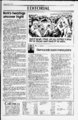
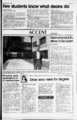
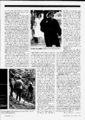
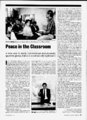
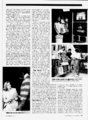
Show TJwisdAy, OcrobER 1, 1Q87 PAQE THIRTEEN Fiw mioffnfis know what sans do By Loreen Erickson Chronicle assistant feature editor " , By the time students become seniors, they pretty well know their way around campus. They know the bookstore and they gives free popcorn at the quarterly book buy-bac- k, a seniors favorite are supposed have parking spot. In short, to be authorities on college life. One campus trivia question, however, posed to several seniors in a senior seminar course in communication showed that seniors have no more common knowledge than freshmen in at least one area. Answers to the question, "What is a dean and what are his responsibilities?" ranged from "I don't think they do much" to "I know this much, you should get them to like you." When one associate dean was asked to describe his job, David Bodily of the the State College ofMines and Mineral Industries, said, "You sign your name an awful lot." Deans have a sense of humor. Actually, a dean is a college's top administrator. He or she coordinates the different departments within a college. A dean can hire professors as well as review research proposals. The University of Utah has 15 deans who head colleges. Three other deans oversee Liberal Education, Student Affairs and Services and the Division of Continuing Education. Oakley Gordon is the dean of D CE. He's been a dean four times, beginning with a position in 1967 as associate dean of the College of Letters and Science. "I've been a dean for a longer amount of time than I've been a teacher," Gordon said. Technically, however, Gordon teaches. He teaches Psychology 101 once a year. Teaching a reduced load is characteristic of most deans. For instance, Bodily, the associate dean of the State College of Mines and Mineral Industries, has been teaching applied science and fuels engineering at the U. for 20 years. "Even though I miss full-titeaching and dislike being distracted from my research, I enjoy it (being a dean) for the most part," Bodily said. Bodily was selected as associate dean four years ago. He was selected by the college dean and then appointed by the academic vice president. The appointment is temporary and usually lasts four years. Then again, it can last a lot longer. Fifteen years ago, Frank Shaw retired from the U.S. Navy and has been the assistant dean of the College of Social and Behavioral Science ever since. Most of his time is spent counseling students. "I enjoy working with young people and helping them get a better education," Shaw said. Students also interact with deans, associate deans and assistant deans when they need college approval. For example, if a student wants to change a grade and has approached his professor with undesired results, he or she can appeal to a dean. Or, if a student wants to withdraw from school after the quarter is under way, he or she needs dean approval and approval is accomplished through discussion and interviews. me ACCENT n 4 On Deans Dean enjoys job, shives to be open By Kelly Hindley Chronicle staff writer ' e illl flHHBHi ill Ip illlr HP 9 lli 1 !i . , , ... 1 Dean Carl Inoway's office is exactly the kind of office you'd imagine an architect would have. The room's sleek brick walls, crowded book shelves and tall panels of windows suggest open space, creativity and precision. As he settles into one of his office chairs and begins describing his job, it is evident the room also reflects Inoway's thoughtful and open approach to his role as the dean of the College of Architecture. Inoway became the head of the College of Architecture in July, 1986. Since accepting the job, he's learned that a dean's primary responsibility is to be a communication link, connecting his or her college with the rest of the university. Other responsibilities of deans vary with the'tpe of college they represent, Inoway said. Some University of Utah colleges,1 such as the College of Humanities or Fine Arts, are made up of several academic departments. Each;, department within these colleges has a department chairman who takes charge of all the department's daily administrative duties. Colleges such as architecture, however, contain only a v. P V s 1 single department. In these colleges, the dean's Chronicle photo hy Steve Wilson College of Architecture Dean Carl Inoway sees his job as a communication link between the college and the rest of the university. He hopes to strengthen ties between the College of Architecture and the campus by offering design and architectural courses for non-major- Chronicle seeks nominations for U.'s best teachers Driver "May I speak with Mike Smith?" I asked a voice on the other end of the phone. ."This is Mike."1" "Hi, Mike. My name ng a new Thursday week from the depths of university . . is Loreen Erickson. You don't know me. I'm a feature writer for the Chronicle." My voice was sounding too cheerful. He could tell I was going to ask a favor. He was going to be the first victim of my weekly column "Looking at U." Mike, I explained, I want my column to profile typical, everyday students at the University of Utah. You, by virtue of your name and with the help of campus directory, are my first profile. He made no objections. In fact, he feature, will pluck. one lucky professor per obscurity and thrust him or her' into the minds and hearts of Chronicle readers. But we can't do this without your help. If you remember a professor, who has inspired or nurtured you, or even one who is just fun to have around a classroom, drop us a note explaining why you think she or he is a likely candidate for a profile. Please include your name, major and telephone number and send your nominations through campus mail to "Professor Profiles," Chronicle, 24Q Union Building. (And please, don't tell us about the other kind of professors the ones who make your life pure torment. We have enough of those of our own.) Your professors. Write about them. -- Loreen Erickson Your professors. Think about them. They, can make your life pure torment. They can also illuminate your learning, ease your trials, increase your sense of and make you want to emotional well-beiclass 7:45 a for every morning. get up (OK, so maybe they can't make you want to get up. There are limits to even the most herculean of strengths. But you do get up. Don't you?) "Professor Profiles," s. responsibilities include those of a department chair. The major disadvantage of this arrangement is that the dean has a subjective opinion about the department, Inoway said. "You're in the trenches all the time," he said. "You can't pull away and have an objective view." ; please see "Inoway" page sixteen , sounded interested. That night, I drove to his house for an interview. He had turned on the front porch light so I could see his address easily. He left the front door as open, and he walked out to greet me I pulled up to,the "street curb. I was impressed.' I "wasn't going to ask this guy for his deep, dark secrets. " So, how do you feel about your name?" was my first probing question. Mike just laughed. "Well, hotel sees need for degree personnel give me the shifty eye when I sign the guest register." He looked at ease. The glass of beer and cigarette pack on the table hinted that he was comfortable. ; His wife," Ramona, later told me "Mike can get along with anyone, anywhere." I believe her. I'll wager he gets along with women best of all. In other words, Mike is not a bad looking fellow: blue eyes and dark hair. But Mike's looks don't solve all his problems. He gets mail that's not his own. (His mail is probably on another Mike Smith's desk right now.) He gets phone calls from people looking for another Mike. And when he bought his home last spring, he had 12 judgments filed against his name. At least Mike has solved one of his name problems. When he goes to a bar or restaurant, he simply gives the name of the couple he's with or his wife's maiden name. Mike, 31, has been married for two years. He also finds time to spend with his two cocker spaniels. He juggles family life, school work and a ' ' hour-a-we: v job. "I'm a truck driver for McKesson Office Products," he said. "(I'm) a blue collar worker all the way." He has worked in the steel industry for six years and at a fertilizer plant for two. Now, he drives to Idaho three times a week and delivers book supplies to "all the mom and pop stores." The 500 mile drive takes him 12 hours. He works from 4 a.m. to 4 p.m. three times a week. This schedule allows him time to go to school on Tuesday and Thursday. After being laid off twice, he now believes a college degree is a necessary 40-pl- us ek priority. "The propaganda you hear is true," he said. "You need a degree. I've seen both sides. I've seen jobs dry up. I need the extra edge. "Besides," Mike, a political science major, said "I enjoy school much more now, and I'm ready to learn." |