| OCR Text |
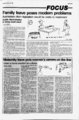
Show Tuesday, February 17, 1987 Page Sevan leave poses modem problems Businesses claim FamoDy Subtle discrimination in hiring could result legislation would be costly to implement By Susan Burke Chronicle staff writer There used to be two types of women: those who worked and those who stayed home and raised a family. The line between the two is now indistinguishable, with many women opting for both a career and a family. Employers have accepted the fact that more mothers are in the work force and are going to stay there. And their absence during pregnancy will affect how their company operates. A family leave proposed bill would require employers with 15 or more employees to entitle workers up to 18 weeks of "family leave" over a two-ye- ar period to have a child or to would one. The include a legislation adopt and benefits. While most businesses agree it is good practice, they claim it discriminates against companies that can't afford to offer it job-guaran- tee voluntarily. Merrill Brown, supervisor of benefits at Moutain Fuel, says the company currently grants a six week maternity leave for women, but not for men or for adoptions. That leave is based on a medical disability and unless a doctor certifies that the woman is not able to return to her job in six weeks, then it is extended until she can. The leave also includes benefits and a guarantee that her position will be open to her when she returns. But if the legislation passes, "it would really have a severe effect because it's hard to hold a job open for that long amount of time," Brown said. "It is really going to stifle businesses," he added. Small businesses would really be hit hard. Brown is also afraid it would lead to subtle discrimination for women when it comes to hiring a man or a woman for a job. 1 r 7W Brown would rather see businesses create a "man-powpool" that would fill in temporarily until the woman is able to return. Mountain Fuel currently follows such a practice. But Brown said his company would comply with the legislation if it does pass. er Jerry Crumpley, manager of employee benefits and records at Unisys, also believes the bill would be costly. "In the first place, if you can do without someone forfour and a half months, you must have too many people," she said. "I think the leave should be a possibility but there should be no guarantee of the job," she added. Unisys does have maternity leave under a medical disability for two weeks prior to delivery and six weeks after. It includes 100 percent pay and all benefits. Crumpley said that while the employee is on leave his or her work is sf?fnp consolidated among other workers or else a temporary employee is brought in. Crumpley also feels that small businesses would discriminate against hiring women, w hile it would not really affect big business hiring. Some feminists agree that discrimination could be a problem. But a recent Supreme Court ruling in California was seen as step forward for women. The court ruled that Calfornia may require employers to grant maternity leave to pregnant workers and reinstate them when they return. Businesses, Brown and Crumpley said, should be allowed to set up their own family leave policies. And it seems that some businesses will be establishing such policies in order to stay competitive in the market. Mlarteirnity leave pulls women's caireeirs on the line Career or family shouldn't be a choice By of Utah, on the other hand, deals with Dee L. Naquin Chronicle city editor Statistics show 65 percent of women of childbearing age are now in the American work force and 90 percent of them have had or will have children during their careers. are entitled, But only about two-thirunder state law or company policy, to pregnancy leaves that guarantee reasonable job security. ds The University of Utah's maternity leave policies may leave something to be desired, but at least they are spelled out. At the U., maternity is covered under sick leave, with a standard six weeks off. New mothers may combine their vacation and sick leave, both accumulated at eight hours per month, said Lee Arent, U. benefits specialist. At the rate of 24 days of leave yearly, then, and if it's not needed for anything else, a woman could earn almost enough time to take six weeks off, losing only six days in unpaid leave. Six months is the maximum leave without pay that can be taken, Arent said, although the specific department can require medical justification. Then, the woman should be able to come back to the same or a comparable job. Arent pointed out, though, that due to budget cuts and job eliminations these days, it might not be as easy to take six months. Paternity leave is another matter. Men are not allowed sick leave, but must use personal or vacation time. "He can use up to five days before the department can ask why," she said, adding that whether the father is allowed to use such leave is up to the department. "There's no obligation to grant that." At least the U. Equal Opportunity Office has not dealt with suits over maternity leave. The department of the Industrial Commission Anti-Discriminat- such suits quite often. "Probably 40 percent of our cases are d. A large number of these are said George Lopez, maternity-related- ," IC investigator. "I just got a call from a woman who gave notice of her doctor's recommendation that she take maternity leave. The company said she had to quit. But the sex-relate- insurance company would cancel her benefits if she quit," Lopez said. In any case, she was out of a job because the company wound up firing her. "It seems the employers got their wires crossed," Lopez said. cases the The sort of maternity-relate- d a follow such often IC handles pattern for women. "They're laid off when they inform the employer that they're against Cal Fed, citing a 1978 California law. Cal Fed counter-sue- d, arguing the law discriminates against men by requiring special benefits that are only available to women. 6-to- -3 The Court upheld the California law which says that states may order private firms to grant short, unpaid companies sell health care packages which make an additional charge for maternity coverage although this is illegal. "You have to carry maternity just like any other disability. Employers are either unaware or are still keeping maternity as a side issue," he said. "I don't see that attitude changing in Utah any too soon," he said. Nationally, there was tremendous pressure against a favorable decision by the Supreme Court. "In some respects, the law didn't go far enough," Lopez said because it doesn't mandate that women and men have a right to leave and return to their prior position. The paternity leave option is not common. Lopez said, "In my eight years here, I could count the cases on one hand." Perhaps as maternity leave is expecting. First, they're told there's no problem, but then can't come back despite verbal assurance," he said. "The bottom line is that when a woman becomes pregnant, she is probably at the highest level of risk for her career," he leave is a said. It is true a four to break in the career continuum, but only women may face a termination in such circumstances, he said. The irony is that there are so many pregnant women in Utah at any one time. "The predominant faith here encourages many children. But what are the disability leaves to new mothers. "I think the reasoning of the court was it's simple common-sens- e when you think of it," Lopez said. "Half of our working force is required to have children due to the demands of nature and society." He noted that people often consider maternity a personal choice, not seeming to realize that, in essence, for society to continue, someone has to have children. "It's like they're penalized," he said, referring to the loss of job security. law is on Some form of pregnancy-leav- e employers willing to do to support the family?" Lopez said, echoing a common criticism of national policy on parental the books of eight states besides leave. California: Connecticut, Hawaii, Kansas, Massachusetts, Montana, New Hampshire, Ohio and Washington. Supreme Court decision, the law would be applicable for men. "We would take a case for a man who had to care for his infant child," he said In Utah, women are entitled to have to choose between her career and six-we- ek Critics say that during the Reagan years, the GOP has emphasized a return to "traditional values" in the family, rather than actually instituting govern- ment policies to aid families. Lopez applauds the recent Supreme Fed Court decision in the Garland-C- al case. Upon losing her job after medically-require- d three-mon- th a mater- nity leave, Lillian Garland filed suit far-sighte- d; whatever sort of leave an employer affords to other employees, he said. For example, if employees can take leaves for missions or sabbaticals, leaves for disability related to maternity must be offered. Whether the employee returns to the same or comparable job is Up to the company. A problem in Utah is insurance packages, Lopez said. Many insurance considered more seriously after the "I basically think a woman should not having children," Lopez said. "In Europe, pregnancy is seen as a natural occurrence and they don't penalize women." "Some women don't mind if they lose their jobs when they become pregnant. They want to stay home and have children, but the economy is taking away that option of staying home," he said. |