| OCR Text |
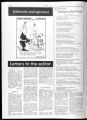
Show Page 4 Mary 4, 1973 Signpost Studeni forum FRANKLY SPEAKING by Phil Frank . . . ... . . 'TU TO Signpost Award Dear Editor: I would like to extend my congratulations to Michael Dabling and his staff for the achievement of honorable mention in general excellence for Signpost 72-73. Few people know the extent of this particular honor. The Rocky Mountain Collegiate Press Association is comprised of colleges and universities from Montana, Idaho, Wyoming, Colorado, Arizona, New Mexico and Utah. It is indeed an honor to walk away from the RMCPA awards contest with recognition for a job well done. Again, congratulations. Jeannie Young Indian Past Dear Editor: One of the most ancient, yet unknown histories is that of the American Indian. His origins are stronger than fiction, but sure. The barberous attacks of Whites have pushed the early ancestors of this nobel race west (NOT east across the Pacific) across the continent of Europe, with the first of these people coming to the Western Hemisphere in the middle of the 19th Century B.C. (My references include Bancroft's Native Races of the Pacific States; the Popul Vol -sacred book of the Quiche-Cakichel Mayas'; and Gregg's Controversial Issues in Scottish History. They called themselves children of Thracia including the MEN SAY TfjeY CCMT FIGHT TOTY, SIR names: Duras (as in Hon-Duras), Deres, Teres, Tar as (as in Taras-cos, Mexico). They came originally from the areas along the Black Sea coast. Julius Caesar noted a redman's tenacity in war and his love for keeping his word; Bancroft noted their high level of culture at the same time of darkness over Medieval Europe. The last recorded migration of these peoples was in 503 A.D. When driven from what is now Scotland, these Agathirsi (people of Thrace) were shoved off the isles, west to the "New" World. Eric Gnupsen (d. 1120 A.D.) came repeatedly, exhorting them in morality and "worship" in the teachings of the Quetzalcoatl(s), the "white gods." Actually, since the 11th ecentury B.C. an Odin (or VOTAN) had carried a message of a lord Baali-Quitze from Chivim (in Palestine). (See Bancroft, Weber State College Library). This Caucasian influence included many facets of human sacrifice that the later Toltecs and Aztecs were known for at the time of the Spanish conquistadores. The relative isolation of the "Indians" (so-called by Westerners) began to quickly fade out of memory. The white man came and brought his sword. There was a terrible decline in the 'Indian' population as a result of such things as slavery, and all the 'fruits' of imperialism. The origins of THE only true living "American" specimen have been concealed by modern WANT AiHgy's'iAri. wvim myths and benign neglect. Thus, the "Indian" is paradoxically having to fight for equally in HIS land!!! Cloaking him in sin and relugating his status to dust: (for in this state, his income averages under $1500) ('Letter from the Office of the Governor, Utah 1972), we increase the need for his searching for his identity in his LONG past recorded history. Equality includes the right to know who you are ... The Irresponsibility of the white man Stains the pages of past and Present history. Steven Koehler General Excellence Dear Editor: Recently the Rocky Mountain Collegiate Press Association, (RMCPA), which is made up of literally every college publication in Montana, Idaho, Wyoming, Utah, Colorado, Arizona, New Mexico and part of Texas, held their annual convention in Santa Fe, N.M. During the awards ceremony at this year's convention of the RMCPA, the Weber State Signpost received an Honorable Mention in the General Excellence category. This means that of all college newspapers classified with the Signpost in the eight state area covered by the RMCPA, the Signpost was judged by professional journalists to be number four. Judging criteria included makeup, writing style, content, photographs and editing. Among Campus planning? by Valerie Boyer "God bless the planners of Weber StateCollege--I curse them every day." This campus needs help from top to toe In almost every way. For instance, did you ever, When it's cold and wet outside, troop to class At the Social Science building? From the dorm? It's one big splash. On the path, not sidewalk, from FAC If you're heading for the gym ; In winter it's an ice slide ; In spring it's a mud swim. Going to the library past the bell tower (Which has a base of dirt) One must walk up through a gutter Being careful not to trip and get hurt. Students are quick to answer When asked " Ha ve you any pet peeves ? ' ' "This campus look like a pasture-No trees!" and "Poor drainage!" another grieves. Yes, it is quite disconcerting when What sidewalks there are up or downhill Serve as waterways for rain, snow and mud Which freezes in winter, causing many a spill. "Beauty is everywhere," so sings a song. However, at Weber State College We have a problem finding beauty In dirt hillsides void of foliage. Commuter students, also, note poor planning: Traffic pile-ups on narrow roads, Filled parking lots early in the day, Finally scurrying far to classes, their patience goads. Those who live off -campus find the trek To the technical building or science hall An interesting car dodge, minus sidewalks Much of the way. Walking in gutters - What a ball ! Another item on the list of student peeves Is finding faculty offices - A chore For even the athletic if several teachers Must be found. They're stuck in nooks galore. Say you need Mr. Hebestreet, Communication Department. His office is in annex five with Security And your Spanish teacher's in Administration. Searches for teachers hidden like this cause insecurity. Yes when the problems are looked at In an appraising way No wonder to hear "God bless the planners of WSC. I curse them everyday." these categories, the Signpost was critiqued as having excellent layout and well above average writing style among other very favorable comments on the other aspects of judging. Those reviewing the entries and making the awards were paid professional journalists, who are considered very knowledgable of journalism and are top men in their respective fields. As editor-in-chief of last year's Signpost which received this honor, I would like to personally thank my entire staff for the work, time and support they gave both the Signpost and myself. Especially important in achieving this recognition were my editors, Denny Osborn, Walt Schaffer, Wil Grey and Bonnie Cantwell; along with our advisor, Jim Foster; and photographer John Shupe. This award I thought was significant not only in the fact that it is the first time the Signpost has achieved such a high recognition, but in the fact that this award shows that the entire staff of last year's Signpost knew more about what they were doing than they were given credit for by students, faculty and staff of Weber State College and various other people in the surrounding communities. Again my thanks to everyone who worked on the Signpost last year and donated their time to support its goals. Mike Dabling |