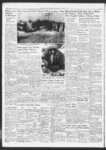
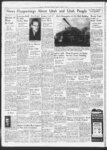
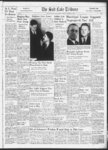
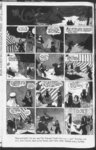
| Show THE SALT LAKE TKIBtTN f J AIYUArtt i3 1939 SUNDAT mUKNINU si D f L 1 JL 1 hi j Theae Photographs of Four Sections of Sugar Cano Stalks Show the Visual Differences Between Healthy Sugar Csnd and Cane Infected With the Mosaic Disease Cano at Left (A) la Healthy B C and D are Mosaic Infected roi7!3iOuini IISQM hurOwn n ii -- hare sugar wizards AMERICAN a greater American scientists began searching equatorial jungles for wild canes to be used in breeding for disease resistance The seed came consumption grows” candjafor the candy holidays” of 1939 than ever before in the national history In fact there seems to bo a distinct possibility that within the next decade sugar scientists will have divorced the United States entirely from any dependence on sugar and that most of the States of the Union will be growing sugar cane— hitherto a tropical product imported in prodigious quantities It’s another example of the scientists aetting the economists back on their keels For the principal producers of cane sugar Cuba the Philippines Java Africa tropical Asia and Oceania depend to a critical extent on income derived from sugar exports to more northerly lands the United States being the largest single consumer The three principal “sugar holidays” ' of the world are Christmas St Valentine’s Day and Easter Of the total “disappearance” of world sugar the United States alone accounts for more than oh the three “sugar holidays” Now already independent as to beet sugar and all the more so since five western states recently started producing sugar beet seed formerly imported from Germany America’s production of eane sugar has been increased by means of a real scientific romance There were really only two major diffl- euhiea standing in the way of wide- spread sugar cane productions most of the United States One was climate and-th- o other was the mosaic disease The mosaic disease has been con-- rfrom Tashkent imported -- injury that they be can grown commercially only in a“restricted area- e n America’s summer Plans were made with the Peru agr- icultural expert- - America’s Sugar Wizard Dr E W Brandes of the U 8 ment itation to Department of Agriculture Examining Sugar Cane Cuttings send arrows or Brought from New Guinea in an Effort to Find aStrain below-freezi- Resistant to Mosaic Disease flowering stalks by in about All of this has followed a period in four days The wild cane was used as 1928 when the American production of the pollen parent' sugar cane mostly then iffLouisiana The other method of reaching apseemed doomed by the mosaic disease same was result lengthproximately the alone This disease was first noticed in ening the days for the wild cane with 1919 and then it spread rapidly farmers artificial daylight starting in early winbeing helpless against its ravages ter Other plants have been made to Out of that situation science has built one of its greatest though little knownr bloom out of season in this manner romances of agriculture Only a short distance from the region known as "the roof of the world” the wide plants are said to grow in areas where temperatures range from below zero to 120 degrees above Because they are reported to grow in the low plains as well as on the mountain slopes considerable variation is probable in individual plants in their native land There is a distinct advantage in reducing even by a single Fahrenheit degree the critical point at which sugar cane is “X injured by cold Dr Brandes says His sugar cane discoveries have already re"S sulted in annual benefits to- the United States hundreds of times more than his V s k government salary and if even a few of the studies which he inaugurated win through to the desired conclusions he' V may become as well known to school children of future generations as is Luther Burbank Brandes led the experiments leading to reduction of the mosaic disease by mixing juice extracted from healthy tis- I sues near thp tip of the cane stalk with virus from diseased portions and then air express ' Cold V American-Grow- n one-eigh- th New JPevei-Machi- about as far north of the Equator as New York-Cit- y Most sugar cane varieties are so susceptible to frost the Gulf of Mexico mostly in Southern Louisiana The wild eane from Turkestan however has already withstood more than 82 days of weather In appearance the wild cane is not prepossessing The stalks are small — about the sizeof a lead pencil —and not more than four or five feet tall Botanic-all- y it is true sugar cane and should cross with other members of the family ’But the wild cane blooms in July The tropical canes bloom in midwinter To make a cross both plants must bloom at the same time The scientists have two along Home-Mad- e - to quered by a procedure closely resembling vaccination of the plants and the scientific breeding of sugar cane which resists mosaic disease The climatic barrier is being attacked with considerable success by a scientist in the Division of Sugar Plant Investi- gations Bureau of Plant Industry -- inoculating plants with the mixture America’s sugar cane of the next ten years' as a result'd scientific breeding 'thus far accomplished and to be accomplished will be a composite of the sugar Sugar Cane Known as Zambales White Growing In Bulacan Province Philippine cane of the world- It will be earlier ma- ——— — — — — — — —— ‘Island---—taring will' tend- to resist variourplafit“’“ disease will give more actual sucrose chances to make this happen to the stalk and a better total yield Because the seasons are reversed Steadily it should tend to an ability to south of the equator common sugar cane grow further northward taking state blooms in South America’s winter when after state into the orbit of its possible the wild plant is blooming in North production — I y Jv 73V"lr x Iff -- I I 5 i s ft Jy i A GROUP of surgical and dental which concentrate light at any desired point and piped illumination bringing a powerful sterile beanl of light into the operating room without heat or glare or danger of electrical shock have been made possible by l: £ - Sixty Years of Electrical Progress D -- i I Ii iV 1 -- Tractor Built to Work in Bogs and Marshes Ns Surgery s Sugar Going Into Candy for the 'Holidays United States Department of Agriculture He is Dr E W Brapdes who has been scouting-th- e the1' sugar canes-o- f world to find one that will grow in north-erl- y climates and which can be bred into v standard varieties Dr Brandes haa come up with a wild sugar cane— resistant to cold— from Soviet Turkestan which promises the most significant breeding experiments since light jr £3 “lucite” methyl methacrylate a crystal-cleand practically unbreakable plastic developed in the laboratories of the du Pont Company The faculty of this plastic like quartz to carry light around curves is said to be primarily responsible for the advantages of these instruments Among the surgical instruments with qualities not previously available is a tongue 'depressor made from a curved “lucite” rod with fqjused light coming out at the end By combining the light and depressor into a single instrument the operator’s hands are left more free and the examination simplified The source of the light is a small electric bulb at the base of the plastic depressor which receives its current either from a cord transforming 110 volts to 6 volts or from a flashlight base made for this purpose The tongue depressor gives a white and brilliant cold light showing up the tissues in their truest color ar “TV 4 Ji 'e' y vw is something HERE “marsh A NEW type of fever therapy machine uses atomized water instead of electricity was demonstrated recently at the annual meeting of the Academy of Physical Medicine held in Washington D C Used to combat circulator and other diseases its makers claim that it Is an improvement over other devices It is declared to be thoroughly hygienic JL which and easy to manipulate entirely new in buggy” line It is built of arc welded steel throughout even to the tires The tires are large arc welded steel drums They are buoyant because of their leakproof arc welded construction On water marsh or highway the “marsh buggy” as pictured here is capable of carrying a 6000 pound load The complete “buggy” weighs 101)00 pounds and measures 21 feet in length and 15 feet in Width overall The wheels 1 FROM FANCY TO FACT or "spout" water as is generally believed Neither art mammals and breathe by means of nostrils and lungs not by gills They bring forth their young ( usually one) alive and suckle them as other mammals do In spite of its size its eyes are no larger than thoss f a horse and its tail is horizontal not vertical like a fish and is of immense power not “blow” WHALES doThey are warm-bloode- d which are seven feet In diameter and four feet wide are of airtight construction making it possible for the unit to float The unit is powered by a Lincoln Zephyr engine which gives an operating speed of two miles per hour in water seven miles per hour in marsh and twelve miles per hour on the highway This “marsh buggy” was constructed by the Stanolind Oil and Gas Company in their Dallas Texas shop and is to be used for transportation and exploration work in the marshy sections of this page will study with interest the above chart reproduced from the sixtieth anniversary number of The Monogram house organ of the General Electric Co It shows the progress and development of electricity from 1878 to 1938 and the important effect electricity has had during these past sixty years in raising the American standard of living Advocates of the “good old days" who sometimes express a wish for a return to the customs and modes of grandfather and grandmother will be able to gather from the illustrated table a very comprehensive idea of the modep advantages enjoyed today as compared with the absence of conveniences endured (but not missed) in grandfather’s day INVERT reader WHALES DO NOT SPOUT OR BLOW WATER SAYINGS AND GENERAL BELIEFS EXPLODED A whale can remain under water sometimes more than an hour When at last it rises to the surface its lungs Is heavrly iaden with moisture and when this air is discharged through the blow holes into the cold atmosphere th moisture condenses to misty spray as our own breath does in the cold If they could spout water it would mean their lungs were full of water and in that case they would the-alr- drown by Stuart D Foulks Whales ere now hunted with a harpoon fired from a gun on a whaling steamer and a charge of guncotton is placed in the harpoon head killing almost instantly Their blubber which is hunted commercially for its ml is a layer of fat just under the skin and is always sewal inches thick sometimes two feet Thj blue whale1 which attains a length of over ninety feet at times spends the winter in the open sea approaching land in April |