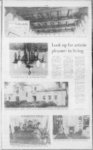
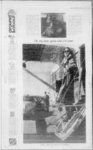
| OCR Text |
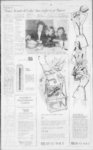
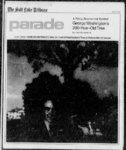
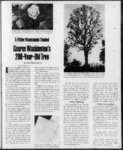
Show fiiTfiiTitii lie fTwir iui'ii irffiTitiHif ife'ivTfTiriiTifrhiiiuinaTariiiffrti.yii'iHttifrtAif.lj is;. . - 7 mm saw e.s Blooms from " Independence Tree Seeds will be retries ed this fall and nurtured in Mount Vernon's hothouse for distribution . by Fred Biumenthal MOUNT VERNON, VA. mericas Bicentennial celebration belongs to all of us, but it is the hucksters who are making it their own. Every fast buck artist, every gimmick salesman has been cudgeling his brains for a patriotic tie-i- n. They're ready now, poised for the big push wth Revolution keyed tee shirts, with red, white and blue ice cream, even beach chairs and umbrellas with the Bicentennial motif. Somewhere in this onslaught of commercialism, the real meaning of what we are celebrating may have been mislaid. Possibly there is something wrong with commemorating the birthday of Independence with the purchase of still another ashtray. To keep green and living the memory of that earlier July 4th, PARADE proposes, as a more appropriate symbol, a tree a very special tree. This particular tree is a native American tulip poplar, a member of the magnolia family, identified by Robert B. Fisher (shown on our cover), nationally known chief horticulturist of Mount Vernon, as one, of the "very fine young poplars" mentioned in the diary of George Washington for January, 1785. "It was selected as a young sapling of perhaps nine or It) years of age and transplanted by General Washington from the nearby woodlands during February, 1785," says Fisher. Washington's diary bears him out. "Planted . . . the poplars on the right walk," says the notation for Monday, February 28, 1785, " the sap of which appeared to be rising." The tree stands there still today, shading the carriage drive to eagle-decorat- Mount Vernon, a tree that germinated was in effect bom with the Declaration of Independence. Millions of visitors since Washington's day have passed beneath it and admired its magnificence unaware of its history. Today it stands 120 feet tall, a living symbol spanning the years between the American Resolution and today. Though the tree is 200 years old. it is no weakling. Its taproot goes far into the soil, drinking deep from the moist earth. "A happy tree," Fisher calls this lovely old poplar. "We spray it occasionally for aphids, of course, but in general it's not bothered by insects." Native to the ground on which it stands, the Independence Tree gets no coddling. It is fed only with lawn fertilizer, taking its nourishment from the sun and the rain and the soft silt loam from the tributaries of the Potomac (However, these trees flourish throughout most of the United States.) Excerpts from Washingtons diary that refer to the "very fine young poplars." This majestic tulip poplar was born 200 sears ago along with the Declaration of Independence and tramp! anted bs George Washington to MountVetnonsshere it happih flourishes !l Over the ears it has been pruned many times. Annually, two men work for three days to keep the canopy of leaves overhead from becoming tins dense to let through the freshening breezes. Wind could be dangerous to the Independence Tree. Jt must go through the branches, filtering through the greenery, or the tree, catching the wind like a sail, might be uprooted. Deflects lightning The sun and the rain are but sometimes there are storms. To deflect the fury of the lightning, two thumb-size- d conductors run the length of the tree on either side, Conner ted to lightning rods and grounded deep into the earth. The cables are buried 50 feet out from each side of the Independence Tree, diffusing the electrical impact. The system, supervised by General Electric, has saved the tree many times. In all seasons, the Independence Tree is beautiful. In spring it is covered with large tulip-lik- e blossoms whose petals shade from pale green to a soft orange and yellow lining From spring to autumn the leaves are a fresh, medium gieen, changing as the weather cools to patched and spotted gold "Glory be to God for dappled things," said the poet Gerard Manley Hopkins, and he might well have been speaking fisher plans this fall to taptuie thousands of tiny seeds of the Independence Tree and take them into his nuisory and botannal gaidens, where he hopes they will sprout. It is PARADt's hope that some of these seedlings will be sent for planting in other states of the union, so that descendants of the tree will tlourish throughout the nation and the Independent? Tree will never truly die. Letters from gardener life-givi- of the Independence Tree. the hitter battles of the Revolutionary War, letters fioin Mount Vernon signed by the gardener found their way to the headquarters ol General Washington. In the darkest hours before the battles of Trenton, Print eton and Valley Forge, he lead reptfhs of his garden and the things he knew would survive the wai If Washington were alive today, he would surely be happy to have a repot t All thiough on his Independence Iree Boh lisher would have no trouble wolmg the re- port "Your tulip poplar Is healthy It has weathered some severe storms, hut is gloriously alive, strong , flourishing " Mount Vernon, home of the Independence Tree, in owned tmd nnrin turned hy the non profit Mount Vernon bodies Associoiioii. 1 |