| OCR Text |
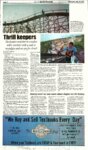
Show StatesmanSpetial Features Page 17 Wednesday, Aug. 29, 2007 ROLLERCOASTER: Roller coaster walkers get an early start. Inspectors check out the Wild One, a 90-year-old wooden coaster at Six Flags America in Largo, Md., about 6 a.m., looking and listening for signs of trouble. Wooden coasters shudder and sway, which actually keep them safe. "If it doesn't shake," woodencoaster wisdom goes, "it's gonna break." Washington Post photo by Thrill keepers Mechanics minister to wooden roller coasters with a nod to nostalgia and an eyefor detail BY DARRAGH JOHNSON but are actually what keep it safe. "If it doesn't shake," wooden-coaster wisdom goes, "it's gonna break." But that doesn't mean wooden coasters are all romance, poetry and picturesque beauty. "Wood coasters are trouble." says Zelko, the same Zelko who calls them "great" and says that "they're so much better than the steel coasters." But, he says, "I spend less on maintenance on a steel coaster." Ultimately, he says, the difference between wood and steel is "the difference between riding a Maserati versus a '57 Chevy." Wooden coasters can be cantankerous. Just ask Brad Sumser, 32, who works at the "Roller Coaster Capital of the World": Cedar Point Amusement Park, on a Lake Erie peninsula in Ohio. For a decade, he has been walking the Mean Streak. "Its personality is MEAN," he says. "They could not have named that ride any better." It climbs almost 16 stories, dips, then ascends a 12-story hill. It stretches for more than a mile. One lesson that Sumser has learned from the coaster is this: "Hard work." It's a familiar story. At Six Flags in Prince George's, Lattin and Garrison lug about 60 pounds of tools and equipment in harnesses hanging from their shoulders. Big wrenches clang as they walk. As they scale each hill early in the morning before the park opens, the sun rising pink, then the sky turning blue, the stage that is Six Flags prepares for another performance. Below the coaster walkers, lawn mowers whir and two guys with a growling power-washer spray a walkway near Skull Mountain. A garbage truck rumbles by, and soon, the other coasters — the steel coasters — are sending out empty trains to test the tracks. The Superman's chain hooks are releasing, and the carts are shooting down the hills. By 8:30 a.m., ride operators start arriving for work. "What ride The Washington Post WASHINGTON — Every morning at dawn, he's out there. They all are. The roller coaster walkers. All across the country, where there's a wooden coaster, walkers such as Tony Zelko at Six Flags America are climbing the descents, rounding the curves and double-checking every wooden plank and every nut, bolt and bit of rail. The job is a throwback and a workout — "think of a StairMaster on steroids," says Zelko, director of maintenance and construction at the park in suburban Prince George's County, Md. And it can be a daily meditation: "the Tao of maintenance," he says. "It's like a big spider web, and we crawl around in it," says Rob Lattin, 28, who has been coaster-walking at the amusement park for eight years. "We're the spiders." He has just climbed down from the Wild One, a 90-year-old wooden coaster that stretches through much of the park. It looks as languidly elegant as an old, white Adirondack chair, although its finicky personality and the shifting temperaments of wood require daily ministrations, "This is what started the whole thing," Lattin says of the Wild One, gesturing one recent day at the park around him — at the modern histrionics, the lurching architectural swoops and the speeds that make steel coasters scream like fighter jets. Without wooden coasters, Lattin says, the amusement parks of today would not have developed around them, with such rides as the Joker's Jinx (zero to 60 in three seconds) and the stomach-levitating elevator drop in the Tower of Doom (140 feet down). "Steel — the computer tells you everything you need to know," says Lattin's coaster partner, Sean Garrison, 23, who has only recently begun walking the rides. "But wood," he says, personifying the material, as though he were apprenticed to it — "I'm learning from Rob and from the coaster itself." Lattin is a carpenter from a long line of tradesmen. His grandfather was an ironworker and boilermaker, his two uncles were boilermakers and carpenters, and his cousin is a carpenter. The family's history reflects some of the tradition of the wooden coasters. "Ain't nothing like getting out there and working with your own hands," Lattin says. "It's pride." More caretaker than carpenter — although at many amusement parks, "carpenter" is the official title — the coaster walker is a throwback to a simpler time, when coasters were regal fixtures of the amusement park landscape, all white latticework and rattle and shake. "It's almost a living, breathing thing," Zelko says, walking behind the Wild One. At night, when the wooden slats light up, "it looks like the Colosseum from "Gladiator."" Abruptly, he catches himself. Did he say that wooden coasters are <I>almost </I> a living, breathing thing? They ARE living, breathing things. Wood breathes. And wooden coasters have their own "character and personality," he says. Their own moods. Like the way, in the mornings, they run slower than in the afternoons, after the grease has heated up and thinned out. And how, after a rain, the ride is slicker and faster, until the droplets dry, and it slows again. Wooden coasters talk. They shudder and sway — chilling particulars that make the ride seem that much more rickety you got today?" they taunt and brag. "You got a FLAT ride? I got a ROLLERCOASTER." Lattin and Garrison are sweating. Their fingernails are rimmed with black; dirt covers their forearms. Still, says Sean Strahl, 24, a coaster walker at Holiday World in Santa Claus, Ind., "in the mornings we come in, and there's really nobody else here. And we're out walking in the woods. And it's quiet." There is, in the grueling demands of coaster walking, a certain freedom. A certain spirit. Not that this is always foremost in a coaster walker's consciousness. "Some days, you don't soak it up," says Sumser, the Mean Streak walker from Ohio. "It gets to be an everyday thing, and no matter how beautiful the view or how fun it seems — it's work. That ride is brutal. "But then other days," he says, and his voice opens up, "you just kind of get caught by it." The Mean Streak sits where Lake Erie meets Sandusky Bay. It is perfectly positioned for him to "smell bacon cooking from the campgrounds. And sunlight's out on the bay, and boats are going out, and people are starting to water ski." Some days, Sumser says, "you can see all the way to Canada from the top of that ride ... and you think: That's a pretty good office view." Romney won't see new movie about chapter in LDS history RENO, Nev. (AP) —Presidential hopeful Mitt Romney says he won't be attending "September Dawn," a movie about the killing of 120 unarmed Arkansas pioneers by Mormon settlers in Utah in 1857. Romney's ancestors include Parley Pratt, a prominent Mormon murdered in Arkansas several months before the massacre at Mountain Meadows on Sept. 11,1857. "That was a terrible, awful act carried out by members of my faith," Romney said during an interview Wednesday. "There are bad people in any church and it's true of members of my church, too." "I hope on average we're better than we would have been as a faith group by virtue of our religious teachings," he said. "But there certainly can be some extremes, some very bad people." Romney rejected the claim by some that Brigham Young, then the president of the Mormon church, shared direct responsibility for the attack. The Mountain Meadows massacre is one of the darkest moments in the history of The Church of Jesus Christ of Latter-day Saints. The depth of the church's involvement in the massacre has been debated in dozens of books from historians and by the descendants on both sides. "September Dawn," an independent feature film from director Christopher Cain, stars Jon Voight, Terence Stamp and Lolita Davidovich. Cain has said he made the movie not to blame anyone but to show the consequences of religious fanaticism. He said the movie is not meant to offend nor be a portrait of Mormons in general. Cain co-wrote the screenplay with Carole Whang Schutter, weaving together historical accounts from nonfiction works and original Mormon sources with a fictional love story between a girl from the wagon train and the son of the church leader who orchestrates the killings. Mormon church officials have termed the movie a work of fiction. The church, which erected a memorial on the massacre site in 1999, maintains that Young had no role in the event. We Buy and Sell Textbooks Every Bring in this c^|M|& receive i ' 117 N. Main Downtown Logan 7534857 TRUE AGGIE FREE Chips; & Reg. Fountain Drink with purchase of 6" Sandwich are CHEAP & Your Lunch is FREE! ,1V,. & [ il i « ' ' |