| OCR Text |
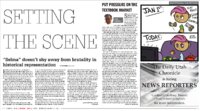
Show PUT PRESSURE ON THE TEXTBOOK MARKET S " S EDWARDS "Selma" doesn't shy away from brutality in historical representation BY CAW PETERSON n 1965, Dr. Martin Luther King Jr. led a group of an estimated 3,200 black and white American citizens on a historical march from Selma, Ala., to Montgomery, Ala., in protest of the restrictions on black American voters. Director Ava DuVernay takes this memorable story to the big screen in the first ever theatrically released biopic of King, "Selma." "Selma" starts off with King, played by David Oyelowo, receiving the Nobel Peace Prize, supposedly signifying that segregation would no longer be a problem. Though the fight for desegregation was supposed to end after the Civil Rights Act of 1964, the right to vote was still withheld from black American citizens in the town of Selma, Ala. Not only did this restriction violate law, but it violated their right to a voice in the country. King knew the way to make the voices of the black population in Selma heard was to drive the journalists and cameramen to the heart of the city and force them to recognize the inequality among blacks and whites. Without the help of the media, no one would ever know what was truly occurring in Selma. King was adamant about keeping the peace in his fight against segregation. He knew the adversary's advantages and tudent Public Interest Research Groups reported in 2010 that "textbook wholesale prices DEREK have risen more than four times the rate of inflation over the last two decades (1990-2009)" Every college student knows textbook prices are insane. Collegiate Times cited College Board's 2009 statistics in a 2010 article: "Books and supplies cost students at fouryear public schools $1,122 per year on average, or $561 per semester These costs might make sense if they represented the transaction cost of exchanging valuable new information, but since when have most undergraduate courses provided students with cutting-edge information? There haven't been widespread advances every year in how beginning students conceptually understand principles of geometry. There is no new literature from the Romantic period — Wordsworth and Coleridge died a long time ago. The periodic table was last updated in 2012, but it's doubtful that any Chemistry 1010 course covers the properties of the highly radioactive lab creations flerovium and livermorium. History overview courses show stubborn resistance to "revisionist" history and new anthropological findings, and students have been dosed with Eurocentrism for decades. Introductory course textbooks don't update their information — they update their answer sheets and layout so students will have to purchase the newer version. Universities incentivize bookstores to keep students buying high-priced textbooks. Professors are courted by textbook companies with benefits such as lecture material packages that make their classroom jobs easier. In a 2005 New York Times op-ed, Ian Ayres explained what it means for a professor to assign a textbook that they have publishing credit for: "I earn a $10.30 royalty on every copy of my textbook that a student buys. Instead of just trying to get the best book for my class (and to do so I should weigh both quality and price), I might also consider assigning my own book and increasing my profit:' With the advent of Massive Open Online Courses and other various free online resources, it's obvious that this is extortion on the part of the higher education system. Anyone can learn pretty much any undergraduate material for free. It is only because the university system has a chokehold on personal accreditation in the United States that these prices can be charged for information that is virtually free. Of course, this has only served to create an alternate exchange of textbook information. Instead of the fraternity test binder, students now sometimes turn to torrents and filesharing sites for textbooks. Legal economies also exist to undercut prices: Independent bookstores often provide exchange services, publishing platforms sell less-expensive ebooks and subscription services, such as chegg.com , offer less expensive rental alternatives than university bookstores. Buying textbooks no one will ever read again at prices five times the cost of any market-priced nonfiction tome is unwise. Students should explore the burgeoning alternate market for textbooks and exert market pressure on normalized textbook sales outlets to reduce their prices. Professors banning e-books and laptops in lecture should be asked why they are resistant to alternate methods of obtaining the same information: Are they just tech illiterate and unwilling to see their students as adults, or are they financially incentivized to get students to purchase hardcovers? letters@chronicle.utah.edu did not have the resources or the manpower to change the face of history with wooden sticks and bullets. There had to be a way around the violence that would still invoke a change in the lives of African-Americans. This way, he found, was to march 54 miles from Selma to the state's capital, Montgomery. As the film depicts the first march over the bridge, tensions rise as the state troopers attack the incoming protestors. Innocent men and women are brutally bruised and bloodied for assembling in a silent protest. This film not only portrays the graphic beatings of black Americans but also credits their innocence as they did not raise arms against the troopers. The men and women did not fight against but rather faced the anger of the antagonists in hopes of establishing a better future. Although the horrific scene was brutal to witness, the film shows how this first march served as a pivotal moment for the Civil Rights Movement as people around the country watched on their television screens the injustice suffered by black Americans. After the first attempted march, the people of Selma knew there was more to be done. King issued a national request for people of all races from all over the country to help fight the prejudice occurring in Alabama. "Selma" portrays the 12 { THECHRONY I NEWS I OPINION I ARTS I SPORTS I WEDNESDAY, JANUARY 21, 2015 /STAFF WRITER preparation for the next march, which included the arrival of white citizens from as far as Boston, Mass. Tragically, some of those who traveled to Selma did not return home. After being noticed at the second attempted march, the new visitors were no longer safe from the opposition. "Selma" represents how a white American stood for King's cause and was viciously killed in the streets, showing that inequality did not only face differences in race but also the opinions of all people. Though King and his supporters underwent unfathomable torments, the time came when they could finally, safely cross the Edmund Pettus Bridge and successful march to Montgomery. This victorious act sparked inspiration and hope in the lives of those who were fighting a battle for far too long. "Selma" depicts the heart-wrenching events that occurred during this time in a manner that is sure to bring apprehension and tears. The film's cast — comprised of Oyelowo, Carmen Ejogo, Tom Wilkinson, Oprah Winfrey and Cuba Gooding Jr. — succeeded in turning this unforgettable story into a whirlwind of emotions marking one of the most triumphant moments in history. c.peterson@chronicle.utah.edu @ChronyArts CARTOON BY JON KIM ,. „. ..%. „. . . _• ....,.„ . _,,.,,_, _,.,._. .,. .,. .:..........,. ....„,.. „_..- ....„ . .,., -o• 'L..' ,... -':. ..-: . -.fir: e Daily Utah Chronicle is hiring -.,- .,{rin .,.17. . . ___ , 4---_ ,:.-eL.D. Wr- j . .*7=" ,,••• : - ..,.% c'4:; 7 ... 6.55.• ,-6.12,. ... . .... .L.-4 - ' .• '''i4 EPORTERS Contact Courtney Tanner c.tanner@chronicle.utah.edu for more information. 13 |