| OCR Text |
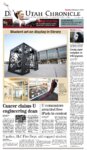
Show Tuesday, February 5, 2013 E 44 UTAHCHRONICLE iversity of Utah's Independent Student Voice Since 1890 www.dailyutahchron, SING IN ACTION Vol. 122 I No. 98 I ©2013 ALSO INSIDE: • • Columnist encourages animal rights activism in Utah Legislature » 5 Red Rocks lose valuable all-around gymnast Corrie Lothrop to injury » 6 Student art on display in library RESEARCH AT THE U PHOTO COURTESY MICHAEL D. SHAPIRO A rock pigeon of the breed Old Dutch Capuchine, which has a head crest known as a mane. Crests show mutation in wild pigeons Carolyn Webber .. 1 WILLARD MARRIOTT LIVIRARY STAFF WRITER Art students exhibit their installations throughout the Marriott Library, located in Library Plaza (above), the third-floor entrance (left) and the fifth floor (right). PHOTOS BY CHAD ZAVALA The Daily Utah Chronicle r 1111 ■1111111 Cancer claims U engineering dean Marjorie Clark NEWS EDITOR Milton Wadsworth, a former professor and dean of the College of Mines and Earth Sciences, passed away Sunday from pancreatic cancer at the age of 9o. Wadsworth attended the U after serving in the military during World War II and received a bachelor's degree in metallurgical engineering. While completing his doctorate degree, he taught part time and accept- MILTON WADSWORTH ed a full-time position after graduating in 1951. During his tenure at the U, he worked as dean of the College of Mines and Earth Sciences and as chairman of the Department of Metallurgy and Metallurgical Science. Even during his appoint- ments and responsibilities at the U he remained focused on the students and research. He had published 145 papers and received honorary doctorate degrees from the University of Liege in Belgium and Colorado School of Mines. His appreciation and understanding of the sciences and technology allowed him to inspire his students, research staff and colleagues, said Jan Miller, chair of the Department of Metallurgical Engineering. m.clark@chronicle.utah.edu U commuters awarded free iPads in contest Marjorie Clark department, and Emily LaBonte, a graduate student in social work. Both Tiney In anticipation of large and LaBonte each won a new crowds coming to campus iPad. to hear Rev. Jesse Jackson Three additional students speak on Jan. 17, U Corn- — Jessica Kennedy, a theater muter Services held a draw- major; Mike Biggs, a computing in conjunction with UTA er science major; and Devin awarding students, faculty Jackman, an exercise and and staff for using public sports science major — were transportation for their daily selected to receive the second commute. place prize: a sso gift card to The first-prize winners the University Campus Store. were Robert Tiney, an employee in the purchasing See CONTEST page 3 NEWS EDITOR U police, SLC Fire Dept. aid trapped student Topher Webb ASST. NEWS EDITOR U police responded to a call about a student trapped inside a locker in Kingsbury Hall on Saturday. According to the police report the student said he and his friends thought the locker was broken and decided to see if he would fit inside. When the door latched, the group could not open the door and did not know the combination to the lock. The student in the locker started to panic and the students decided to call 911. The student did not sustain any injuries. "[He] learned a valuable lesson," the report said. The building supervisor let the student out of the locker with a key. Both U Police and the Salt Lake City Fire Department responded to the call. t.webb@ chronicle.utah.edu Pigeons get a bad reputation of being dirty, city birds or rats of the sky. But Mike Shapiro, a professor in biology, found some beauty in the genetic variation of these birds. With Mark Yandell's lab in the medical school, Shapiro studied genes within pigeons that activate the representation of head crests. On birds, head crests occur when the feathers surrounding the head grow upward instead of down, and they can vary in size. Shapiro said he chose to study pigeons because they have a high variation in traits, yet there is little knowledge regarding this species. China's BGI-Shenzhen (Beijing Genome Institute) offered the genome sequence to reference so researchers here would be able to compare it to the genome sequence of other breeds and locate the mutation. Zev Kronenberg, a graduate student in molecular biology, was instrumental in the major analysis behind the head crests. The software is used traditionally with humans to find defective genes that lead to disease, but Kronenberg said it was not too hard to transition its use for pigeons. There is a relation to humans though, because the single for pigeons is in the gene called EphB2. "[This] gene plays an important role in other processes, such as formation of the nervous system," Shapiro said. "What others have found in studies of human disease in that this same gene may have a role in progression of prostate cancer, possibly in colon cancer, and also Alzheimer's disease." Since all animals basically use the same "toolkit" for development and processes, scientists can now better understand how EphB2 works in other animals, including humans. Within the study, Shapiro also unlocked genetic similarities between pigeons from Iran and India, which indicates those migratory routes were not only for humans and goods, but also birds. This may also help lead to finding where the species originated, which most believe is the Middle East. Shapiro said one of his ultimate goals for the study is to understand how mutations generate diversity in wild populations. "If we could, we'd love to take a toucan and an owl and cross them in a laboratory to study how the genetics of beak size and shape works, but we can't cross those species," he said. "We have pigeons with gigantic beaks and tiny beaks, though." See PIGEON page 3 |