| OCR Text |
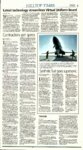
Show HILLTOP TIMES TIMES March 27, 2008 Latest technology streamlines Virtual Uniform Board Air Force Print News W ASHINGTON — Air Force officials recently announced the new Virtual Uniform Board, which transforms the Air Force Uniform Board process by providing a streamlined tool for submitting recommendations to improve dress and personal appearance standards. Recommendations will be initiated in accordance with AFI38401, The Air Force Innovative Development Through Employee Awareness (IDEA) Program. The IDEAs will remain automated from the time they are submitted until the chief of staff of the Air Force takes final action. Ruth Ewalt, the Air Force uniform pol- , icy and programs chief, acts as an adviser to the board. She ensures the uniform • board process seamlessly transitions airmen's IDEAs to a final decision from the chief of staff. Here are highlights of a recent interview with £walt: Why change a program that already exists? Tbday, technology plays vital roles in our lives; subsequently, we have fewer people, yet we demand much more from them. Tb that end, automating this process allows board members and advisers the latitude of providing inputs without disrupting everyone's normal work schedule. They can schedule convenient times and access the board in multiple sessions to review inputs. Electronic inputs also provide board members identical information that is not reliant upon handwritten notes or interpretation required during verbal dialogue. How will the VUB handle duplicate submissions? They will be eliminated during review by specialists at the Air Force Manpower Agency, the organization that manages the IDEA program. This step alone reduces the manpower requirements of the board process by more than 75 percent and significantly streamlines the process. In the past it was a laborious and repetitive process at base, MAJCOM and ulti- mately Air Staff level to consolidate and eliminate duplicate inputs. Eliminating them at the onset is much more efficient. What if my IDEA is disapproved, and I don't agree with the rationale? You can gather additional information or justification and resubmit your IDEA. How do you feel the VUB will impact the Air Force? Programmatically, I see it speeding up the uniform board process and saving thousands of travel and lodging dollars. Also, looking beyond our uniform program, I see it as an application that could potentially change the paradigm of how the Air Force conducts other boards in the future. Contractors get specs manages such complex weapon sysas the ICBM and F-16, the 84th tems Hilltop Times Interim Editor Combat Sustainment Wing, supply t's not always just about the chain manager for Hill AFB managed big guys when it comes to Air systems, and the 309th MXW responForce contracts. sible for depot maintenance. A visit to the Hill Air Force Base In the breakout session for the Requirements Symposium, held 75th ABWs Construction, EnviMarch 17-18 at the Davis Convenronmental and Services a range of tion Center in Layton, revealed many contracts was available. Construction types of contracts up for grabs as of containment buildings on the east presenters gave out information to side of the base master plan versus contractors on a variety of possible the new West Side development was applications. a focus. Symposium co-chairwoman The possibility of the F-35 services Christy Smittle, of the Small Business contract had Russell Thompson, chief Office at Hill Air Force Base, report- of programming engineers, hinting at ed a lot of first-time small business a few possibilites, once a decision has representatives attended this year as been reached and confirmed. But he well as a lot of first-time representacouldn't get specific. tives expressing an interest in Hill "The new airplanes have bigger contracts. engines," he said. Some things would She said they were taking the have to change. opportunity to network among the New containment buildings would prime contractors, to make those have to go up. But enhanced-use leaskinds of connections and find sub-con- ing is where a lot of the money will be tracting opportunities as well. spent, he said. "Lots of folks are just trying to Thompson said the base has had figure out how they fit in our mix," a lot of visitors to the base over the Smittle said. prospect of the F-35 contract. "But She found a common thread in the we won't hear from them until much contractors' comment cards regardlater." ing the event. Wayne Godfrey, representing Ser"Many said that they have attendvices and Commodities talked about ed similar symposiums at the other efforts made to help lessen the imtwo Air Logistics Centers and this pact of the gaps created when large one was the best they had been to," contracts come and go. reported Smittle. "They greatly ap"I know what small businesses go preciated having the ALC Command- through because I have eight daugher, Maj. Gen. Kathleen Close, give the ters," he said, and he knows what it's opening remarks as that showed the like to take them shopping at the mall. high level of support for this effort, Such things as umpires and and for maintaining a strong relation- aerobic instructors, mail service and ship with our contractor community. alteration and tailoring services were "They also offered constructive part of the lists of things contractors ideas for the next symposium to help could consider for prospective small us maintain the high quality of the contracts. Hill AFB event," she added. Godfrey did indicate that a good When approached at the sympoportion of their work was completed sium, Norm Burch, contractor with in the last month of the fiscal year AAI Services Inc., Hunt Valley, Md., because of funding cycles. "The bulk said he has attended the event every of our dollars come then." year they've had it. And in his opinHe said any resubmitting contracion, "It has improved every year." tor should strive for a record of good Burch, a contractor who said he service. maintained a small Utah office noted, "Get good past performance, 'The presenters made a noticeable that's what I recommend," Godfrey effort to provide meaningful business stressed. outlook information to contractors "That will count more when you're as well as expressing their concerns doing trade-offs, nine times out of with core work-load and 50/50 rules. ten. No longer do we do it for lowest "It was an up-front discussion. No price in some cases. The government one was kidding each other on wheth- may want to pay more for good past er they were going to have to pull performance," he said. something in-house later. If they had Those trade-offs tend to come into to continue to do work in-house they play when new innovations are sugwere good to explain those situations gested by contractors. t(Every soliciso industry representatives had a tation is different," he said. more accurate feel for real opportuniThe 84th CSWs Space and C3I ty versus unfunded desires, unfunded contracts ran into the more technical opportunities," Burch added. and larger side of the scale in another Walter W. Saeger, president of breakout session. Everything from Utah AFA Industrial Associates, was maintaining and replacing radar the "business-side" co-chairman who systems parts to developing a new served along with Smittle for the way to keep radar components cool symposium. in desert environments was part of Burch praised the organizers for the brief synopsis as presented by Lt. the event. "I would like to congratuCol. Ronald Phipps, Systems Support late the co-chairs and the staff who manager, for his part of the session. worked to make this a success. The Flight leaders provided broad sessions that I attended were pertidetails and possible contract amounts nent to the mission of those organiza- in the 500th Combat Sustainment tions, and they were useful for busiSquadron and Battle Management's ness planning," he added. areas of potential contracts. Specific All of the wings and many of the workers' skills and past technical functional offices at Hill AFB preexperience were stressed for service sented information on the various recontracts. quirements they manage. The briefSpecifications and division coners included the 75th Air Base Wing tracts could total anywhere from $2 which manages the infrastructure or million to up to $60 million in a sam"city* known as Hill AFB, the 508th pling of some projections for fiscal Aerospace Sustainment Wing which year 2008. BY MARY LOU GORNY _____ I TECH SGT. CECILIO RICARDO/U.S. Air Force Senior Airman Hector Gonzalez and Airman 1st Class Jeffery Pollitt conduct an operational check March 19 on a B-1B Lancer at Dyess Air Force Base, Texas. A B-1B from Dyess AFB became the first aircraft to fly supersonic speeds using a 50/50 blend of synthetic and petroleum fuel over the White Sands Missile Range airspace in south-central New Mexico. Synthetic fuel goes supersonic BY STAFF SGT. MATTHEW BATES Air Force News Agency D YESS AIR FORCE BASE, Texas —A B-1B Lancer from the 9th Bomb Squadron became the first Air Force aircraft to fly at supersonic speed using an alternate fuel March 19 in a flight over Texas and New Mexico. The fuel, a 50/50 blend of synthetic and petroleum gases, is being tested as part of an ongoing Air Force program to help the environment and to use a fuel produced domestically. Air Force officials are in the process of evaluating and certifying this alternative fuel, which is derived from natural gas using the Fischer-TVopsch process, for use in all Air Force aircraft. "The goal is to have every aircraft using synthetic fuel blends by 2011," said Maj. Don Rhymer, assigned to the Air Force Alternative Fuels Certification Office. "By 2016, we hope at least 50 percent of this fuel will be produced domestically." Air Force officials previously have tested the fuel blend in the B-52 Stratofortress, the first aircraft to use the fuel, and the C-17 Globemaster m. The supersonic flight by the B-1B occurred over the White Sands Missile Range airspace in south-central New Mexico, but the flight took off from Dyess AFB. Within the federal government, the Air Force is the single largest user of aviation fuel, using an estimated 3 billion gallons per year. Each time the price of oil goes up $10 per barrel, it costs the Air Force an additional $600 million for fuel. The Fischer-lropsch process gives the Air Force a cleaner, more cost-efficient fuel source. Synthetic fuel created using the FT process costs an estimated $30 to $50 less per barrel than its petro- TANKER From page 1 "Tankers give us the ability to go anywhere on the face of the planet and strike our enemies, or deliver cargo or humanitarian aid." The tanker procurement, if it goes as planned, is still a 30-year process, which means airmen could still be flying the KC135 into the year 2040, the general said. Considering most airlines retired the commercial version of the KC-135 — the Boeing 707 — years ago, "It's unconscionable for us to ask our airmen to fly in, and attempt to maintain, aircraft that are 80 years old," he said. The aging aircraft puts a significant strain on maintenance and aircrews who keep them in the air, said Lichte. "The only reason the KC-135s are doing so well now is because of the total force airmen at our bases keeping them flying," he said. "For every sortie we fly, aircrews and leum counterpart. Still, saving money is not the only reason the Air Force is looking to use synthetic fuel. "A lot of people are quick to point to the cost-efficiency of alternative fuel," Rhymer said. "But this innovative domesticallyproduced fuel will also help alleviate our dependence on foreign energy sources." Alternative fuels can be produced from domestically available hydrocarbon products such as natural gas, coal and shale, and then gasified and converted into any number of liquid fuel products. These fuels are also proven to burn cleaner, reducing combustion-related emissions and particulates in the air — all without compromising performance. 'There was no noticeable difference flying with this fuel," said Capt. Rick Fournier, the B-1B synthetic fuel flight mission commander. maintenance remain flexible and consider a myriad of options if the primary aircraft can't fly. Those airmen make sure when that thirsty fighter is in the sky over Iraq or Afghanistan, or that C-17 Globemaster in or C-130 Hercules needs to provide food or relief to a country in need, they are able to accomplish their missions. They make sure those airlifters, rushing home with a wounded soldier, sailor, airman or Marine, can get them to the loving arms of their families and a U.S. hospital for the critical care they need "The reason those tankers are airborne is because when they are deployed, our airmen work six days a week, 12 to 14 hours a day to make sure they can launch them every day," he said. Another issue facing tanker maintenance crews is the availability of parts for such an old aircraft. "Just like an old car, you start it up and hope ifll make it When it breaks down, you hope you can find the spare parts you need to fix it," Lichte said. "That's the problem our maintainers face." |