| OCR Text |
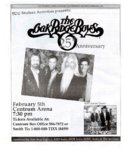
Show OPINION GLENN HALTERMAN COMMENTARY ~\&~--r ON J Affirmative field of dreams THE In a pamphlet produced by the Students for Campus Diversity titled Af/innative Action: Facts and Myths it states: "There is a playing field in which both proponents and opponents of Affirmative Action can come together to conquer the conflict. We believe in ammending (sic], not abolishing:.. '' I know where that field is; in the tniddle of some com stalks in a remote section of Iowa. As many times as I have beard the phrase when referring to affirmative action that we should ' 1mend it, don't end it," I have never heard a satisfactory proposal as to how to go about the repair process. Perhaps this is due to the reality·that no matter how many spools of legislative and political thread one may use to sew up its seams, the fact remains the impaired attire which is affirmative action will always be inherently flawed. Under our democratic, constitutional form of government, all are given an equal opportunity under the law. Of course, this doesn't mean the road to success or fulfillment of a given endeavor will be as straight and even for one as it is for another; this is a fact of life. The playing field is not even; there will be some bad hops. But, as in baseball, the rules cannot be changed to accommodate just some players to the detriment of others. In short, it's impossible to create a special advantage for o~e person without creating a special disadvantage for another. This, however, doesn't seem to faze the proponents of affirma~ive action. It would appear that, to them, a breach of someone's rights under the guise of affirmative action is acceptable so long as it furthers the cause of a "protected class." What's more, some minority groups with grievances about how they have been treated in the past seem to want the rest of the United States to walk around in sackcloth and ashes, repenting continually for past wrongs in order to satisfy those who would seek political and social retribution. As Ward Connerly would say to these people1 "It's time to get on with life." The affirmative action issue is abounding in contradictions, even here on campus. On page eight of SUU's affirmative action policy it states: "Applicants for employment are considered and placed without regard to race, religion, coler, national origin, sex, age, marital status, or disability." But at the same time, David McGuire, director of human resources, said during a recent panel discussion on affirmative action that if two equally qualified applicants applied for a job on campus, one male and one female, he would recommend that the woman be hired. r can hear it now: "Sorry, Bob. But she is a woman." "But I thought that wasn't supposed to matter. What about not regarding sex or color when considering applicants for a position? ' 1 "Oh you mean the language on page eight. We need to change that, d~n'twe? Sorry, Bob.1 hear Iowa's oi~ this time of year." Glenn Halterman is a political science major from Parowan. PROFESSIONAL STAEF AND DESK PHONE NUMBERS: Editor Campus Editor Con5ulting Spans Editors Larryllakcr 586-7751 Jim Robinson 586-1997 Neal Gardner 586-7753 Bn:tt Jewkes 586-7752 STIJDl,NT STAFF AND DESKJ'HONE NUMBERS: Associate Editors D.W. Andefl!ln 865-822.5, 586-7750 B•n Winslow 865•8125, 586-7750 AP Wi.r e. 1:'.ditor Kami Egan 586,7759 Copy Editor Tiana Tew 586-5488 Photo Editor John Guertla 586· 77S9 ()pinion Ditcctor B~odoo Rhodes 586-1992 Sports Editor Chad Lamb 865,&443 ArU Editor Anna Turpin 586-5488 Adnrtising MDlagu Maggie Nei5"n 586-7758 Adnrtising Design« Ccmmie Cole S86-7758 llEl'ORttRS' DESK 586-7757 The Univus(ty /ournal is published every Monday. Wednesday ond FJiday of th• ocademlc yur u a publication o! Southe.m Ut~~ Urtiv•rsity, i11 _dcpartm<nt ol communication. apd th~ SUU Stu<knt A""°"l.iti,<>n. The •i=• and opmions oxpreueil an the /oumal ""' thooe ol lndivtdu•l and dd oot necessarily.reflect t.h~ opi.nion of the fouroal or any entity of. the un.ivtts1ty. Leue:n. 1a the editor must be type-d .i.nd i nclude the narnc and phone number. Ottly· th~ ~1mc. ~ill be pl'inted. Namu will.not be withlldd und<r any cin:u..,.t•nces and the editor racrvcs ediung pnvtlcgcs. Lcttcu mus! be aubmntcd by noon fnday, for Monday tditio'ns, TUc•days lor Wcdnaday editions and Thunclay1 for Friday editions. GrinaacH: Any lndlvldual with a gncvancc· a~L the foumol spould direct such probl~m lim '!' ~· tdltor. II uruooolvtd, that grievance-mould th<n be. directed to the Touma/ S!«rin& Committee, which 11 wn..,~ cbmcd by Dt. Frain C . Pear,on, 586-7971. Uaivu,;1y foumlll: Olli= in SUU Technology Building QOJ. Mill at SW Box 9384, Cedar City, Utah 847W. FAX {4351586-5'187. £.mall oddteus jC)llmalO.Uu.edu ( )PRINTED ON llECYCUD PAJ'Elt. PUA$£ UCYCU nns COPY \S c..0~\ 11) N6- sou ! . 1 OAKRIDGE \T 5 ~S'l\\Ji T lMt: WE- 6C>T BOYS ~ Ml>S\C. ~ t Wt; ~ ~1'-.\ RE-Ui€ To! DERK Journa l 2-4-98 SEAN GONSALVES COMMENTARY What do black people really wantl "What is it that you blacks want?" asked a letter-writer, inquiring from the wonderful state of Washington. I usually respond to letters directly, but I felt compelled to write this in a column, although l'm not a spokesman for black America. The letter reminded me of an innocent girl who's been wounded by the legacy of white supremacy. A good friend of mine went to pick up his daughter at, school Upon arriving, the teacher told him that "Keisha" lnot her real name) was rubbing sand on her face during recess. He asked his daughter why. "J was trying to scrub the black off and make myself white. Black is ugly." What kind of society puts these thoughts in the souls of children, -polluting those like Keisha who grow up in relatively stable, loving families, surrounded by people of various ethnic backgrounds? l hate using a term like "white supremacy" because it's such an ugly and uncomfortable concept fm most African-American and EuroAmerican bwthers and sisters.13ut definitions are of crucial importance, especially if you have an interest in bridging gulfs of misunderstanding. So it's of the utmost significance for blacks and whites to understand each other's words in the dialogue on race. Let me suggest we all look at the word "racism. 1' In his recent book A Country of Strangers: Blacks and Whites in America, David Shipler, a white journalist who traveled throughout America for more than five years interviewing whites and blacks, defines the dominant white attitude toward racism. "Racism is seen as an absolute-either you're infected, or you're notrather than what it truly is: one ingredient of behavior that is either more or less pronounced." There are problems with the ''white" attitude. (There are problems with the "black" attitude too.) I don't think very many people besides a few confused rednecks and a handful of "Afrocentric" nuts believe one race is intellectually and morally superior to another. Not on biological grounds, anyway. If racism meant only the stupidity of neo-Nazi. types, there wouldn't be a race problem. Blacks would worry about racism as much as they worry about sunburn. Another problem is it divorces racial animosity from power. Shipler recounts an interview with a white woman named Peggy McIntosh, who talked about how her white skin bestows benefits on her. "I can do well in a challenging situation without being called a credit to my race. I can criticize our government and talk about how much I fear its policies and behavior without being seen as a I cultural outsider," she said. And this brings- us to the issue of white-skin privilege. The "race problem" is white-skin privilege, specifically, not prejudice in general. l don't give a damn if most white people don't "like" me or whatever. I only care if the white people I interact with respect my humanity. Just because racism has changed forms doesn't mean it's non-existent-or that it's even waning. So let's talk about "racism" in such a way that we can keep nack of those bearing the brunt of social misery caused by racial bigotry. Racism has changed forms, manifesting itself commonly among neoconservatives like economist Thomas Sowell and alleged scholar Dinesh D'Souza. Their view is black inferiority is not found in African-American people but in their cultural habits and mores. Their answer is for blacks to assimilate into ".mainstream" culnue. This sounds absurd to those who understand cultural decadence knows no racial boundaries. The mainstream culture neo-cons sentimentalize has produced some of the most vicious movements in human history-from Nazism to Jim Crow, to the ravages of corporate capitalism. What do blacks want? Most probably want what I want-to live a meaningful life. rd like to live in a world where black intelligence, beauty and moral ca_pacities aren't constantly assaulted and called into quest-ion by "mainstream" America. So what do white people want? Sean Gonsalves is a nationally syndicated columnist. |