| OCR Text |
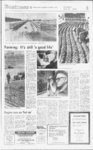
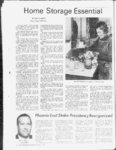
Show Home Storage tssential V BY DAVID CROFT 1 f Church News Staff Writer Let every head of every household see to it that he has rn hand enough food and clothing, and, where possible, fuel aiso, for at least a year ahead. This statement of the late President J. Reuben Clark Jr., made in 1937, was requoted in a message released Saturday, Oct. 6, as approved by the First Presidency. The message deals with the home storage program of the church and was prepared for the First Presidency by the Church Welfare Services Department. Planned storage in the home will assist the membership to be in times of need," said the message. The likelihood of such eventualities as accidents, illness, and unemployment face nearly every family at one time or another. V.ars, depressions, and famines, as well as earthquakes, floods, and tornadoes, loom as possibilities to be considered in looking ahead and planning for the care and protection of the family. The message points out that the home storage program is an integral part of the church welfare services but is undertaken individually, according to the needs of each member. Its application, therefore, will differ in relation to circumstances, but the responsibility of preparedness remains. According to the message, storage of foods is of primary consideration. However, the message points out that no particular recommendations are made as to the kinds or amounts of food to be stored. The message notes that specific recommendations are not given because of the varying factors involved, such as locale, availability of products, climate, special diets, and the number of family members and their ages. Counsel from President Harold B. Lee, given in the welfare agricultural meeting in October of 1966, is quoted in the message. President Lee said, Perhaps if we think not in terms of a years supply of what we ordinarily would use, and think more in terms of what it would take to keep us alive in case we didnt have anythat last would be very easy thing to to put in Si ..rage for a year. If you think in terms of that kind of annual storage rather than a whole years supply of everything that you are accustomed to eat, which in most cases, is utterly impossible for the average family, I think we will come nearer to what President Clark advised us way back in 1937. The home storage message notes that storage should begin with basic items to sustain life in an emergency, with other items ordinarily eaten considered after adequate amounts of basics are stored. Emphasized is that food stored meets nutrition requirements essential to good health. food Acquiring a years supply should be done in an orderly and systematic manner, consistent with a familys income, says the message. Borrowing money to put into the storage of foods is not advocated. Another recommendation is storage of fabrics, thread, needles and other sewing items, plus a reserve of fuel and first aid articles. The message includes specific advice for food storage items that might be considered. Four basic foods, with the amounts needed to sustain an average woman for one year, are suggested. These are grains (wheat, rice or other of the grass cereals), 300 pounds; nonfat powdered milk, 100 pounds; sugar or honey, 100 pounds, and salt, five pounds. These items, used exclusively, provide a diet that supplies approximately 2,300 calories per day, which is recommended for an average woman 25 years old, says the message. The statement suggests that to the basic foods, nay be added other items according to availability, cost and individual taste. Those in highly mobile situations, such as being in the armed services or enrolled in school, or who have small homes with little storage area, may find it more difficult to store a years supply of food, clothing and fuel. This does not release them from the obligation of doing their best to be prepared for an emergency, the message emphasizes. The statement adds, Often in rather limited space, basic food items such as wheat, nonfat dried milk, sugar or honey, and salt can be stored. Closets, attics, space under beds, or Mrs. Pamela Rex cans pears for home storage. even space made available by others can be utilized in providing for food storage. It is better to have food storage sufficient for a few months than to have no storage at all," says the message. Emphasized is that the food storage program be adapted on an individual basis. "The church neither sponsors, nor endorses, any commercial products or firms, says the statement. According to the home storage message, successful food storage depends on several factors, including quality of product, proper containers, storage facility, temperature and rotation. Also, in home storage planning, some water reserve may be considered. The approximate requirement per person on a k basis is 14 gallons (seven gallons for drinking and seven gallons for other uses). The message concludes, Security through the home storage program can be strengthened by the observance of further counsel that (1) we live righteously; (2) we avoid debt; (3) we practice thrift; and (4) we have a willingness to work. All members are encouraged to participate in the home storage program to provide for their own. The message quotes I Timothy 5:8, which says, If any provide not for his own, and specially for those of his own house, he hath denied the faith. two-wee- Phoenix East Stake Presidency Reorganized Bishop Jack T. Fuller ot the Phoenix 15th Ward was sustained as president of the Phoenix East (Ariz.) Stake, Sept. 9, 1973, at quarterly conference of . 14 Jack T. Fuller . . was bishop CHURCH that slake. Named as counselors were Lyle Elmer Whitmer and Lynn Jacobsen Benninn. Elder Gordon B. Hinckley of the Council of the Twelve presided at the conference He was assisted by Elder E. Talmage Jones, Regional Representative Twelve Ires. Fuller was bom July WEEK ENDING OCTOBFR 6, 1973 28, 1931 in Safford, Ariz., a son of Lawrence and Viola Owens Fuller. He married Colleen Payne and they have three sons. He has served as a missionary-iFrance, stake missionary, president of an elders' quorum in two stakes, and as bishop. He received a B.S. degree from the University- of California and the J.D. degree from the University of Arizona. He is employed as a tax and corporate lawyer. Pres. Whitmer was born Nov 14. 1929 in Centred. Ariz , a son of Benjamin F. and Winnie M. Webb Whitmer. He married Marcelline M. Miller and they are parents of six children. He has served as a missionary the East Central States, branch president. YMMIA president, and high councilor. in He was graduated from Utah State University with a B.S. degree and is employed as loan manager of Equitable Life Assurance Society. Pres. Bennion was born June 2, 1942 in Oakland. Calif., a son ol Donald Clark and Margaret Marie Jacobsen. He married of Margaret Jean Hinckley Belmont, Mass., and they have two children. He has .served as ward clerk, high priests group leader, high councilor, counselor in stake mission presidency, and president of a seventies quorum. He also served as a missionary in France. He received A B. and M l), degrees from Harvard University and is now employed as a |