| OCR Text |
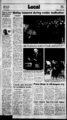
Show ThcmU;, April 23, 7 if .. THE DAILY HERALD, Pmt, luk Fafr El v. VC . m 0 Ik J ..AO i.. IfH O 0 AP Photo run from ty, Mo. Thimesch was making a 200-mil- e North Kansas City, Mo., to Springfield, Mo. field, Mo., eats his breakfast cereal as the early morning sun hits his freight train in Barton Coun Unable to stop the train lor a meal break, Burlington Northern engineer Nick Thimeach of Spring at the Railroad Industry SWITCH Journey grows long for locomotive's crew ..r flatlguo problem By FRED BAYLES AP National Writer Lance McClaren sees it unfold again in his nightmares. locoThe huge motive looming out of the night to smash his train in a shower of sparks. His desperate scramble up the steep sand hill in a lightning storm as 30-to- n coal cars fly through the air. And over and over, he sees the locomotive bearing down on the parked train as if it didn't exist. "He appeared to be operating his train as if he had green signals," says McClaren, whose days of engineering ended with the June 194 crash. "I have no idea why he was doing that. There's only ,tw people w ho would know and jlcy're dead." i vfiut safety investigators believe 1, know. ,V National Transportation ty Board says the crew of the Lgdincton Northern locomotive Vss exhausted w hen their train hit two other freights at 3:25 a.m. near Thedford. Neb. The conductor, the NTSR said, had only three hours rest in 27 hours and may have been asleep; the engineer was so tired that "fatigue likely adversely affected his judgment and contributed to (the accident." i The NTSB has named fatigue as factor in at least iu serious rau- crashes in the past decade. ;,iaing the Feb. 9 commuter itt collision at Sccaucus, N.J.. Ll left three dead. jt Its warnings to the railroad Ljustry, its unions and Congress o take the issue of sleep seriously have taken on a greater urgency as I resurgent business keeps the rails humming day and night. But a solution is not quick in coming. Union member worry about smaller paychecks; railroad executives worry about smaller bottom lines. Congress, which has sole control over railroad work noun, is hesitant to act. "The companies will tell you there is a fatigue problem. The unions will tell you there's a fatigue problem. Everybody has horror stories, but no one wants to go out on a limb anJ do something," says Bob Lauhy. chief of the N I SB s railroad division. Meanwhile, out on the rails. i fi crews who weave trains of hazardous materials through curves and mountain passes talk about accidents waiting to J f Si', II happen. "The last trip I made, I fell asleep past two or three signals and I can't tell you what they were." said one CSX engineer from the Southeast who asked not to be identified. The potential disasters implicit in the admission are frightening. "I could have run through a stop signal and hit another train." the engineer said. "I could have hit an automobile and woke up and never known he was there. I could have exceeded the speed limit and derailed a train carrying hazardous materials and killed a lot of people." Said another engineer "You sit back in awe because you know people are nodding off and something terrible is going to happen one of these davs." Engineers and conductors who poke with The Associated Press despite railroad rules against it, and the accompanying threat of disciplinary action repeated similar stories. Working seven or more days in a row. fighting their bodies" surrender to the cireadian rhvthms of sleep at 4 in the morning, they confessed to falling asleep or operating drowsy Another CSX engineer recalled a time when he and his conductor, both exhausted in the early morning hours, missed a warning signal and came around a curv e to see another train sitting i n the same track. "I went into an emergency stop," he said. "If we hit. another train behind us would have also piled in." Under the Hours of Service Act. a law that retains much of its original 1907 language, train crews can work no more than 12 hours with 10 hours off in between shifts. They gel eight luxirs off if they w ork under 12 hours. But engineers say the time it takes erew to travel from the train to a hotel, get a meal and then settle in cuts into their rest time. "You don'i just walk off the locomotive and fall asleep." said Jeff Clements, a union representative on the Illinois Central Railroad. "It may sound like this guy is getting 10 hours rest, but in actuality he's getting four or five hours at ."'Al" Axs,' w i car stops at a railroad crossing after sunrise in rural western Missouri as viewed from the cab of a Burlington Northern freight train. Such crossings cause major concerns for railroad crews. Burlington Northern locomotive engineer Nick Thimesch says he lengthens his whistle blows at this time of day to alert drivers of school buses and people who are rushing to work who may try to drive around the gates and warning lights. A best." Even when the crews must also fight the body's own cycles, a biological imperative that makes wakefulness in the hours between I and 5 in the morning a struggle. "It's the hardest time to stay awake." said one engineer from the South. "Especially when you're supped. You're not allowed to read, or listen to music. You just stare out the window fighting sleep." While crew members have had similar complaints for decades, the problems have grown with the surging railroad business. traffic on the rails is near capacity. Long coal trains wind from Wyoming to power plants in the East and Midwest. Grain trains carry heavy loads to ports for export overseas. Container trains rush from those same ports ladened with imported goods. Rail traffic has jumped by 27 percent over the past 10 years. At the same time, the number of train scheduling isn't safe. A Federal Railroad Administration study that observed engineers working in a simulator found a steady schedule of 12 hours on and 10 hours off produced observable crewmen is half what it was in 1980. Instead of five-me- n crew s of two decades ago. most trains cany only an engineer and conductor. The pressure to keep tlie trains mov ing may mean long stretches of uninterrupted wxxi days and around the clock calls from dispatchers. Engineers say the toll is heavy: little family contact, divorce and a grinding, hopeless exhaustion in exchange for pav ranging from S45.000 to $85,000 a year. "You almost feel like a slave," says Robert Mannick, a CSX engineer and union official. "It's a job that pays fairly good money, but then you see what you have to do for it." All sides agree this kind of problem. For each new hire, a railroad can expect to pay an additional $20,000 in fringe benefits alone, a bottom line buster that is not ignored. "The simplistic v iew of it is you change the schedules or you change the people." said Charles well-reste- d, full-sca- le fatigue. r rev iew of train schedules found that crews who worked nxre than six starts in a sev y period had a higher probability of accidents, injuries or rules violations. While both management and union agree something needs to be done, both sides are distrustful of changing the status quo. The railroad administration has asked Congress to grant it the same A joint 2 million industry-labo- en-da- regulator) authority over railroad work rules that federal agencies have over the airlines and highway carriers. But lobbv ing has st) mied legislation. The railroads fear a simple approach of limiting hours and shifts would force them to hire more crews without getting at the Dcttmann. executive vice presi- dent oHjpcrations and research at the American Association of Railroads. "If I hired more engineers that means my existing engineers earn levs money and for every add w have to add employee more fringe money." The unions don't want Congress to surrender its powvr over railroad wxxi rules to an executive agency . eases the long train out of the By FRED BAYLES AP National Writer " ABOARD BNSF TRAIN 26 The dimly lit cab of Train 26's locomotive is a laboratory of fatigue. Engineer Nick Thimesch battles drow siness with mouthfuls of sunflower seeds, constantly cracking and spitting out shells as he watches the track tush up in the ghovtlv circle of the train's headlight. When he tires of seeds, he resorts to gum. Smoking isn't allowed. Conductor Tom Shirley tries regular doses of Bandit snuff, spitting brown tobacco juice into an empty water bottle as he busies himself with paper work. But the men running the Burlington Northern Santa Fe overnight freight from Kansas City to Springfield. Mo., have no illusion they have mastered sleep's seduction. "We're just like everybody else."says Shirley, never taking his eves off signals coming out of the darkness. "You can't teach vour body to do this job." The challenge of the job. which began at 3 a.m.. is to try and get along with just two luxirs of sleep and navigate the train of truck trailers and containers of gunpowder and chemicals through an obstacle course of rail traffic at speeds over 50 mph. "It's a killer out here." Thimesch. an engineer for 20 years, explains in a jovial Ozarks twang. "If they keep you moving it's pretty good. But if you're sitting there for 30 minutes at 4 in the morning, your head starts banging against the wall." The constant congestion on the rails makes steady progress impose run from sible. The Kansas City can take eight to 2 hours. In the first hour alone. Tram 26 will creep only three miles as it waits for another long freight to cross its tracks. The growing demand for rail shipments makes it impossible to plan an outside life, or even predict when the next cluster of av ailable sleep w ill come. Shirley and Thimesch start the day w ith an 8:30 morning run from Springfield to Kansas. City that ends at 4:30 p.m. Thimesch was well rested from a day off, but Shirley had only eight hours off. They were given a 5 a.m. start. But added trains pushed departure time up to 2 a m. eliminating three hours of planned sleep. Thimesch, 39. is talkative as he 200-mil- 1 Mur- ray Yards in North Kansas City. Shirley is quieter, calling out each time a signal pole comes into view with its red. y ellow and green lights. A new policy requires Shirley to write down each signal, a macabre living document of what the men believe they saw just in case there is an accident. "More Big Brother." Thimesch laughs as he pushes the button for the alerter, a mechanized nag that activates a flashing light followed by a siren if he hasn't proven he is conscious by working the throttle, brakes or horn in 30 to 60 seconds. While the idea of pointing a train down the track may seem less demanding than driving a truck or flying a plane, there are unforgiving demands of physics that require subtle skills. You must constantly think of weight, acceleration and inertia. With trains as long as two miles, some of the train may be rushing down a curve while the rest is dragging uphill. the first few hours of Train 26"s run is straight and flat. Thimesch is still busy, blasting two long, one short and another long on the train's horn as he flies past grade crossings in Hillsdale, Fontana and Pleasanton. Dawn comes as Train 26 turns southeast out of Fort Scott, already delay ed by both north and southbound traffic. Daylight offers passing scenery of river bottom, cows, deer and wild turkey. But there are new risks. Road traffic picks up as trucks and cars dart across the road in front of the train. Tram 26 isn't as long or heavy as the coal and grain trains tt shares the tracks with. But at 55 mph it will take Thimesch three quarters of a mile to bring the 2 300 tons of iron to a halt. Signals are harder to spot in daylight. Both men still call them out. but the alertness in their voices fades as the hours grow. Their voices retain an edge when they talk of the sacrifices they make to the unrelenting schedule. "1 haven't seen my daughter in four day s, but when 1 get home I'll have to lay down right away." says Shirley. "You have to do that because you may only have eight hours before they call you again." "No social life, no friends outside the railroad." Thimesch recites as the Springfield yard comes into sight. "But where else is someone like me going to find a job thai pays 50.0W) a year?" |