| OCR Text |
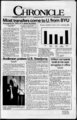
Show DAILY UTAH F MRfWflO IV I I WEDNESDAY, OCTOBER 16, 195 students te some commenting that people at BYU "are just looking for someone to marry." Other transfer students said it is that Each year more students feed into the University of Utah from Brigham Young University than from any other institution, including area high schools. With 2,182 new transfer students last autumn quarter, 322 (or 14.8 percent) came from BYU. That figure accounts for 24 percent of te transfers. social structure they miss most about in-sta- Gary Oyler, director, of institutional research at the U., said each year this percentage remains about the same. This figure does not include graduate students coming to the U. for advanced degrees, he said. In an informal poll of former BYU students now attending the U., most said the they transferred for financial reasons. Many students, especially those who arc married, said it's difficult juggling school, work and family life in Provo. Salt Lake Gty offers more jobs, resident tuition is lower, and housing is less expensive than in Utah Valley, they said. Another common reason given for transferring from BYU is that students found the U.'s department of their In-sta- te "With everyone living on campus or near it, you really get to know everyone," one student said. "School becomes a main part of your life, not just a place to go to class. There's a school spirit that vou can't feel here." A small percentage of students say they left BYU for what some named "ideologi- transfers to the U. of U. Autumn E R 20 C E N 15 T Though the number of BYU transfers at the U. is greater, conversely, a large number of U. students move to BYU. BYU Director of Admissions Jeff Tanner said this semester "about 200 students with some U. credit" transferred to BYU, but did not say what percentage of transfers that represents. Last fall 233 Utah State University transferred to the U. Weber State College is the U.'s third largest feeder institution with 226 transfers, and Utah Technical College at Salt Lake takes fourth with 188. The U. also gained the following G 10 transfers: 70 66 59 Dixie College. Utah Technical College at Provo. Snow College. E BYU 48 42 40 40 College of Eastern Utah. Westminster College. LDS Business College. Southern Utah State College Skyline High School sends more entering freshmen than any other high school. Each fall, an average of 228 former Skyline students come to the U. about that subject. On what kind of a president Ronald Reagan is Anderson said this, "I've gotten to know him rather well." He's got that appeal, he quality and is Ronald would that noted. "I Reagan say pretty much the Ronald Reagan you see." J is putting on some kind of presidential performance in Washington. Anderson said people forget what "a lousy actor he was." Reagan is at the helm of this country, giving it direction, Anderson told the audience. He has simplistic solutions for complex problems. He is able to delegate his authority and he means what he says. As for who is most likely to succeed Reagan, Anderson spoke first of Vice President George Bush. Bush has more political savvy and experience than the others, Anderson said, and he's got the best manager. He meets almost daily with Secretary of the Treasury, Jim Baker. "They're plotting political strategies all the time," he said. For right now, Anderson is sure Bush could get the nomination, but doesn't know that he's all that electable. "He has kind of a preppy image," Anderson said. "He has flashes of charisma, probably when his electric underwear shorts out." Sen. Bob Dole is another possibility, Anderson said. He's shrewd and pragmatic. He'll do whatever it takes to get the nomination, Anderson said. On the Democratic side, Anderson said they are in great need of fresh faces and ideas. "I don't really see any," he said. Ted Kennedy has interest in the nomination and for him to seek it would be a mark of personal courage, Anderson said. Too many people mistake him for John Kennedy and that is a mistake. There is always Gary Hart, Anderson said, and he will likely run again. "He would like to portray the image of a new face with new ideas," Anderson said, but his ideas are nothing new. "He occasionally has a bowel pain and thinks it's an idea." From politics, Anderson went on to terrorism. Cain was the first terrorist and we've had them ever since, he said. They criticize, complain, agitate and clamor, Anderson said. They tear down freedom and pull down the pillars of our society. "We have to learn how to disagree without being disagreeable." At the close of his speech, Anderson put it all in perspective. So far, the U.S. system has worked well, he said. "Wherever I go, the United States is criticized and condemned, but I've never encountered one single person who wanted to go to the Soviet Union."" People know the difference, he said, and closed his remarks with this advice, "My young friends, remember where you are." star, he rn M'-IliHii- l I j f j Chronicle photo hy Alan Overmoe Freedom is something you can't afford to give up, said Jack Anderson to an Union Building audience Tuesday afternoon. . Weber State Some people may think because Reagan was a movie "Freedom is something you never give up for anything else. And if you do, you have made a bad bargain." So were the words of Jack Anderson, as he addressed the audience at ASUU's first Challenge Lecture, Tuesday at the University of Utah. . He talked of politics, and the questions he is most asked 1f 1984 25 A Staff writer ; BYU P cal differences." by Amy Page Iff 1 I VOL. 95 NO. 21 Anderson praises U.S. freedoms mid-weste- I BYU. particular field more desirable. Several students said they came to the U. because they prefer its social structure, all-Ameri- Si V UNIVERSITY OF UTAH by Drew Staffanson Staff writer XII A irs come to U. from iSos tomsf Accounts for 24 of in-sta- VV Utah State Utah Tech-SL- Others C Olympus High sends an average of 197 students each fall, followed by 169 from East. Following are the average number of incoming freshmen from local high schools: 161 160 Cottonwood. Highland. Wilson compares book to his own struggles in office by Shia Kapos Staff writer Had former Mayor Ted Wilson read Governing the Ungovernable City before he went into office a decade ago, Salt Lake City might have been different. "I wish I had read the book before I was elected mayor," said Ted Wilson, director of the Hinckley Institute of Politics, in his review of Barbara Ferman's book. Wilson, also a 1964 graduate of the University of Utah, praised the book for its extensive research into bipartisan mayors and politics and for its relativity to Salt Lake City government. The book draws from many scholars to achieve a theoretical notion on mayors and how they govern cities, Wilson said. "But there are also broader implications than just the study of a mayor.. .it will benefit all who seek power," he said. The author focuses on two cities Boston and San Francisco during the 1960s and into the '70s. That was a period of time in which cities were most ungovernable, Wilson said. That was the period of race violence and riots over segregation and living conditions. It was a time when people concluded that mayors couldn't govern, Wilson said. "She (the author) seeks to dispel that entire notion through examples." The author picked Boston and San Francisco because they are nonpartisan governments. And like Salt Lake Gty, he said, only informal partisan support was given making the cities ungovernable. The main focus of the book, Wilson said, is on how mayors acquire power. The author used Boston as an example because it is a city with centralized power. "People enjoy their politics. They accept the (political) machine and don't see them as a threat to good government." San Francisco, on the other hand, is highly fragmented with constituent groups, said Wilson. This has decentralized the power, he said. continued on page five Non-Prof- it Org. U.S. Postage Paid Permit No. 1529 Salt Lake City, UT |