| OCR Text |
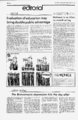
Show The Daily Utah Chronicle, Tuesday, January 17, 1978 Page Four eoiforiQ rick hall A GUEST OPINION Matheson is no villain, no smooth sailing Evaluation of education may bring double public advantage College students are understandably concerned about education. They are surrounded nearly all the time with textbooks, discussing Emerson and Thoreau or a generally accepted accounting principle almost as much as the weather. Additionally, they work part-tim- e jobs in order to pay for rising tuition. And that concern has, as one might expect, given rise to a myriad of views, ideas, thoughts and opinions as to the value of a college education. Somewhere in that discussion about the value of higher education, it seems relative to consider one's public education. In other words, that thing which prepared you for that which would prepare you for life. But for some, maybe even many, high school students there is no stopping between high school and life; 12 years in a public institution and a '57 Chevy is all he's got. Like just about everything else, a high school education is just what the student makes it. And in that sense, the school has no responsibility to teach kids to wipe their noses so their foreman doesn't have to. But if he's going to assembly-lin- e 12 years (mandated by state law) in school, a student spend come to out with at least some concept as to how toco-exiought with others of the same species. And that concept may not or better yet, is probably not found in the three Rs. Many states, most notably Florida, have instituted programs based on that logic there is more to education than reading, writing and arithmetic. Their answer is the functional literacy test which asks students to do such things st now there must be, in the minds of many, two perceptions of this year's lobbying effort. One is that ASUU Public Affairs Board would like to see Governor Scott Matheson hangedin effigy. The other is that it will be smooth sailing from now on with regard to a tuition hike. Both are incorrect. We don't think Governor Matheson is such a villain. But we certainly feel justified in voicing some loud complaints over the way he has treated higher education. For example, in attempting to explain his proposal for a 10 percent increase, tuition increase, Matheson implies that the Board of Regents suggested such a figure. What really happened was that Matheson recommended only a 12 percent increase in higher education's total budget, instead of the regents' 17 percent. Some regents, in an informal meeting, told the governor that if he insisted on such a cut, he'd have to make it up with a 10 percent tuition hike. So the idea of a 10 percent increase began with Matheson's cut, not with the regents. Besides, the governor has for two months, given every indication that he was in favor of a hefty increase. Not only was he unyielding and almost brusque in our November meeting, but he was talking privately to some people we know about a 10 percent increase for some time before that. And he knows it. So why blame the regents? No, there's no rancor between us and the governor. We just don't think he deserves the white hat he seemed so anxious to put on in the January 12 Chronicle article. We'd love to work with him if he's willing. And that's up to him. About our chances on the tuition issue; we don't want it to appear that we're home free. A battle has been won, but certainly not the war. This is going to be a lean year tor the State System of Higher Education. Everything from salaries to programs seems likely to suffer (thanks to Matheson's budget). There are legislators who what to see our tuition increased and will actually work to make it happen. Further, budgetary pressure for an increase will be immense. The legislature is already looking for an extra $1.6 million to compensate for revenues lost due to its reduction of the governor's recommendation from 10 percent to 3.3 percent. Also, the Appropriations Subcommittee will probably propose a budget exceeding Matheson's by another $3 million. When the Executive Appropriations Committee, which attempts to put together all the budgets of all the subcommittees under it (of which higher education is only one) sees the latter's need for $4.6 million, our 3.3 percent increase may become only a memory. So we students have have a rocky road ahead. Whatever happens, we at Public Affairs Board want all University students to know what we're up against and what the governor's really doing. Maybe some of us will get a little upset about it all. By as read a simple road map, figure the cost per ounce of items on a gorcery shelf or determine a monthly electric bill (given the rate per kilowatt hour). The questions aren't difficult but are of the type which are necessary. The test also asks students to pick between a factual and an opinionated statement, determine where the name Hones is in the phone book and give a percentage equivalent for one-fiftThe questions not only ask a student to apply what he or she has been taught but require the use of common everyday skills everyone should have. h. The test has not only proved its worth but pointed out a need for increased instruction (and, of course, learning on the students' part) in those areas; nearly 40 percent of Florida's high school juniors failed it. Teachers are concerned that the test will be used to grade them rather than students. The test, teachers argue, judges a student's ability in areas affected equally (if not more) by parents, television, etc. The fears are misplaced. Teachers should have the ability to teach those things just as easily and effectively as they teach traditional subjects. And if the test teachers, so much the does point to some better the public will get more than it bargained for. Adding the final touches on an excellent concept, the Florida education commission is offering remedial coaching for those who do not pass. Because it is so practical, the entire program is a giant step for education. Let's hope it spreads. lower-than-avera- ge -- Lowell Brown Public Affairs Board II III taitim ii tllALW I HCHRONICLE The opinion! expressed on the editorial pagr of the fWy I lah ( humu Ir do not necessarily represent the vie wi of the studenthody ot the I 'nisemtv administration Published daily during fall, winter and spring quarim (not in luding test week 1.1 quartet breaks) by Publications Count il of the I niversily of I iah Sub riplions J20 a year (including lummer quarter), 6anaademi( quarter All sub riplions must be prepaid. Two weeks notice for change of address Forward all subvription correspondence to: Subscription Manager.Daiy I'tah ( hronu If, Imon Building, University of Utah. Letters to the editor must be typed and of 200 doublespaied on a 74 spate line words or less will be given priority Address letters to Inters 10 the Kdnor" The CAroniWehas typewriters available for your us- We reserve the right loeditfor libel, propriety and spate. - colleen reichert The Broncomanic depression hits the day After weeks of anticipation and preparation, it's all over in just a matter of a y few hours. And now, I'm experiencing depression. Yes, the letdown after the Super Bowl holiday is severe. Broncomania has reverted to Broncomanic depression. Why all the moping around as if it were December 26? It's because the Super Bowl was talked about and promoted like a holiday. In fart in America, the Super Bowl is even easier to promote than Christmas; it has no age, sex or religious barriers to cross and it's a whole lot cheaper to celebrate. We can all look forward to the time when Super Bowl Sunday is declared a National Holiday and we can all enjoy a three-da- y weekend. On December 25, the next generation may be post-holida- asking, "Mommy, how many more days until Super Bowl?" The star wars of the football field and the Star Wars on the screen used the same approach to shape public sentiment. Both events made the magazine covers, both had extensive television and radio coverage, plus a few carefully planned spontaneous happenings. For the past month, it has been difficult to escape Darth Vader's visage or regular features about the Orange Crush on the 10 p.m. news. The only thing missing is a disco version of the Super Bowl soundtrack. All this hype adds up to changing the public's attitude from "I'd like to see" to "I've just gotta see." So, Americans are real suckers who think as independently as moths when it comes to distinguishing excess from excellence. We hover around the movie, rock group or sports event that catches our attention. Commercials and magazines dictate what we should see and hear and we immediately flock to it. But what's wrong with getting excited about something as trivial and meaningless as an game or flashy movie? At least people are getting excited about something. At a time when no one wants to let their emotions show, it is refreshing to see people getting caught up in a spirit, even if it is only over a game. Then there are those wily public relations men who do nothing but sit around and devise ways to separate you from your over-promot- after money with their clever campaigns. People buy all the trinkets and watch the games purely by choice. No one forces anybody to sit in front of the TV for three hours on a Sunday afternoon. You can hardly blame the promotion for making the Super Bowl or Star Wars so popular and talked about. It's people who create the hype because it's fun to be in the mainstream and take part in something that's a success. A Star Wars is proof that you know what is going on today. Yes, promoters are making money off us all. But if we'll buy it, why shouldn't they sell it? It's the American way! I just wish I'd been the first one to think of manufacturing Star Wars socks, sheets, dolls.... T-shi- rt |